
New Year Sale Limited Time 70% Discount Offer - Ends in 0d 00h 00m 00s - Coupon code: simple70

Pass the Oracle Oracle Database 19c 1z0-076 Questions and answers with CertsForce

Viewing page 1 out of 4 pages
Viewing questions 1-10 out of questions
Questions # 1:

Which three statements are true about redo transport?

Options:

A.

With synchronous redo transport, LGWR ships redo directly to RFS processes on the standby database instances and waits for an acknowledgment.


B.

An RFS process on a standby database instance may receive redo from an archiver process on the primary database instance to perform archive gap resolution.


C.

With asynchronous redo transport, TTnn processes may read redo from the log buffer or from standby redo logs on the primary database.


D.

Multiple RFS processes may receive redo on one standby database instance.


E.

Multiple RFS processes may receive redo on one far sync instance.


Expert Solution
Questions # 2:

A customer has these requirements for their proposed Data Guard implementation:

1. Zero data loss must still be guaranteed through the loss of any one configuration component.

2. The primary database must be protected against a regional disaster.

3. Performance overheads on the primary should be minimized as much as possible given these requirements.

4. Downtime on the primary database for any reason must be kept to a minimum.

Components referred to in the broker commands are:
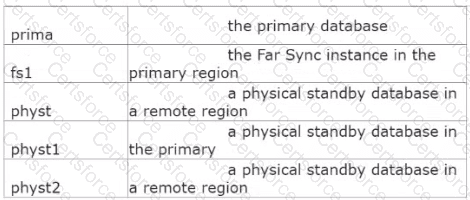
Question # 2

A)

Question # 2

B)

Question # 2

C)

Question # 2

D)

Question # 2

Options:

A.

Option A


B.

Option B


C.

Option C


D.

Option D


Expert Solution
Questions # 3:

You detected an unrecoverable archive gap in your data guard environment. So, you need to roll standby.

forward in time without applying a large number of archive log files using this command:

RMAN> RECOVER STANDBY DATABASE FROM SERVICE-;

When running this command, which of the following steps can be performed automatically?

1. Remember all data file names on the standby.

2. Restart standby in nomount.

3. Restore controlfile from primary.

4. Mount standby database.

5. Rename data files from stored standby names.

6. Restore new data files to new names.

7. Recover standby.

Options:

A.

2,3,5,6,7


B.

2,3,6,7


C.

1,3,5,6,7


D.

1,2,3,4,5,6,7


E.

1, 2,3,4,6,7


Expert Solution
Questions # 4:

Which TWO are TRUE about offloading backups to a physical standby database in a Data Guard environment?

Options:

A.

The standby database must be registered in an RMAN catalog after the primary database has been registered.


B.

The standby database can not be registered in an RMAN catalog if the primary database has not been registered.


C.

Backups of the standby control file taken while connected to the catalog where the database is registered, may be used to restore the control file on the primary database.


D.

The standby database must be registered in an RMAN catalog before the primary database has been registered.


Expert Solution
Questions # 5:

Which two are prerequisites for configuring Transaction Guard in a Data Guard environment?

Options:

A.

Grant execute permission on the DBMS_APP_CONT package to relevant database schema owners.


B.

Ensure that connection descriptors for database clients use the failover clause with the COMMIT_OUTCOME parameter set to TRUE.


C.

Set INSTANCE_NAME identically on all the Data Guard Configuration databases and modify the local service name on the client to include a CONNECTION_LIST containing all the standby hosts.


D.

Create a database service with COMMIT_OUTCOME set to TRUE, and ensure clients use that service to connect to the database instance.


E.

Create a database service with COMMIT_OUTCOME set to TRUE and ensure that the service is statically registered with the default listener on the primary host.


Expert Solution
Questions # 6:

There are currently 6 applief. and 6 pfepafef processes running and no idle applier processes on y logical standby database.

The max_SERVERS SQL apply parameter and number of archiver processes are both set to 12.

Identify two changes, each of which would allow you to increase the number of applier processes.

Options:

A.

Decrease the number of archiver processes on the standby database.


B.

Increase the processes initialization parameter. D Decrease the number of FREPARER processes.


C.

Increase the value for the MAX_SERVERS SQL apply parameter.


D.

Increase the parallel_max_server initialization parameter.


E.

Increase the RECOVERY_PARALLEL initialization parameter.


Expert Solution
Questions # 7:

Which three are true about using RMAN in a Data Guard environment?

Options:

A.

Backups of archived redo logs taken on a physical standby are interchangeable with a primary.


B.

Backups of control files taken on a physical standby are not interchangeable with a primary.


C.

A recovery catalog is required when RMAN is used to take backups from a physical standby database if you plan to recover the primary using those backups.


D.

Backups of data files taken on a physical standby are interchangeable with a primary.


E.

A recovery catalog is required when RMAN is used to take backups from a logical standby database in a Data Guard configuration if you plan to recover the primary using those backups.


Expert Solution
Questions # 8:

Your Data Guard environment consists of these components and settings:

A primary database supporting an OLTP workload

A remote physical standby database

Real-time query is enabled

The redo transport mode is set to SYNC

The protection mode is set to Maximum Availability

Which two statements are true regarding the DelayMins database property for the standby database?

Options:

A.

It can only be enabled for a configuration in Maximum Availability mode.


B.

It allows user errors on the primary to be recovered by using the physical standby database.


C.

It can only be enabled for a configuration in Maximum Performance mode.


D.

It specifies a delay before the primary ships redo to the standby destination having DelayMins set.


E.

It allows logical corruptions on the primary to be recovered by using the physical standby database.


F.

It enables you to bypass the default network timeout interval specified for the standby redo transport destination.


Expert Solution
Questions # 9:

Which two are true concerning the configuring of Flashback database in a Data Guard environment?

Options:

A.

It permits a physical standby database to be converted to a snapshot standby database.


B.

It is required in order for a snapshot standby database to be converted to a physical standby database.


C.

It enables the use of far sync instances.


D.

It permits a primary database that was disabled after failover to be reinstated as a standby.


E.

It is a prerequisite for the use of Fast Start Failover.


Expert Solution
Questions # 10:

Which two Data Guard features require the use of flashback database by the broker?

Options:

A.

Far Sync Instances


B.

Snapshot Standby databases


C.

Read-Mostly physical standby implementations


D.

Fast-Start Failover


E.

Real Time Query


Expert Solution
Viewing page 1 out of 4 pages
Viewing questions 1-10 out of questions



