Pre-Summer Special Limited Time 70% Discount Offer - Ends in 0d 00h 00m 00s - Coupon code: force70

Pass the Nutanix NCP-BC NCP-BC-7.5 Questions and answers with CertsForce

Viewing page 1 out of 4 pages
Viewing questions 1-10 out of questions
Questions # 1:

An administrator is creating a recovery plan between two availability zones. The production VMs use a subnet that does not exist at the recovery AZ. To ensure the VMs can successfully connect after a failover, what must be configured?

Options:

A.

A local-only schedule in the protection policy


B.

A new protection policy with synchronous replication


C.

Network mappings to a valid subnet in the recovery plan


D.

A required matching subnet name at the recovery AZ


Expert Solution
Questions # 2:

An organization uses Nutanix Disaster Recovery with automatic virtual network creation in the Nutanix Cloud AZ. After a successful failback operation from the Nutanix Cloud AZ to the on-premises site, what is the expected behavior regarding the dynamically created virtual networks at the recovery site?

Options:

A.

Converted into production networks for use in the future


B.

Automatically cleaned up when no longer required


C.

Must be manually deleted by the administrator


D.

Remain active until the billing cycle ends


Expert Solution
Questions # 3:

What must an administrator verify before starting a migration of entities from a protection domain to a protection policy?

Options:

A.

The entities must be added to a category in Prism Central.


B.

The recovery plan must be active.


C.

The entities must have no ongoing replication tasks.


D.

A full backup of the protection domain must be completed.


Expert Solution
Questions # 4:

How does Nutanix Disaster Recovery automatically handle Container Mapping if a storage container with the same name does not exist at the recovery Nutanix cluster?

Options:

A.

The data is temporarily kept in the SSD tier of the remote site pending intervention.


B.

The system automatically creates a new Storage Container with the same name on the remote site.


C.

The initial replication fails and generates a critical alert requiring manual mapping in Prism Central.


D.

The recovery points replicate to a random storage container at the recovery Nutanix cluster.


Expert Solution
Questions # 5:

An administrator needs to provide leadership with a report showing the timeframe of each step during Recovery Plan failover testing. How should the administrator produce this report?

Options:

A.

Filter the Events log in Prism Central for Recovery Plan activity.


B.

Review the built-in execution report from the test failover results.


C.

Generate a custom report within Prism Central Intelligent Operations.


D.

Use ncli on a CVM to query Recovery Plan execution history.


Expert Solution
Questions # 6:

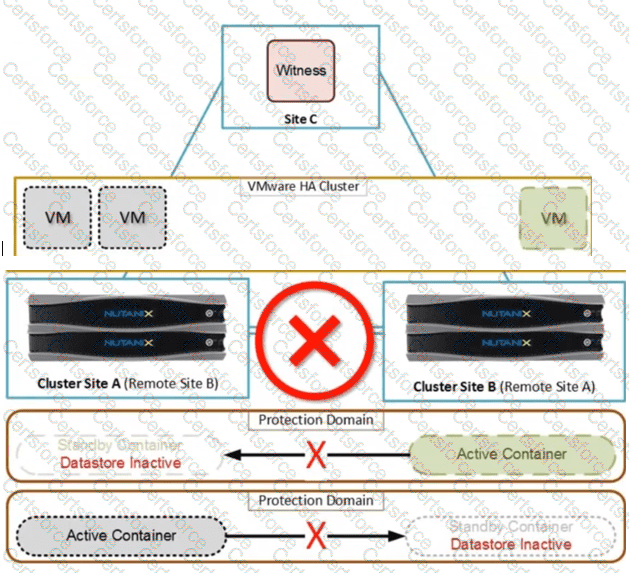
Exhibit:

Question # 6

An administrator wants to protect the snapshots created on the cluster. Only authorized users should be allowed to modify or delete the snapshots on the cluster. How can the administrator harden the security of the snapshots?

Options:

A.

Configure CVM and AHV hardening.


B.

Configure a backup user with admin privileges.


C.

Configure cluster lockdown and use SSH keys.


D.

Configure Approval policy for snapshots.


Expert Solution
Questions # 7:

An administrator wants to run a test failover and maps the primary production virtual network to the recovery site production virtual network for the test. What are the two most likely outcomes? (Choose two.)

Options:

A.

Test failover can overlap with production networking and can lead to IP conflicts.


B.

Using production networks on recovery AZ for test failover provides the most accurate validation.


C.

It defeats the intended isolation between production and test workflows.


D.

Test failover does not require network mapping, so the selection of production or test networks will have no impact.


Expert Solution
Questions # 8:

What snapshot recovery point interval does Self-Service Restore support in a Nearsync setup?

Options:

A.

15 minutes


B.

30 minutes


C.

1 hour


D.

4 hours


Expert Solution
Questions # 9:

A solution architect designs a protection policy in Prism Central to protect a specific set of VMs. The design calls for synchronous replication to two separate availability zones (AZs) simultaneously to ensure zero data loss at multiple physical locations. Which configuration limitation prevents the implementation of this specific design?

Options:

A.

Synchronous replication requires a minimum RPO of 1 hour when targeting multiple sites.


B.

Prism Central prevents pairing with more than one AZ at a time.


C.

A protection policy supports only one synchronous replication schedule.


D.

Synchronous replication is restricted to Protection Domains and cannot be used in Protection Policies.


Expert Solution
Questions # 10:

Two AHV clusters are 4 ms RTT apart. The business requires:

    0 RPO

    Automatic failover

    No application performance degradation

    Hybrid HCI nodes with 100 TB capacity

What storage configuration must be validated before enabling synchronous replication?

Options:

A.

Minimum one SSD per node


B.

No SSD requirement for synchronous replication


C.

Minimum two SSDs at 10% capacity per node


D.

Only HDD capacity matters


Expert Solution
Viewing page 1 out of 4 pages
Viewing questions 1-10 out of questions