You have two servers that have the Hyper-V server role installed. The servers are joined to a failover cluster. Both servers can connect to the same disk on an iSCSI storage device. You plan to use the iSCSI storage to store highly available Hyper-V virtual machines that will support live migration functionality. You need to configure a storage resource in the failover cluster to store the virtual machines. What should you configure?
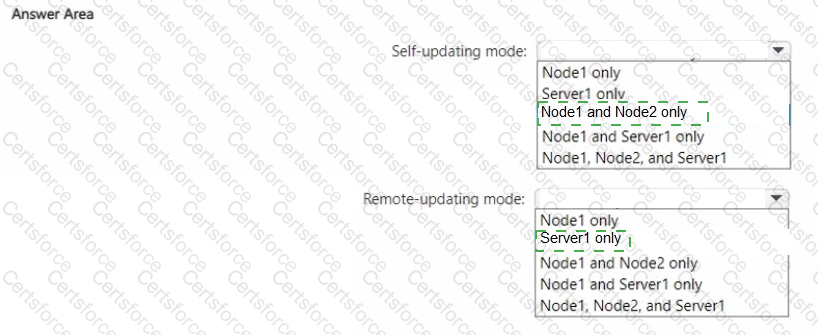
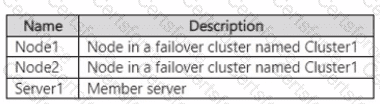
Your network contains an Active Directory Domain Services (AD DS) domain. The domain contains the servers shown in the following table.
The Failover Clustering tools are NOT installed on the servers.
You plan to enable Cluster-Aware Updating (CAU).
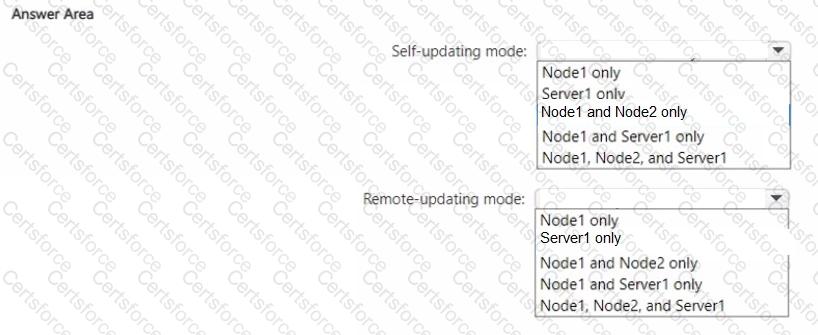
On which servers should you install the Failover Clustering tools to implement CAU in self-updating mode, and on which servers should you install the Failover Clustering tools to implement remote-updating mode? To answer, select the appropriate options in the answer area.
NOTE: Each correct selection is worth one point.
Exhibit
Your network contains an Active Directory Domain Services (AD DS) forest. The forest contains a root domain named contoso.com and a child domain named branch.contoso.com. The forest contains the domain controllers shown in the following table: DC1 (contoso.com; a global catalog server that holds the schema master, domain naming master, PDC emulator, RID master, and infrastructure master roles); DC2 (contoso.com; NOT a global catalog server and does NOT hold any FSMO roles); DC3 (branch.contoso.com; a global catalog server that holds the PDC emulator and RID master roles); DC4 (branch.contoso.com; NOT a global catalog server and holds the infrastructure master role). You discover that cross-domain object references in contoso.com fail to update for objects in branch.contoso.com. You need to modify the FSMO role placement. The solution must minimize administrative changes. What should you do?
Note: This question is part of a series of questions that present the same scenario. Each question in the series contains a unique solution that might meet the stated goals. Some question sets might have more than one correct solution, while others might not have a correct solution. After you answer a question in this section, you will NOT be able to return to it. As a result, these questions will not appear in the review screen. Your network contains a single-domain Active Directory Domain Services (AD DS) forest named contoso.com. The functional level of the forest is Windows Server 2012 R2. All domain controllers run Windows Server 2012 R2. Sysvol replicates by using the File Replication Service (FRS). You plan to replace the existing domain controllers with new domain controllers that will run Windows Server 2022. You need to ensure that you can add the first domain controller that runs Windows Server 2022. Solution: You upgrade the PDC emulator. Does this meet the goal?
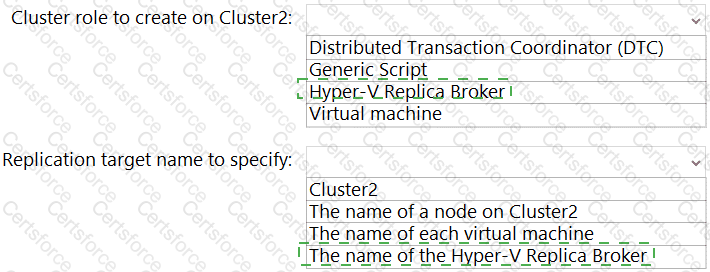
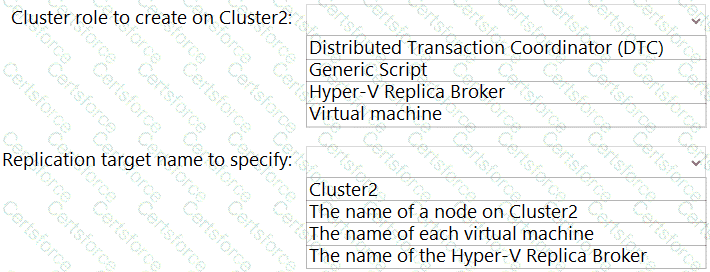
You have a Hyper-V failover cluster named Cluster1 at a main datacenter. Cluster1 contains two nodes that have the Hyper-V server role installed. Cluster1 hosts 10 highly available virtual machines. You have a cluster named Cluster2 in a disaster recovery site. Cluster2 contains two nodes that have the Hyper-V server role installed. You plan to use Hyper-V Replica to replicate the virtual machines from Cluster1 to Cluster2. What should you do? To answer, select the appropriate options in the answer area. NOTE: Each correct selection is worth one point.
You have an Active Directory Domain Services (AD DS) domain that contains the domain controllers shown in the following table: DC1 (Schema master), DC2 (Infrastructure master), DC3 (Domain naming master), DC4 (PDC emulator, RID master). The domain contains an app named App1 that uses a custom application partition to store configuration data. You decommission App1. When you attempt to remove the custom application partition, the process fails. Which domain controller is unavailable?
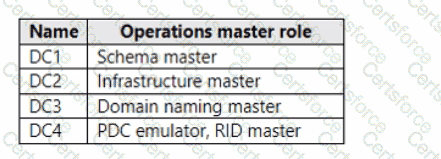
Domain controller FSMO role table
You have an Azure subscription that contains the virtual machines shown in the following table. You plan to use Azure Site Recovery to replicate supported virtual machines to a secondary Azure region. Which virtual machines can be replicated by using Azure Site Recovery? (Exhibit: VMs with their security type and OS.)
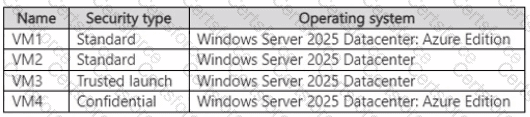
Virtual machines with their security type and operating system
You have an on-premises server named Server1 that runs Windows Server. Server1 contains an app named App1 and a firewall named Firewall1. You have an Azure subscription. Internal users connect to App1 by using WebSockets. You need to make App1 available to users on the internet. The solution must minimize the number of inbound ports open on Firewall1. What should you include in the solution?
You deploy Azure Migrate to an on-premises network. You have an on-premises physical server named Server1 that runs Windows Server and has the following configuration: Operating system disk 600 GB, Data disk 3 TB, NIC Teaming: Enabled, Mobility service: installed, Windows Firewall: Enabled, Microsoft Defender Antivirus: Enabled. You need to ensure that you can use Azure Migrate to migrate Server1. Solution: You disable NIC Teaming on Server1. Does this meet the goal?
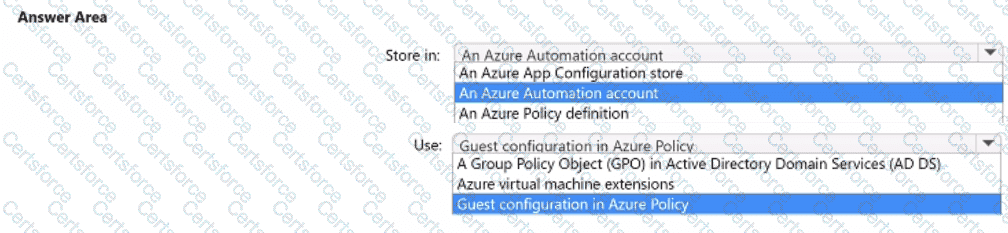
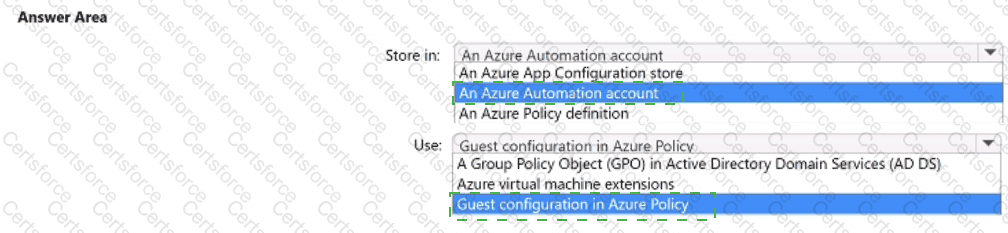
Your on-premises network contains an Active Directory domain named contoso.com and 500 servers that run Windows Server. All the servers are Azure Arc-enabled and joined to contoso.com. You need to implement PowerShell Desired State Configuration (DSC) on all the servers. The solution must minimize administrative effort. Where should you store the DSC scripts, and what should you use to apply DSC to the servers? To answer, select the appropriate options in the answer area. NOTE: Each correct selection is worth one point.