Spring Sale Limited Time 70% Discount Offer - Ends in 0d 00h 00m 00s - Coupon code: simple70

Pass the Juniper JNCIP-ENT JN0-650 Questions and answers with CertsForce

Viewing page 2 out of 2 pages
Viewing questions 11-20 out of questions
Questions # 11:

You must implement EVPN signaling on an EX Series device that is configured with both underlay and overlay networks. Which network protocol accomplishes this task?

Options:

A.

OSPF underlay network


B.

IS-IS underlay network


C.

MPLS overlay network


D.

EBGP overlay network


Expert Solution
Questions # 12:

You have several switches in your network that use Cisco ' s PVST+ protocol. You want your Juniper switches to interoperate with those devices.

In this scenario, which protocol would you use?

Options:

A.

RPVST+


B.

MSTP


C.

VSTP


D.

RSTP


Expert Solution
Questions # 13:

When configuring Q-in-Q tunneling, which type of tunneling involves the swapping of S-VLANs with C-VLANs?

Options:

A.

L2PT


B.

many-to-many


C.

VLAN rewrites


D.

all-in-one


Expert Solution
Questions # 14:

Which two EVPN types advertise an ESI without advertising a MAC address? (Choose two.)

Options:

A.

Type1


B.

Type 2


C.

Type 3


D.

Type 4


Expert Solution
Questions # 15:

You are implementing an EVPN-VXLAN edge-routed bridging design using Layer 3 gateway operations. In this scenario, which statement is correct?

Options:

A.

Each distribution switch has unique IP addresses for IRB interfaces; routing protocols run on IRB interfaces


B.

Distribution switches share the same anycast IP addresses for IRB interfaces; routing occurs at the distribution layer.


C.

Only core switches have IRB interfaces; all Layer 3 routing happens in the core.


D.

IRB interfaces are disabled; all routing happens through external routers only.


Expert Solution
Questions # 16:

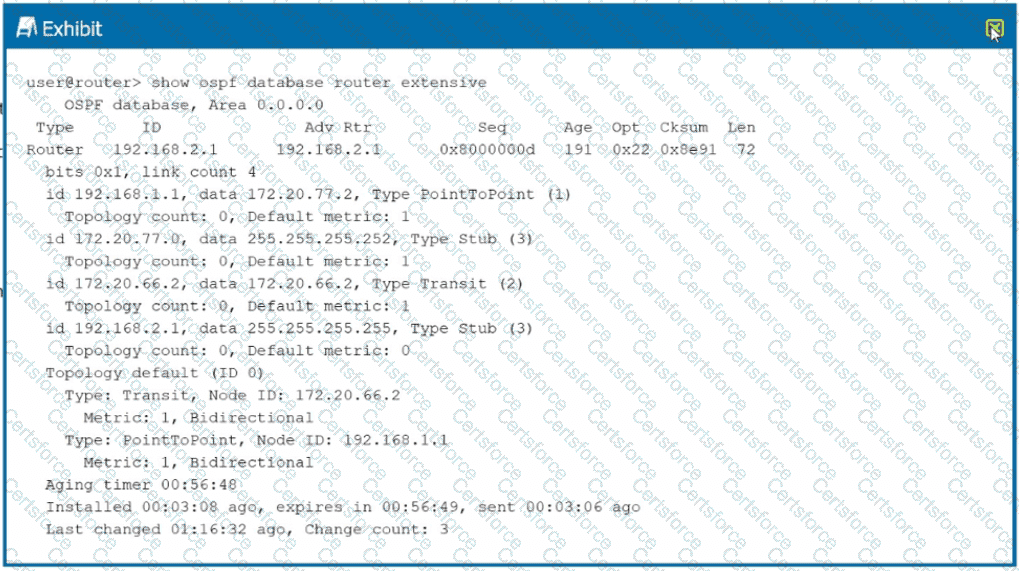
Exhibit

Question # 16

What is the OSPF router type shown in the exhibit for router 192.168.2.1?

Options:

A.

neither an ABR nor an ASBR


B.

an ASBR


C.

both an ABR and an ASBR


D.

an ABR


Expert Solution
Questions # 17:

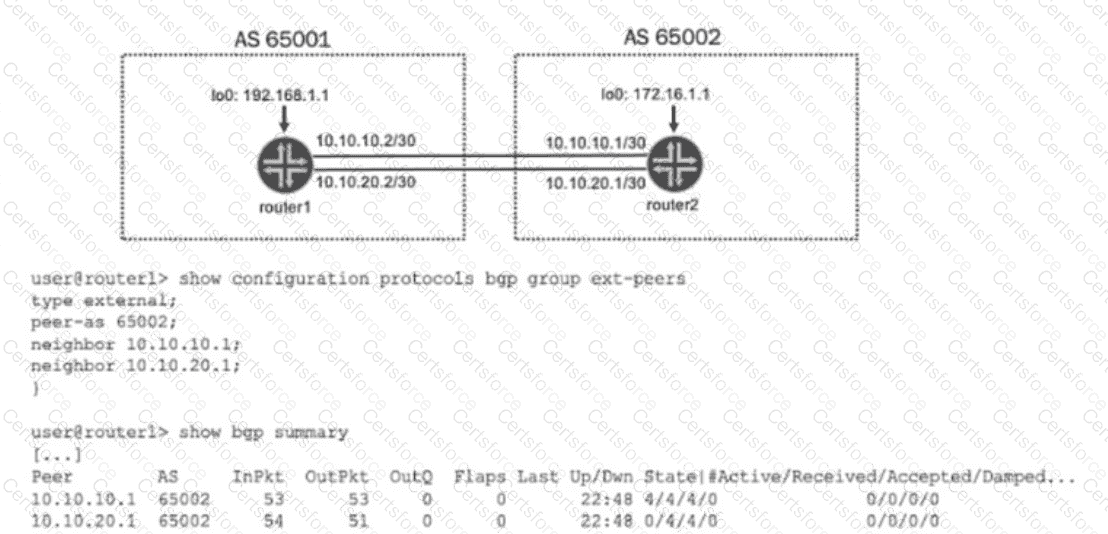
Exhibit.

Question # 17

Question # 17

Referring to the exhibit, which statement is correct?

Options:

A.

The device with the highest IP address is elected as the DR.


B.

The OSPF state will be stuck in the Exstart state


C.

The OSPF state will be stuck in the 2Nay state


D.

The device with the lowest IP address is elected as the DR.


Expert Solution
Questions # 18:

You are enabling CoS throughout your enterprise network using the DSCP bits. You plan to use an MF classifier on all edge devices while using BA classifiers on all transit core devices

In this scenario, what should you use to provide consistent handling of traffic?
Options:

A.

You should implement rewrite rules on the edge devices ' egress interfaces to rewrite the DSCP bits as it leaves the device toward the core.


B.

You should implement rewrite rules on the edge devices ' ingress interfaces to rewrite the DSCP bits as it enters the device.


C.

You should implement rewrite rules on the core devices ' ingress interfaces to rewrite the DSCP bits as it enters the device.


D.

You should implement rewrite rules on the core devices ' egress interfaces to rewrite the DSCP bits as it leaves the device toward other core devices.


Expert Solution
Questions # 19:

Exhibit

Question # 19

Referring to the exhibit. R2 receives a packet from the multicast source on its ge-0/0/4 0 interface.

Which two statements are correct in this scenario? (Choose two.)

Options:

A.

R2 verifies the existing unicast routing table and determines that this interface is not on the reverse path back to the source


B.

All interfaces other than ge-0/0/4.0 will be on the outgoing interface list.


C.

The packet is discarded


D.

R2 determines that the packet is coming in on an interface that is on the reverse path back to the source.


Expert Solution
Questions # 20:

Exhibit

Question # 20

You are receiving the 203 0.113.0/24 route from both upstream ISPs You are asked to ensure that ISP A is the preferred ISP for traffic being sent to the 203.0.113.0/24 network from devices in AS 65512.

Referring to the exhibit, which two statements will accomplish this behavior? (Choose two.)

Options:

A.

You should assign a local preference that is lower than 100 for the route learned from ISP A.


B.

You should assign a local preference that is higher than 100 for the route learned from ISP A.


C.

You should assign a local preference that is lower than 100 for the route learned from ISP B.


D.

You should assign a local preference that is higher than 100 for the route learned from ISP B.


Expert Solution
Viewing page 2 out of 2 pages
Viewing questions 11-20 out of questions