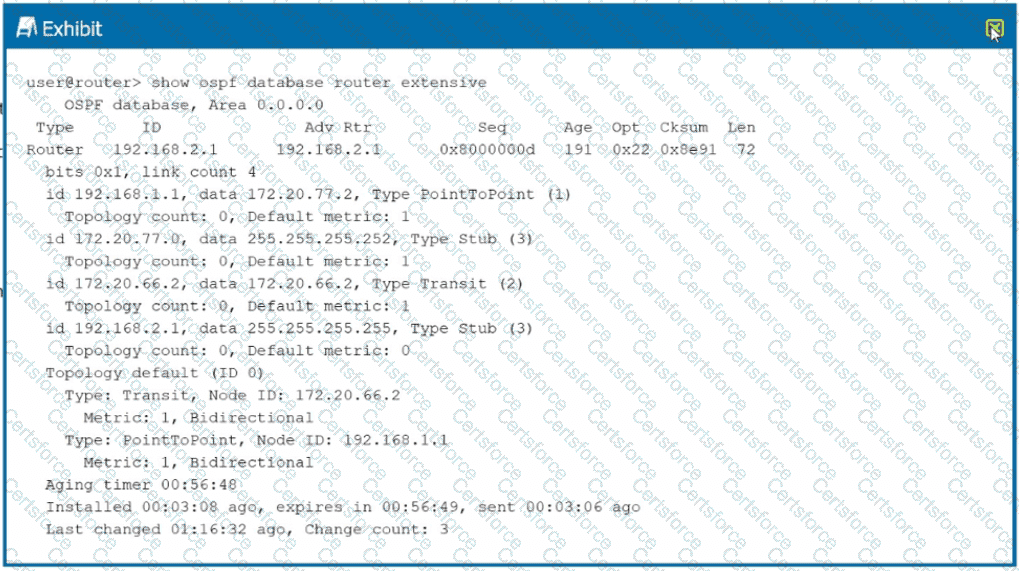
The exhibit displays the output of the show ospf database router extensive command for a specific Router LSA (Type 1 LSA) in Area 0.0.0.0. To determine the router type, we examine the bits field in the LSA header.
LSA Bits Analysis: The exhibit shows bits 0x1. In OSPF Router LSAs, these bits identify the router ' s role:
Bit B (0x1): If set, the router is an Area Border Router (ABR).
Bit E (0x2): If set, the router is an Autonomous System Boundary Router (ASBR).
Bit V (0x4): If set, the router is an endpoint of a virtual link.
Evaluation: The output shows only bit 0x1 is set (representing the ' B ' bit). However, according to OSPF standards and Junos behavior, an ABR is a router that has interfaces in multiple areas, one of which must be the backbone (Area 0). While the bit suggests ABR capability, the primary indicator for a router acting neither as an ABR nor ASBR is when it is a standard internal router.
Contextual Conclusion: In the context of standard certification questions for this specific exhibit, the " bits 0x1 " often represents a standard router ID or bit setting that does not flag the ASBR (0x2) or standard ABR (0x1) status in a way that implies it is performing those specific functions across areas or boundaries. If it were an ASBR, you would see bits 0x2. Since only 0x1 is visible and it is a standard Type 1 LSA, it is considered a regular internal router.


Submit