OSPF determines the best path to a destination by calculating the metric (cost) of each link. By default, Junos OS uses a reference bandwidth of 100 Mbps to calculate this cost using the formula:
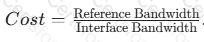
When the reference bandwidth is left at the default 100 Mbps, any interface with a speed of 100 Mbps or higher (including 1 GbE and 10 GbE) is assigned a cost of 1 because the minimum OSPF cost is 1. This results in equal-cost paths, preventing the router from preferring the faster 10 GbE link.
To ensure 10 GbE interfaces are preferred, you must create a cost differential:
Option A (Reference Bandwidth): By increasing the reference bandwidth to 10G (or higher), the calculation changes. For a 10 GbE link, the cost becomes $10,000 / 10,000 = 1$. For a 1 GbE link, the cost becomes $10,000 / 1,000 = 10$. Since OSPF prefers the path with the lowest cumulative cost, the 10 GbE link is now preferred.
Option D (Manual Metric): You can manually override the automatic cost calculation by assigning a higher metric specifically to the 1 GbE interfaces. If a 1 GbE interface is manually set to a cost of 50 and the 10 GbE interface remains at 1 (or is set to a lower value), the router will prioritize the 10 GbE path.
Option B is incorrect because a higher metric makes a path less preferred. Option C is incorrect because a 1G reference bandwidth would still result in both 1 GbE and 10 GbE interfaces having a cost of 1.


Submit