Summer Certification Special Limited Time 70% Discount Offer - Ends in 0d 00h 00m 00s - Coupon code: force70

Pass the Juniper JNCIS-ENT JN0-352 Questions and answers with CertsForce

Viewing page 1 out of 2 pages
Viewing questions 1-10 out of questions
Questions # 1:

Which two characteristics describe the default behavior of aggregate routes? (Choose two.)

Options:

A.

They advertise all contributing routes individually by default.


B.

They hide internal routing instability from external peers.


C.

They use a default next hop of discard.


D.

They use a default next hop of reject.


Expert Solution
Questions # 2:

A GRE tunnel is experiencing fragmentation issues. You confirm that the tunnel is up and is functioning correctly. You confirm that hosts are sending 1500-byte packets.

In this scenario, which statement is correct?

Options:

A.

You should use the clear-dont-fragment parameter to allow fragmentation.


B.

You should lower the physical interface's MTU to 1476 bytes to avoid fragmentation.


C.

You should enable BFD to more rapidly identify tunnel link failures.


D.

You should use ToS copying to reduce header size.


Expert Solution
Questions # 3:

How does BGP prevent routing loops between internal peers?

Options:

A.

It uses VRRP.


B.

It uses AS path.


C.

It uses BFD.


D.

It uses a logical full mesh.


Expert Solution
Questions # 4:

How would you view the metric assigned to a route in OSPF? (Choose two.)

Options:

A.

Use the show route protocol ospf command.


B.

Use the show ospf route intra command.


C.

Use the show ospf database extensive command.


D.

Use the show ospf interface command.


Expert Solution
Questions # 5:

Which two fields must match in an OSPF hello packet to form an adjacency over a broadcast link? (Choose two.)

Options:

A.

network mask


B.

designated router


C.

router priority


D.

dead interval


Expert Solution
Questions # 6:

You need to block SSH (TCP port 22) traffic from the 192.168.10.0/24 network.

Which firewall filter term is correct in this scenario?

Options:

A.

term block-ssh { from { source-address 192.168.10.0/24; protocol tcp; destination-port 22; } then discard; }


B.

term block-ssh { from { destination-address 192.168.10.0/24; protocol tcp; destination-port 22; } then discard; }


C.

term block-ssh { from { source-address 192.168.10.0/24; protocol tcp; source-port 22; } then discard; }


D.

term block-ssh { from { source-address 192.168.10.0/24; service ssh; } then reject; }


Expert Solution
Questions # 7:

Which two statements are correct about BGP local preference? (Choose two.)

Options:

A.

A local preference of 100 is the Junos default.


B.

Local preference is advertised to EBGP peers.


C.

Local preference is used to direct outbound traffic within an AS to a specific peer.


D.

A local preference of 0 means to drop the route.


Expert Solution
Questions # 8:

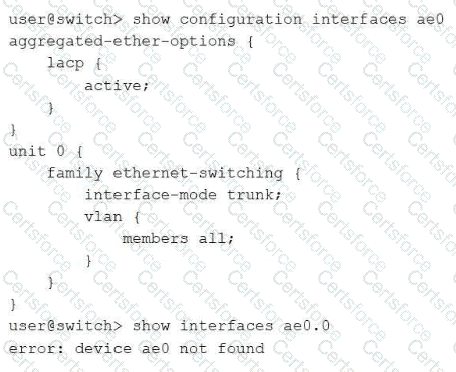
[Exhibit]

Question # 8

Click the Exhibit button.

You are troubleshooting an aggregated Ethernet interface on a Juniper Networks EX Series Switch. The aggregated Ethernet interface does not appear in the output shown in the exhibit.

Which action will solve this problem?

Options:

A.

Configure the number of aggregated Ethernet devices under the [edit chassis] hierarchy.


B.

Install the aggregated Ethernet interface license on the switch.


C.

Restart the switch to enable the aggregated Ethernet switching process.


D.

Configure LACP passive-mode.


Expert Solution
Questions # 9:

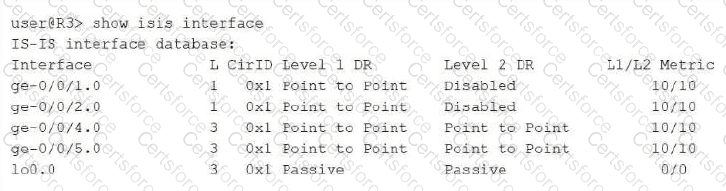
Refer to Exhibit:

Question # 9

Click the Exhibit button.

Which two statements about the output shown in the exhibit are correct? (Choose two.)

Options:

A.

A designated router is elected for each IS-IS interface.


B.

R3 cannot establish an L2 adjacency on the ge-0/0/2.0 interface.


C.

R3 uses its loopback interface to establish an L2 IS-IS adjacency.


D.

R3 advertises its loopback interface IP address.


Expert Solution
Questions # 10:

You are deploying a Juniper Networks EX Series Switch to connect 24 end devices to VLAN 70, with an uplink interface to a distribution switch that carries VLANs 30, 50, and 70. You need to correctly configure the interface type for the end-device interfaces.

In this scenario, which statement is correct?

Options:

A.

Use trunk mode with VLAN 70 set as the native VLAN.


B.

No configuration is needed since VLAN 70 is the highest VLAN-ID.


C.

Use trunk mode with VLAN 70 as the only allowed VLAN.


D.

Use access mode and assign the interfaces to VLAN 70.


Expert Solution
Viewing page 1 out of 2 pages
Viewing questions 1-10 out of questions