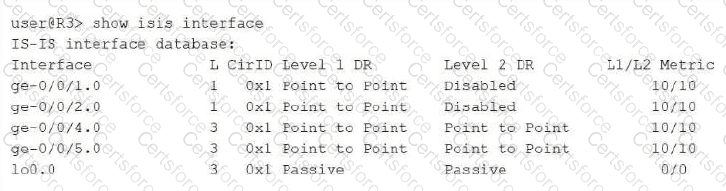
The L column in this output identifies which IS-IS levels are active on each interface, using the standard bitmask where 1 represents Level 1 only and 3 represents both Level 1 and Level 2 combined. Interface ge-0/0/2.0 shows an L value of 1 and its Level 2 DR field explicitly reads Disabled, meaning Level 2 has not been enabled on that circuit at all; consequently no Level 2 adjacency can ever form there, regardless of what the neighboring router advertises, which confirms that statement as correct. The lo0.0 loopback interface shows Passive under both the Level 1 DR and Level 2 DR columns. A passive IS-IS interface is deliberately excluded from adjacency formation — no IIH PDUs are sent or expected on it — but its associated prefix is still injected into the router's own LSP and flooded throughout the area, which is precisely why loopbacks are configured as passive: to guarantee the router ID/loopback prefix is reachable network-wide without wasting adjacency overhead on an interface with no real neighbor. This confirms that R3 advertises its loopback address, while ruling out the claim that the loopback is used to form an adjacency. Regarding designated routers, all circuits shown here report 'Point to Point' rather than an actual DR system ID, because DR election in IS-IS is a construct exclusive to broadcast (LAN) circuits; point-to-point circuits never elect a DR, so the first statement is false. Reference topics: Junos Enterprise Routing – IS-IS, Interface Levels and Passive Interfaces.
Contribute your Thoughts:
Chosen Answer:
This is a voting comment (?). You can switch to a simple comment. It is better to Upvote an existing comment if you don't have anything to add.


Submit