
You have been assigned as Test Analyst on a project that is in the test design stage. Test cases have been written, which activity should you do next before test design is complete?
Your project is developing an application to generate quotes for motor insurance. The calculation requires a wide range of input data and a reliable model of it has been built in a spreadsheet. There will not be enough time to get adequate functional correctness coverage from the base choice or pairwise techniques, so you have decided to do some random testing based on a probability distribution of variable values that is weighted towards their business criticality.
Which limitation of random testing should you be MOST concerned about?
You are developing test cases for an application which performs complex calculations and have decided to model these calculations on a spreadsheet, to determine expected results from inputs.
Which solution to the test oracle problem BEST describes the approach you are using?
You have been assigned as Test Analyst on a project that will deliver quotes for motor insurance. The amount quoted depends upon the combined values of twelve variables, that are resolved by a set of business rules.
What should be your MAIN task during the test analysis activity?
You are working on an Agile project to develop a web-based online dating service that will allow members of the service to enter their profile, meet people who would be a good match for them, arrange social events with those people and to block people with whom they do not want contact.
The features for member profile entry have been delivered and tested. The current iteration will deliver profile matching. The regression tests for profile entry will be the acceptance criteria for its user stories. These tests have not been automated yet so you have decided to perform regression testing on the basis of a checklist.
Which checklist would be BEST in these circumstances?
Which test technique would be most suitable for testing a database application that supports adding and deleting data, and that also controls which users can view the data and which users can update it?
The test basis for your latest project contains the activity diagram that is shown below. The business architect has confirmed that this model has been reviewed and approved by the stakeholders.
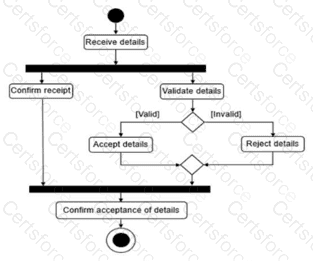
Which of the following conclusions is correct?
Which of the following demonstrates the test analyst’s contribution to interoperability testing?
A credit risk scoring system accepts two integer inputs, L and E, representing credit scores calculated by two independent systems. The system assesses credit risk using the following business logic:
IF L > = 50 OR E > = 50 THEN the risk is high
IF L < = 49 AND E < = 49 THEN the risk is low
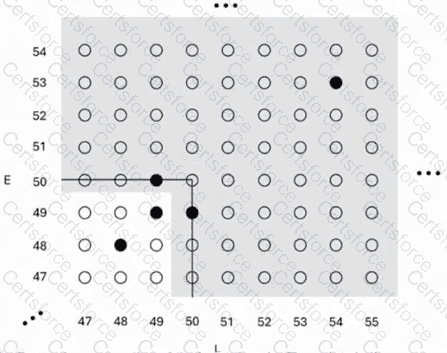
The figure displays a section of the input domain. Points in the gray area are part of the “high risk” equivalence partition, and points outside it are part of the “low risk” equivalence partition. The lines indicate the closed boundary of the “high risk” equivalence partition.
You use domain-based testing to verify the correct implementation of the above requirement. The test set contains the five black points in the figure: (L=48, E=48), (L=49, E=49), (L=49, E=50), (L=50, E=49), and (L=54, E=53).
What level of RELIABLE domain coverage does this set of test points achieve?
You are testing the functional correctness of an application which generates quotes for motor insurance. The amount of the quote is governed by a combination of the following factors:
• Type of Cover (can be: comprehensive, third party damage only, or third party damage + fire and theft)
• Vehicle Engine Size (can be: < 1500cc, < 2000cc, < 2500cc, = > 2500cc)
• Driving Licence Type (can be: fully qualified, or student driver)
• Vehicle Storage Type (can be: locked garage, or unlocked private place, or public place)
• Time Since Last Claim (can be: < 1year, < 2yrs, < 3yrs, = > 3yrs)
In order to achieve full PAIRWISE coverage, how many combinations must be tested?
