
A simple DVD player is described in the following state transition diagram:
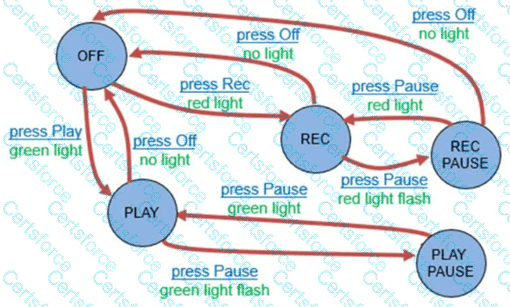
All round trips are feasible, even those that do not start at OFF. How many test cases will be needed for complete round-trip coverage?
BeRich is preparing to launch a mobile application to manage personal finances. The app is expected eventually to attract a broad range of users, from young people through adults to retirees. It provides various functions, including budgeting, expense analysis, saving, and financial advice. The project team includes specialists from different departments: marketing, product development, testing, UX, and system architecture. To ensure consistent performance and positive reception of the application, the team will review the functional documentation before entering the intensive implementation phase.
Each department views the app through the lens of its own goals and expertise. For marketing, it is essential that the application offers unique market-differentiating features that are intuitive for users. The system architecture team concentrates on scalability, security, and protection of user data. Testers, on the other hand, focus on making sure that every function is easy to test and on anticipating scenarios that could create user problems. In contrast, UX specialists focus on the application’s accessibility for a wide range of users.
Which type of review applied to the functional documentation would be the BEST solution in this scenario?
You are working on a project to build a purchasing system. The main requirements for the system are that it shall:
1. Allow users to enter details of items that they wish to have purchased and, from these details, create a purchase request.
2. Take each purchase request through a workflow that will allow the requestor’s line manager to approve the request, reject it or return it for clarification / modification.
3. Forward approved requests to the Purchasing Department.
4. Allow purchasers to find the best available supplier for each approved request and place the request on that supplier as a purchase order.
The solution is being developed according to the company ' s traditional V-model methodology. The requirements are clearly documented and include a business process model.
The main release has now been live for three months and you are working on the first maintenance release. The test manager has asked you, the senior TA, to identify those parts of the test process which were most and least effective at finding defects in the main release.
You have collected statistics for the independent test activities, i.e. excluding developers’ testing, including only the 178 defects in the three highest of your five defect severity levels. The results are presented in the table below:
Phase of defect Introduction
Test analysis, including requirements review
Test design, including solution design review
System testing
Acceptance testing
Live operation 1st 3 months
Total quantity of defects introduced
Requirements
13
12
20
10
10
65
Solution design
28
5
5
10
48
Implementation
50
10
5
65
Total quantity of defects found
13
40
75
25
25
178
Assume that all defects not found at the first opportunity could have been, e.g. that all defects that escaped into acceptance testing were within the scope and objectives of system testing. By applying Defect detection percentage (DDP) analysis, which test activity was LEAST effective?
Which of the following is not an example of a test analyst’s contribution to defect prevention?
You are working on a project to replace an old sales and merchandising system with a new system that will be based on modern platforms. The old system is still in production but is poorly documented and expensive to maintain. The new version will be developed using modern technology. The main requirements for the system are that it shall:
1. Load sales data, sent electronically from the stores each evening, into a central database.
2. Produce actual sales reports for the merchandisers, whose job is to manage stock levels in stores.
3. Produce sales forecast reports based on a combination of sales history and forecasting parameters. The parameters will be entered by the merchandisers into a browser-based front end and the reports will be produced overnight. The users will be able to see the reports next day, on screen or in print, by requesting this through the browser.
Requirements 1 and 2 are satisfied by the existing system and will be rewritten with no significant changes. Requirement 3 is new and has been clearly specified.
The entry of forecasting parameters and of requests to see the reports will be low volume, but the Merchandising Manager is concerned about usability because the forecasting parameters are complex.
Which test charter would be BEST for the initial exploratory testing of requirement 3?
What testing do test analysts carry out when verifying that the system complies with accessibility standards such as WCAG?
You are defining key words to test an application which will create a Purchase Request (PR) from details of goods that a Merchandiser wants their organization to buy. When valid details have been entered, the resulting PR will be sent to the Merchandise Manager for authorization.
You have a diagram in Business Process Modeling Notation and this section shows the initial steps in this process:
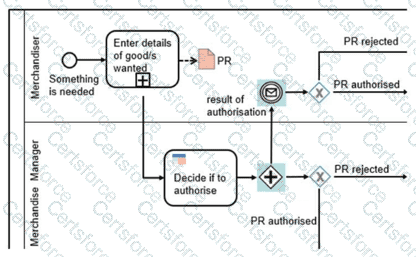
• The process starts when Something is needed.
• The Merchandiser performs the action Enter details of goods wanted.
• This creates a PR.
• The process then continues toward the Merchandise Manager, who will Decide if to authorise the PR.
• The PR may then be authorised or rejected.
For the first process, when “Something is needed”, which option contains the MOST appropriate keywords for action and verification?
Which of the following is a way to ensure your synthetic data is reflective of production data?
You are working on a project to replace an old sales and merchandising system with a new system that will be based on modern platforms. The old system is still in production but is poorly documented and expensive to maintain. The new version will be developed using modern technology. The main requirements for the system are that it shall:
1. Load sales data, sent electronically from the stores each evening, into a central database.
2. Produce actual sales reports for the merchandisers, whose job is to manage stock levels in stores.
3. Produce sales forecast reports based on a combination of sales history and forecasting parameters. The parameters will be entered by the merchandisers into a browser-based front end and the reports will be produced overnight. The users will be able to see the reports next day, on screen or in print, by requesting this through the browser.
Requirements 1 and 2 are satisfied by the existing system and will be rewritten with no significant changes. Requirement 3 is new. The development will use your company’s Agile SDLC, with 2-week iterations. Technical skill levels in the team are high and the approach to automate test execution is aggressive. Each requirement will be specified with user stories, will be released only when complete, and will need more than one iteration. The main business benefit will come from requirement 3, which depends on the other two requirements, and the stakeholders are keen to get this into production as soon as possible.
Release planning has begun for requirement 3 and you need to know at a high level what the testing scope will be, to ensure that the correct resources will be available. Which functional test techniques will be MOST effective for this release?
a) Domain testing
b) Combinatorial testing
c) Random testing
d) CRUD testing
e) Scenario-based testing
f) Decision table testing
g) Exploratory testing
