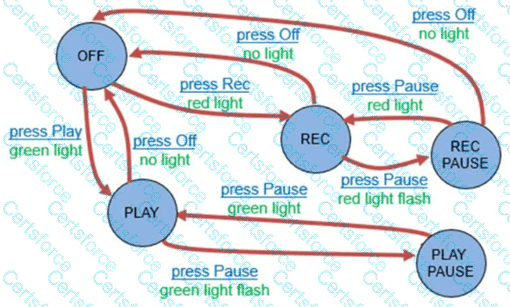
The correct answer is B, because complete round-trip coverage requires every feasible round trip in the state model to be covered, not only those that start from the initial OFF state. CTAL-TA v4.0 explicitly includes state transition testing with N-switch and round-trip coverage as the focus of its state transition topic. A round trip is a path that starts and ends in the same state, normally without repeating an intermediate state.
The feasible round trips are:
1. OFF → PLAY → OFF
2. PLAY → OFF → PLAY
3. OFF → REC → OFF
4. REC → OFF → REC
5. REC → REC PAUSE → REC
6. REC PAUSE → REC → REC PAUSE
7. PLAY → PLAY PAUSE → PLAY
8. PLAY PAUSE → PLAY → PLAY PAUSE
9. OFF → REC → REC PAUSE → OFF
10. REC → REC PAUSE → OFF → REC
11. REC PAUSE → OFF → REC → REC PAUSE
That gives 11 round trips. The warning in the question is important: if only OFF-starting round trips were counted, the answer would be too low. Option A overcounts by adding a non-modeled or duplicate round trip. Options C and D miss feasible non-OFF-starting round trips.
[Reference: CTAL-TA v4.0, Section 3.2.2 State Transition Testing, round-trip coverage.]
Contribute your Thoughts:
Chosen Answer:
This is a voting comment (?). You can switch to a simple comment. It is better to Upvote an existing comment if you don't have anything to add.


Submit