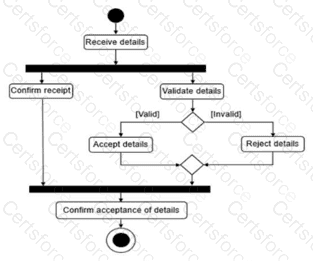
The test basis for your latest project contains the activity diagram that is shown below. The business architect has confirmed that this model has been reviewed and approved by the stakeholders.
Which of the following conclusions is correct?
A.
The diagram may contain a defect but this cannot be confirmed until the results of the tests created from it are known
B.
The diagram may contain a defect but this cannot be confirmed until test cases have been designed from it
C.
The diagram is correct because it has been reviewed and approved by the stakeholders
D.
The diagram contains at least one defect because it contains an internal inconsistency
The correct answer is D. The diagram contains an internal inconsistency that can be identified directly from the model, without waiting for test design or execution. The activity diagram shows Receive details, then splits into parallel activities: Confirm receipt and Validate details. The validation path then branches into [Valid] Accept details and [Invalid] Reject details. However, after either acceptance or rejection, the flow rejoins and continues to Confirm acceptance of details. That means the model allows rejected details to proceed into an activity that confirms acceptance, which is logically inconsistent.
CTAL-TA v4.0 states that scenario-based testing uses workflow models such as activity diagrams, use cases, flowcharts, BPMN diagrams, sequence diagrams, and collaboration diagrams to derive scenarios through the test item. The syllabus also emphasizes that modeling and test analysis can reveal defects in the test basis, including workflow-related defects, before dynamic test execution begins.
Option A is wrong because the inconsistency is visible statically; test execution is not needed to confirm it. Option B is also wrong because formal test cases are not required before recognizing the contradiction. Option C is dangerous and incorrect: stakeholder approval does not prove technical or logical correctness. The issue is a structural workflow defect in the model itself.
[Reference: CTAL-TA v4.0, Section Scenario-Based Testing and Test Analysis of the Test Basis.]
Contribute your Thoughts:
Chosen Answer:
This is a voting comment (?). You can switch to a simple comment. It is better to Upvote an existing comment if you don't have anything to add.


Submit