
Pre-Summer Special Limited Time 70% Discount Offer - Ends in 0d 00h 00m 00s - Coupon code: force70

Pass the HP Aruba Certified Switching Expert HPE7-A08 Questions and answers with CertsForce

Viewing page 3 out of 4 pages
Viewing questions 21-30 out of questions
Questions # 21:

You are implementing a design where the campus network should be in an isolated spanning tree topology from the data center network. The core switches are connected by a single layer-2 interface carrying multiple VLANs. When you examine the switches you discover that the campus core sees the data center core as the root bridge.

Which configuration can you apply to the campus to data center core link to resolve the issue?

Options:

A.

Root guard


B.

BPDU filter


C.

BPDU guard


D.

Admin edge


Expert Solution
Questions # 22:

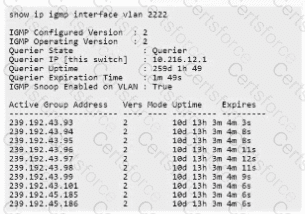
An HPE Aruba Networking CX switch is configured with IGMP using the given output:
Question # 22

Which statement is true about the possible supported message types?

Options:

A.

Leave and Report


B.

Join, Leave, Query and Report


C.

Query and Report


D.

Join and Query


Expert Solution
Questions # 23:

What are valid NAE agent actions? (Select two)

Options:

A.

Run a CLI command


B.

Generate an SNMP trap


C.

Generate a local system log


D.

Start/stop a packet capture


E.

Create a new TAC case


Expert Solution
Questions # 24:

After configuring BFD for OSPF you are receiving monitoring alerts for high CPU utilization on your switches. Based on the configuration below, how should you resolve the issue?

Bash

bfd

!

router ospf 1

bfd all-interfaces

Options:

A.

Enable ICMP active mode.


B.

Ensure BFD is enabled on all passive OSPF interfaces.


C.

Enable BFD echo mode.


D.

Disable ICMP redirects.


Expert Solution
Questions # 25:

You are deploying a pair of VSX switches parallel to some existing HPE Comware switches. You would like to configure a common first-hop redundancy protocol as part of your migration strategy. Which of these would be suitable?

Options:

A.

Active Forwarding


B.

HSRP


C.

VRRP


D.

Active Gateway


Expert Solution
Questions # 26:

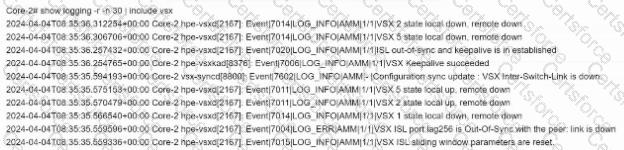
Your network monitoring system has issued a critical alert indicating that the ISL between two VSX core switches is down. What can you determine from the log output below?
Question # 26

Options:

A.

Core-2 has disabled its VSX LAG interfaces.


B.

Keepalive packets are being dropped.


C.

Both switches are forwarding traffic over VSX LAGs.


D.

Downstream switches are not able to forward traffic.


Expert Solution
Questions # 27:

Your customer ' s CISO would like to deploy colorless ports across the network. Which will you need to configure to meet this requirement?

Options:

A.

VRRP


B.

VNBT


C.

VSF


D.

VRF


Expert Solution
Questions # 28:

Which statement is valid when enabling ARP protection features on HPE Aruba Networking CX switches?

Options:

A.

Once you enable DHCP snooping, you can enable ARP protection, and you will have full information to mitigate security risks.


B.

In an active network, you should generally wait at least a week after enabling DHCP snooping to enable ARP protection.


C.

Client lease time on the DHCP server should be at least 3600s before enabling ARP protection.


D.

DHCP server utilization is required for IP to MAC binding to enable ARP protection.


Expert Solution
Questions # 29:

You have added a switch with existing configuration to an existing group in HPE Aruba Networking Central but the configuration is not synchronizing. What could cause this?

Options:

A.

The switch is configured in a VSX pair, which HPE Aruba Networking Central does not support.


B.

The switch is still pending authorization on the organization settings page.


C.

The switch cannot establish a management connection with HPE Aruba Networking Central.


D.

Only switches with factory default config can be added to a group with existing config.


Expert Solution
Questions # 30:

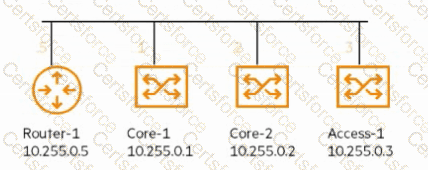
You are configuring OSPF on each of the devices shown. After verifying the OSPF neighbor table on each, you notice that Router-1 and Access-1 have neighbors in the 2WAY state. What is the reason for this?

Question # 30

Options:

A.

Router-1 and Access-1 have reached a tie in the DR election.


B.

Router-1 and Access-1 have no OSPF networks to advertise.


C.

This is normal behavior for OSPF neighbors on a broadcast network.


D.

IGMP snooping has been configured on Router-1 and Access-1.


Expert Solution
Viewing page 3 out of 4 pages
Viewing questions 21-30 out of questions