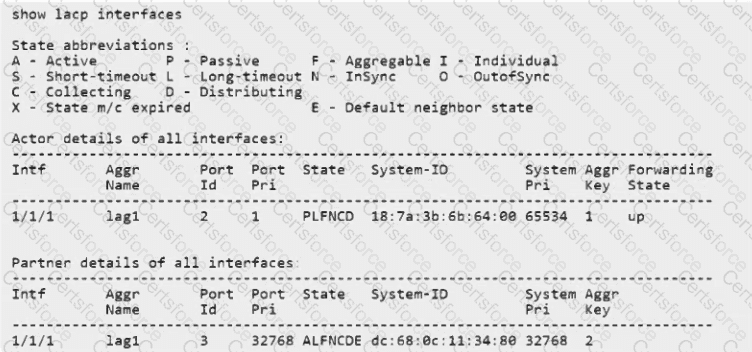
The show lacp interfaces output directly identifies the LACP operating mode of both sides of the aggregation. In AOS-CX terminology, Actor represents the local switch and Partner represents the neighboring LACP device.
For interface 1/1/1, the Actor State shown in the exhibit is:
PLFNCD
HPE Aruba defines P = Passive , while A = Active . Therefore, the local CX 6000 is operating in LACP passive mode . The remaining flags indicate Long-timeout (L), Aggregable (F), InSync (N), Collecting (C), and Distributing (D). The forwarding state is also up, confirming that the member is participating successfully in the aggregate. Aruba Networks
The Partner State begins with A , meaning the remote CX 6000 is operating in LACP active mode . This is a valid pairing: the active peer initiates LACPDU exchanges, while the passive peer responds. A passive-to-passive combination would not normally establish LACP because neither side initiates negotiation.
Option B is also incorrect because a static LAG does not negotiate LACP and therefore would not present the normal negotiated Actor/Partner LACP state displayed here. Aruba Networks
Study Guide References: Link Aggregation; LACP Active/Passive Modes; show lacp interfaces; Actor and Partner State; LACP State Flags.
===============


Submit