
A credit loan officer at a commercial bank reviews a loan application from a company engaged in coal-fired power generation. The loan officer examines transition risks associated with the company’s business strategy.
What policy risk driver should the loan officer identify?
A prominent housing developer plans construction of a small low-carbon-emitting city in an equatorial nation. The developer plans to maximize renewable energy use and estimates daily city summer solar energy generation capacity and load (total electricity demand), in megawatts (MW):
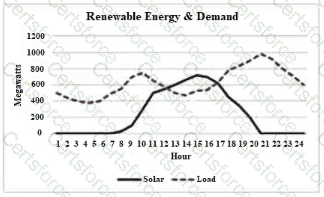
The developer estimates the following for capacity and load:
At 14:00 solar generation is highest at 720 MW
At 20:00 solar generation decreases to 0 MW
At 20:00 load is highest at 980 MW
At 4:00 load is lowest at 380 MW
How should the developer meet additional energy demand while achieving the lowest-carbon-emission goal option?
A Southeast Asian national military plans infrastructure investments that incorporate climate risk considerations. Part of the planning process includes climate scenario analysis. After considering several scenarios, the military assumes a future with increasing regional rivalry and conflict among nations.
The military will rely on which global reference scenario to inform its scenario analysis?
T he sustainability team at a Central European agricultural firm identifies nature-related risks threatening agricultural productivity and supply chain resilience. Declining yields are linked to environmental degradation and biodiversity loss. To avoid biodiversity loss, which of the following actions will the team most likely recommend?
A large real estate investment firm increases resources to understand transition and physical risks as it expands into markets with climate regulations and increasing flooding events. Senior leadership requires the risk team train all business units in understanding how both climate risks can impact operations.
During this process, how should the risk team define commonalities between both risks?
An insurance firm announces it will adopt sustainable practices. To inform sustainable strategy, a company risk analyst researches climate risk. The analyst reviews how climate risk manifests as financial risk through effects on microeconomic company-level risks on various types of companies and institutions. The analyst also identifies possible opportunities resulting from climate risk. Risks and opportunities are presented to senior management.
Which of the following does the analyst cite as an example of how climate risk affects liquidity risk?
The climate risk team at a global bank works on a sustainability and climate risk report for a forthcoming company strategy meeting. The meeting will focus on bank goals to achieve net zero GHG emissions by 2050. Bank leaders will discuss potential risk exposures the bank may face, as well as possible financial systemic effects.
Which of the following is an example of how systemic climate risk can translate into liquidity risk for the bank?
A bank assesses lending portfolio alignment with various climate change scenarios. To assist in this process, the risk team applies the Paris Agreement Capital Transition Assessment (PACTA) tool to examine transition risk for power generation, automotive, and steel sectors. The team examines different PACTA metrics for each sector based on data availability and sectoral profile.
For sectors with no clear zero-carbon pathway, what metric will PACTA employ?
An investment bank of a southern African country appoints a task force to assess current climate risk practices. The task force examines the potential of climate change to cause systemic risk at the macro level to inform climate investment strategies. The task force evaluates potential disruption scenarios to the financial system due to climate risk. Which risk type will most likely have the lowest potential to cause systemic risk to the financial system of the country?
A senior advisor from a government agency in Southeast Asia proposes a national framework to classify sustainable economic activities, aligned with the EU Taxonomy. The new framework will limit environmental harm and promote sustainable growth. Which EU Taxonomy requirement will the advisor most likely incorporate into the proposed framework?
