
A task orchestrator has been configured to run two hourly tasks. First, an outside system writes Parquet data to a directory mounted at /mnt/raw_orders/. After this data is written, a Databricks job containing the following code is executed:
(spark.readStream
.format( " parquet " )
.load( " /mnt/raw_orders/ " )
.withWatermark( " time " , " 2 hours " )
.dropDuplicates([ " customer_id " , " order_id " ])
.writeStream
.trigger(once=True)
.table( " orders " )
)
Assume that the fields customer_id and order_id serve as a composite key to uniquely identify each order, and that the time field indicates when the record was queued in the source system. If the upstream system is known to occasionally enqueue duplicate entries for a single order hours apart, which statement is correct?
A data pipeline uses Structured Streaming to ingest data from kafka to Delta Lake. Data is being stored in a bronze table, and includes the Kafka_generated timesamp, key, and value. Three months after the pipeline is deployed the data engineering team has noticed some latency issued during certain times of the day.
A senior data engineer updates the Delta Table ' s schema and ingestion logic to include the current timestamp (as recoded by Apache Spark) as well the Kafka topic and partition. The team plans to use the additional metadata fields to diagnose the transient processing delays:
Which limitation will the team face while diagnosing this problem?
A data engineer is using Lakeflow Declarative Pipelines Expectations feature to track the data quality of their incoming sensor data. Periodically, sensors send bad readings that are out of range, and they are currently flagging those rows with a warning and writing them to the silver table along with the good data. They’ve been given a new requirement – the bad rows need to be quarantined in a separate quarantine table and no longer included in the silver table.
This is the existing code for their silver table:
@dlt.table
@dlt.expect( " valid_sensor_reading " , " reading < 120 " )
def silver_sensor_readings():
return spark.readStream.table( " bronze_sensor_readings " )
What code will satisfy the requirements?
An external object storage container has been mounted to the location /mnt/finance_eda_bucket .
The following logic was executed to create a database for the finance team:

After the database was successfully created and permissions configured, a member of the finance team runs the following code:
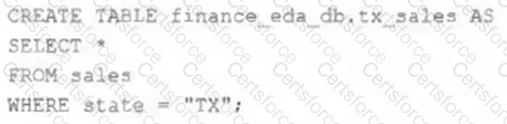
If all users on the finance team are members of the finance group, which statement describes how the tx_sales table will be created?
To reduce storage and compute costs, the data engineering team has been tasked with curating a series of aggregate tables leveraged by business intelligence dashboards, customer-facing applications, production machine learning models, and ad hoc analytical queries.
The data engineering team has been made aware of new requirements from a customer-facing application, which is the only downstream workload they manage entirely. As a result, an aggregate table used by numerous teams across the organization will need to have a number of fields renamed, and additional fields will also be added.
Which of the solutions addresses the situation while minimally interrupting other teams in the organization without increasing the number of tables that need to be managed?
An organization processes customer data from web and mobile applications. Data includes names, emails, phone numbers, and location history. Data arrives both as batch files (from SFTP daily) and streaming JSON events (from Kafka in real-time).
To comply with data privacy policies, the following requirements must be met:
Personally Identifiable Information (PII) such as email, phone number, and IP address must be masked or anonymized before storage.
Both batch and streaming pipelines must apply consistent PII handling.
Masking logic must be auditable and reproducible.
The masked data must remain usable for downstream analytics.
How should the data engineer design a compliant data pipeline on Databricks that supports both batch and streaming modes, applies data masking to PII, and maintains traceability for audits?
An analytics team wants to run a short-term experiment in Databricks SQL on the customer transactions Delta table (about 20 billion records) created by the data engineering team. Which strategy should the data engineering team use to ensure minimal downtime and no impact on the ongoing ETL processes?
A data engineer has created a transactions Delta table on Databricks that should be used by the analytics team. The analytics team wants to use the table with another tool that requires Apache Iceberg format.
What should the data engineer do?
A Databricks job has been configured with 3 tasks, each of which is a Databricks notebook. Task A does not depend on other tasks. Tasks B and C run in parallel, with each having a serial dependency on Task A.
If task A fails during a scheduled run, which statement describes the results of this run?
A data engineer needs to capture pipeline settings from an existing in the workspace, and use them to create and version a JSON file to create a new pipeline.
Which command should the data engineer enter in a web terminal configured with the Databricks CLI?
