Summer Certification Special Limited Time 70% Discount Offer - Ends in 0d 00h 00m 00s - Coupon code: force70

Pass the Cisco CCNP Enterprise 300-410 Questions and answers with CertsForce

Viewing page 6 out of 13 pages
Viewing questions 76-90 out of questions
Questions # 76:

Refer to the exhibit.
Question # 76

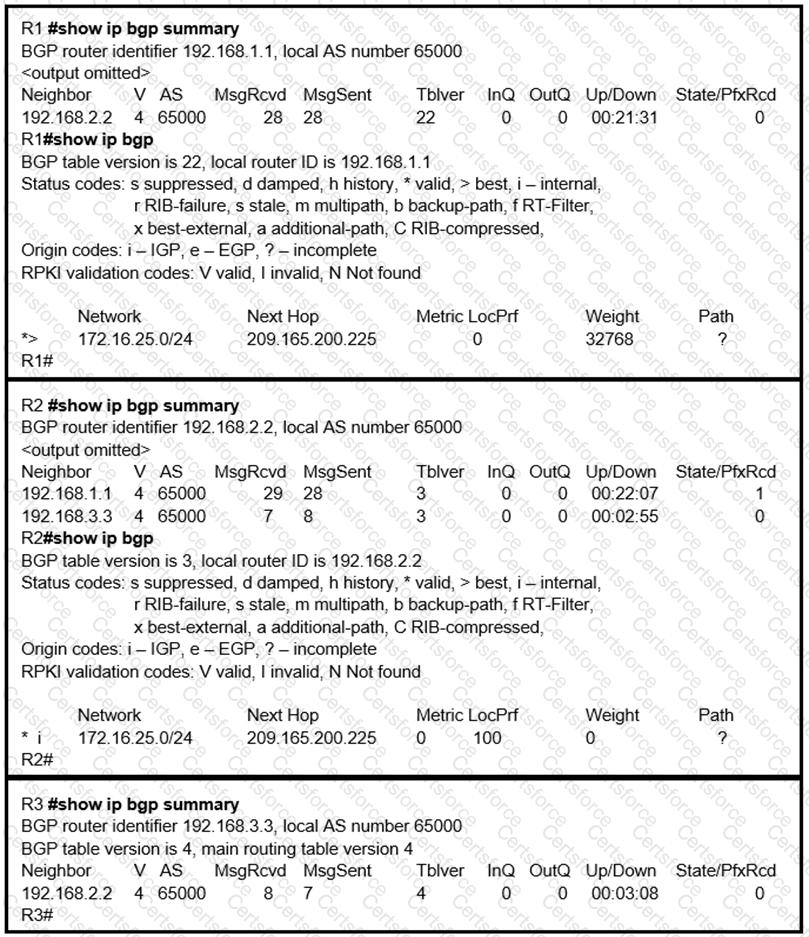
R2 is a route reflector, and R1 and R3 are route reflector clients. The route reflector learns the route to 172.16.25.0/24 from R1, but it does not advertise to R3. What is the reason the route is not advertised?

Options:

A.

R2 does not have a route to the next hop, so R2 does not advertise the prefix to other clients.


B.

Route reflector setup requires full IBGP mesh between the routers.


C.

In route reflector setup, only classful prefixes are advertised to other clients.


D.

In route reflector setups, prefixes are not advertised from one client to another.


Expert Solution
Questions # 77:

When provisioning a device in Cisco DNA Center, the engineer sees the error message “Cannot select the device. Not compatible with template”.

What is the reason for the error?

Options:

A.

The template has an incorrect configuration.


B.

The software version of the template is different from the software version of the device.


C.

The changes to the template were not committed.


D.

The tag that was used to filter the templates does not match the device tag.


Expert Solution
Questions # 78:

What is a function of IPv6 ND inspection?

Options:

A.

It learns and secures bindings for stateless autoconfiguration addresses in Layer 3 neighbor tables


B.

It learns and secures bindings for stateless autoconfiguration addresses in Layer 2 neighbor tables


C.

It learns and secures bindings for stateful autoconfiguration addresses in Layer 2 neighbor tables.


D.

It learns and secures bindings for stateful autoconfiguration addresses in Layer 3 neighbor tables.


Expert Solution
Questions # 79:

Refer to the exhibit.

Question # 79

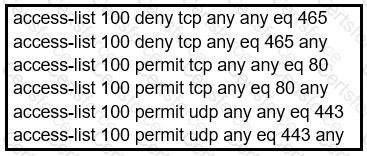
During troubleshooting it was discovered that the device is not reachable using a secure

web browser. What is needed to fix the problem?

Options:

A.

permit tcp port 443


B.

permit udp port 465


C.

permit tcp port 465


D.

permit tcp port 22


Expert Solution
Questions # 80:

Refer to the exhibit.

Question # 80

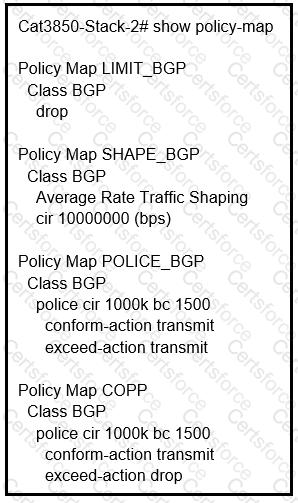
Which control plane policy limits BGP traffic that is destined to the CPU to 1 Mbps and

ignores BGP traffic that is sent at higher rate?

Options:

A.

policy-map SHAPE_BGP


B.

policy-map LIMIT_BGP


C.

policy-map POLICE_BGP


D.

policy-map COPP


Expert Solution
Questions # 81:

Refer to the exhibit.

Question # 81

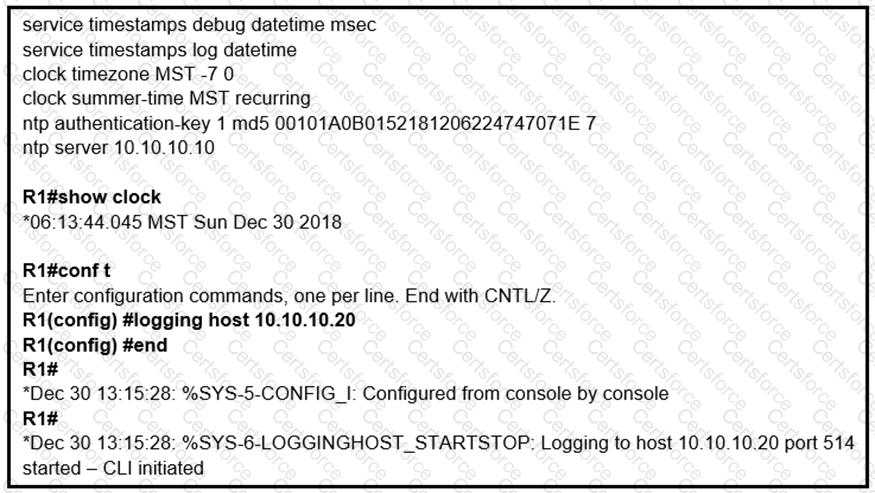
An administrator noticed that after a change was made on R1, the timestamps on the system logs did not match the clock. What is the reason for this error?

Options:

A.

An authentication error with the NTP server results in an incorrect timestamp.


B.

The keyword localtime is not defined on the timestamp service command.


C.

The NTP server is in a different time zone.


D.

The system clock is set incorrectly to summer-time hours.


Expert Solution
Questions # 82:

Refer to the exhibit.

Question # 82

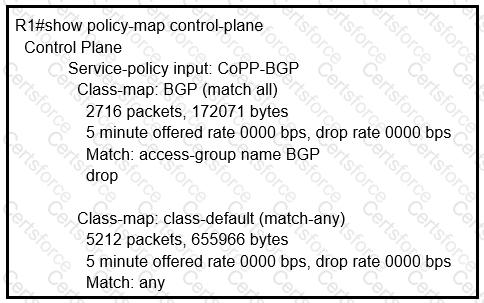
What is the result of applying this configuration?

Options:

A.

The router can form BGP neighborships with any other device.


B.

The router cannot form BGP neighborships with any other device.


C.

The router cannot form BGP neighborships with any device that is matched by the access list named “BGP”.


D.

The router can form BGP neighborships with any device that is matched by the access list named “BGP”.


Expert Solution
Questions # 83:

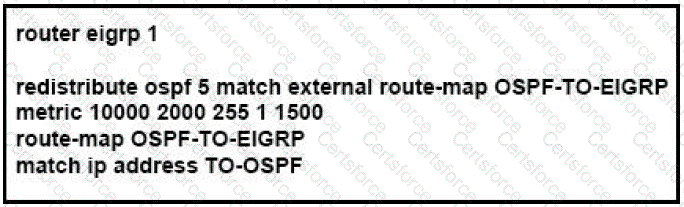
Refer to the exhibit.

Question # 83

Which routes from OSPF process 5 are redistributed into EIGRP?

Options:

A.

E1 and E2 subnets matching access list TO-OSPF


B.

E1 and E2 subnets matching prefix list TO-OSPF


C.

only E2 subnets matching access list TO-OSPF


D.

only E1 subnets matching prefix listTO-OS1


Expert Solution
Questions # 84:

What is an advantage of using BFD?

Options:

A.

It detects local link failure at layer 1 and updates routing table.


B.

It detects local link failure at layer 2 and updates routing protocols.


C.

It has sub-second failure detection for layer 1 and layer 3 problems.


D.

It has sub-second failure detection for layer 1 and layer 2 problems.


Expert Solution
Questions # 85:

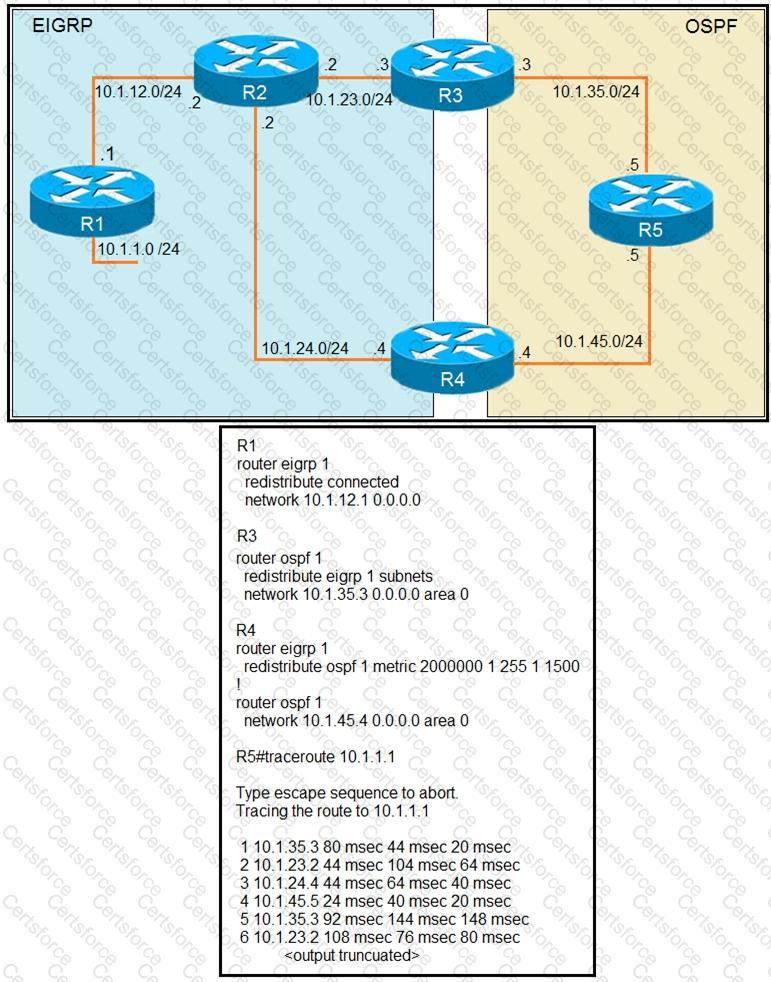
Refer to the exhibit.

Question # 85

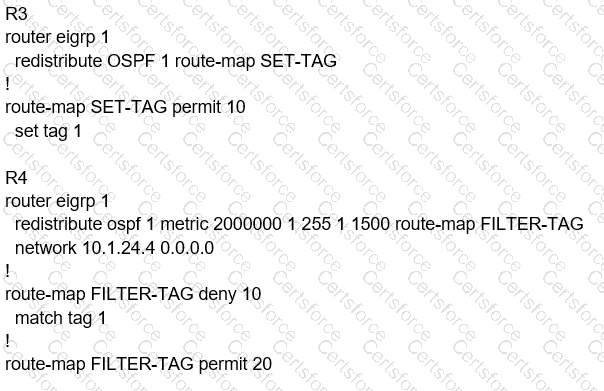
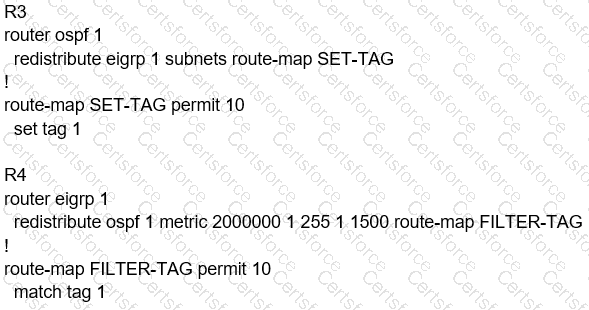
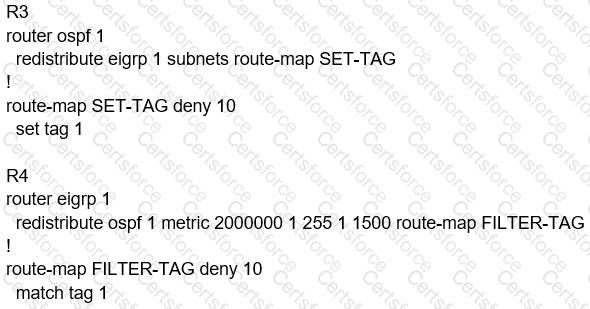
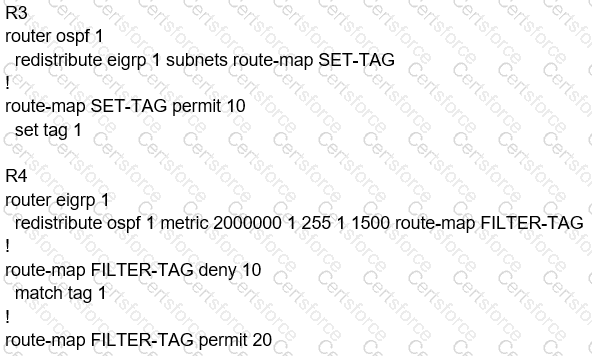
The output of the trace route from R5 shows a loop in the network. Which configuration

prevents this loop?

A)
Question # 85

B)

Question # 85

C)

Question # 85

D)

Question # 85

Options:

A.

Option A


B.

Option B


C.

Option C


D.

Option D


Expert Solution
Questions # 86:

Refer to the exhibit.

Question # 86

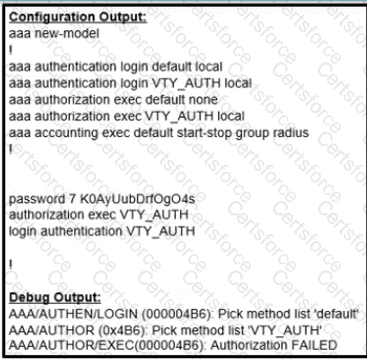
Which action resolves the failed authentication attempt to the router?

Options:

A.

Configure aaa authorization login command on line vty 0 4


B.

Configure aaa authorization login command on line console 0


C.

Configure aaa authorization console global command


D.

Configure aaa authorization console command on line vty 0 4


Expert Solution
Questions # 87:

Refer to Exhibit.

Question # 87

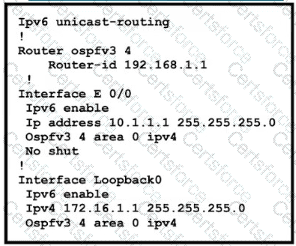
The network administrator configured the branch router for IPv6 on the E0/0 interface. The neighboring router is fully configured to meet requirements, but the neighbor relationship is not coming up. Which action fixes the problem on the branch router to bring the IPv6 neighbors up?

Options:

A.

Enable the IPv4 address family under the router ospfv3 4 process by using the address-family ipv4 unicast command


B.

Disable IPv6 on the E0/0 interface using the no ipv6 enable command


C.

Enable the IPv4 address family under the E0/0 interface by using the address-family ipv4 unicast command


D.

Disable OSPF for IPv4 using the no ospfv3 4 area 0 ipv4 command under the E0/0 interface


Expert Solution
Questions # 88:

Exhibit:

Question # 88

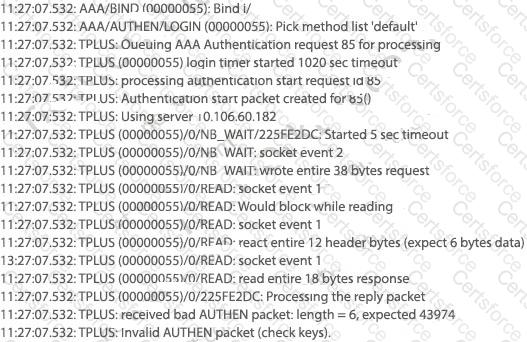
Which action resolves the authentication problem?
Options:

A.

Configure the user name on the TACACS+ server


B.

Configure the UDP port 1812 to be allowed on the TACACS+ server


C.

Configure the TCP port 49 to be reachable by the router


D.

Configure the same password between the TACACS+ server and router.


Expert Solution
Questions # 89:

Question # 89

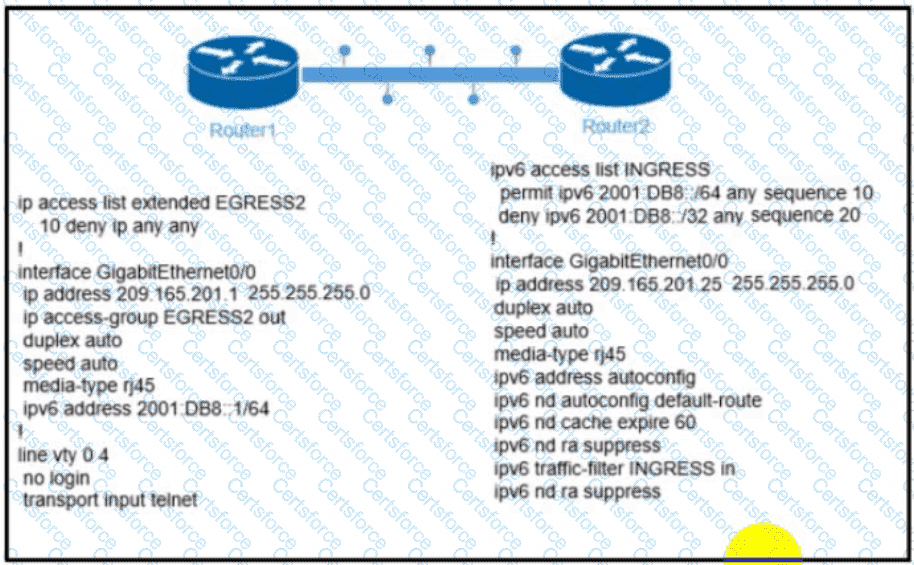
Refer to the exhibit. The engineer configured and connected Router2 to Router1. The link came up but could not establish a Telnet connection to Router1 IPv6 address of 2001:DB8::1. Which configuration allows Router2 to establish a Telnet connection to Router1?

Options:

A.

jpv6 unicast-routing


B.

permit ICMPv6 on access list INGRESS for Router2 to obtain IPv6 address


C.

permit ip any any on access list EGRESS2 on Router1


D.

IPv6 address on GigabitEthernet0/0


Expert Solution
Questions # 90:

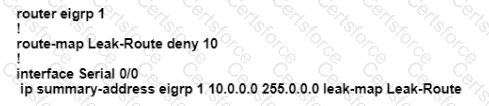
An engineer configured a leak-map command to summarize EIGRP routes and advertise specifically loopback 0 with an IP of 10.1.1.1.255.255.255.252 along with the summary route. After finishing configuration, the customer complained not receiving summary route with specific loopback address. Which two configurations will fix it? (Choose two.)

Question # 90

Options:

A.

Configure access-list 1 permit 10.1.1.0.0.0.0.3.


B.

Configure access-list 1 permit 10.1.1.1.0.0.0.252.


C.

Configure access-list 1 and match under route-map Leak-Route.


D.

Configure route-map Leak-Route permit 10 and match access-list 1.


E.

Configure route-map Leak-Route permit 20.


Expert Solution
Viewing page 6 out of 13 pages
Viewing questions 76-90 out of questions