Summer Certification Special Limited Time 70% Discount Offer - Ends in 0d 00h 00m 00s - Coupon code: force70

Pass the Cisco CCNP Enterprise 300-410 Questions and answers with CertsForce

Viewing page 1 out of 13 pages
Viewing questions 1-15 out of questions
Questions # 1:

Question # 1

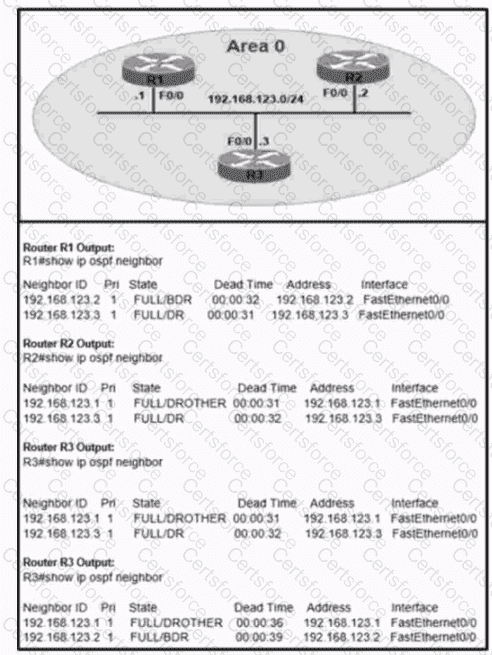
Refer to the exhibit. An administrator wanted to make R1 always elected as DR. R2 as BDR. and R3 as DROTHER but could not achieve the desired results. Which two configurations resolve the issue? (Choose two.)

Options:

A.

On the R1 FO/0 interface, configure OSPF priority to 255.


B.

On the R2 FO/0 interface, configure OSPF priority to 201.


C.

On the R1 F0/0 interface, configure OSPF priority to 202.


D.

On the R3 FO ' O interface, configure OSPF priority to 201.


E.

On the R2 FO/0 interface, configure OSPF priority to 200.


Expert Solution
Questions # 2:

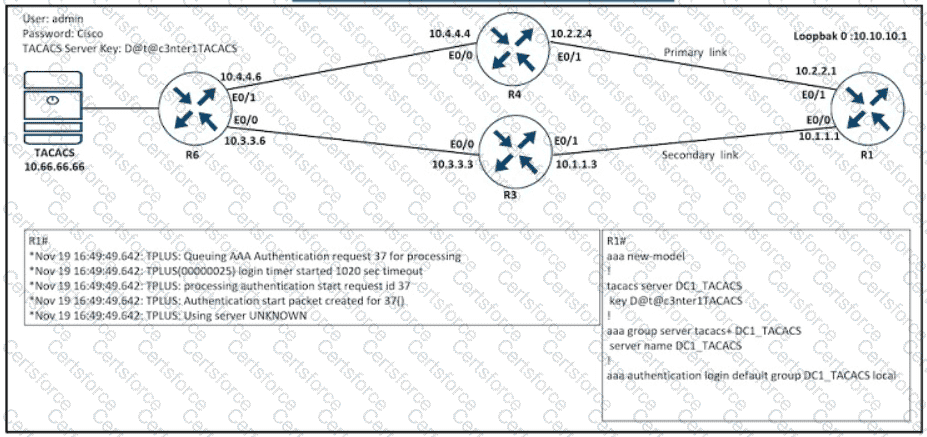
Refer to the exhibit.

Question # 2

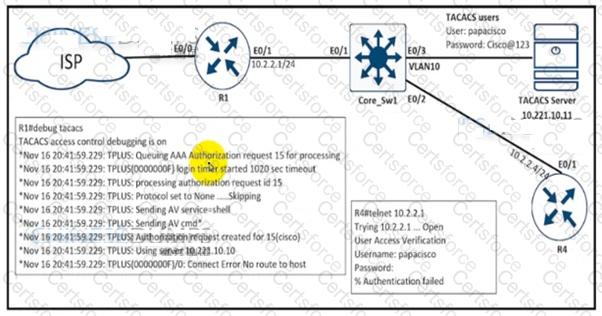
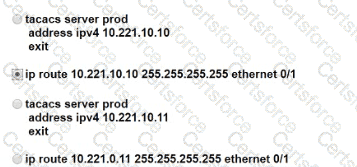
Refer to the exhibit R1 cannot authenticate via TACACS Which configuration resolves the issue?
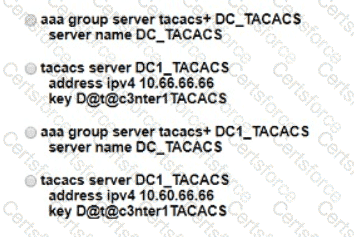
Question # 2

Options:

A.

Option A


B.

Option B


C.

Option C


D.

Option D


Expert Solution
Questions # 3:

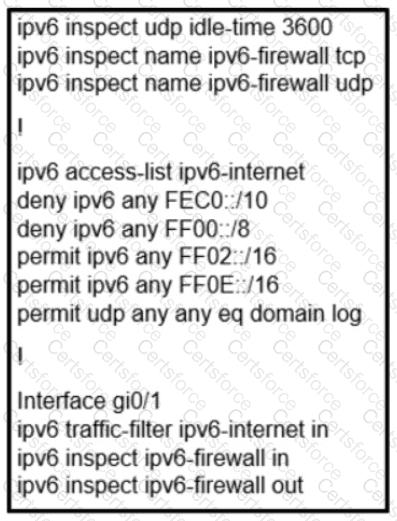
Refer to the exhibit.

Question # 3

A network administrator configured name resolution for IPv6 traffic to be allowed through an inbound access list. After the access list is applied to resolve the issue, name resolution still did not work. Which action does the network administrator take to resolve the name resolution problem?

Options:

A.

Remove ipv6 inspect ipv6-firewall in from interface gi0/1


B.

Add permit udp any eq domain any log in the access list.


C.

inspect ipv6 inspect name ipv6-firewall udp 53 in global config.


D.

Add permit any eq domain 53 any log in the access list.


Expert Solution
Questions # 4:

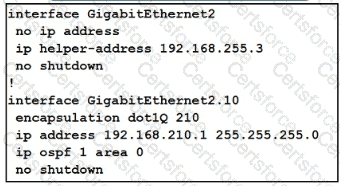
Refer to the exhibit.

Question # 4

With the partial configuration of a router-on-a-stick. Clients in VLAN 10 on Gi2 cannot obtain IP configuration from the central DHP server is reachable by a successful ping from the route. Which action resolves the issue?

Options:

A.

Configure the ip/ip/dhcp pool f and network 192.168..210.0.255.255/0 commands.


B.

Configure the ip header-address 192-168.265.3 command on the Gi2 10 subinterface.


C.

Configure a valid IP address on the Gi2 interface so that DHCP requests can be forwarded.


D.

Configure the Ip dhcp excluded-address 192.168.255.3 command on the Gi1.10 subinterface.


Expert Solution
Questions # 5:

The network administrator configured the router for Control Plane Policing to limit OSPF traffic to be

policed to 1 Mbps. Any traffic that exceeds this limit must also be allowed at this point for traffic

analysis. The router configuration is:

access-list 100 permit ospf any any

!

class-map CM-OSPF

match access-group 100

!

policy-map PM-COPP

class CM-OSPF

police 1000000 conform-action transmit

!

control-plane

service-policy output PM-COPP

The Control Plane Policing failed to monitor and police OSPF traffic. Which configuration resolves this

issue?
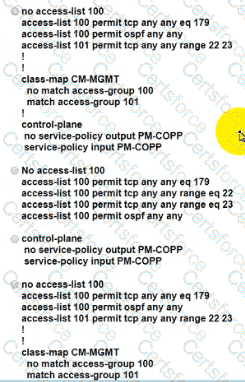
Question # 5

Options:

A.

Option A


B.

Option B


C.

Option C


D.

Option D


Expert Solution
Questions # 6:

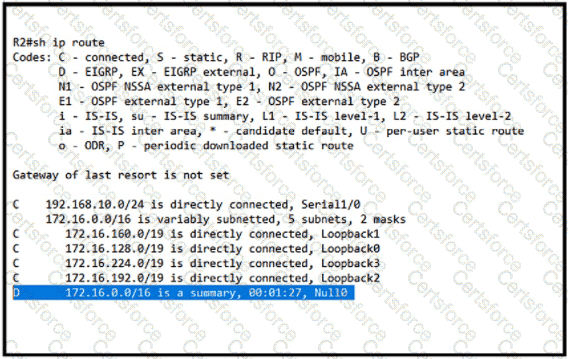
Refer to the exhibit.

Question # 6

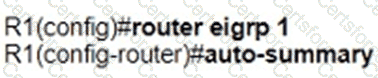
An engineer must configure EIGRP between R1 and R2 with no summary route. Which configuration resolves the issue?

A)

Question # 6

B)

Question # 6

C)

Question # 6

D)

Question # 6

Options:

A.

Option A


B.

Option B


C.

Option C


D.

Option D


Expert Solution
Questions # 7:

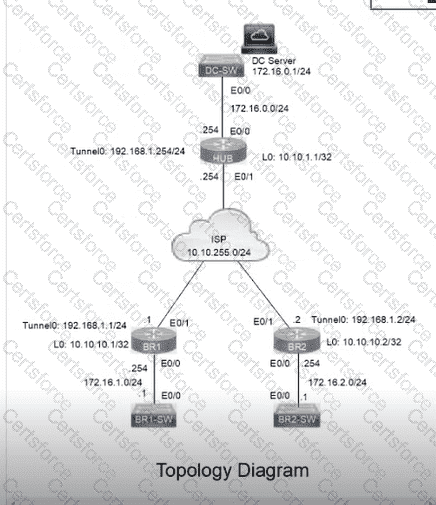
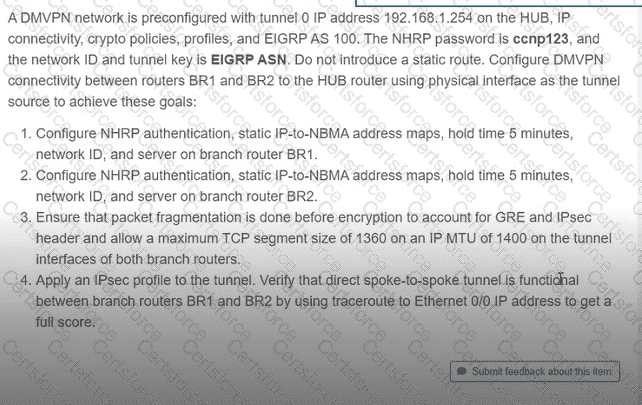
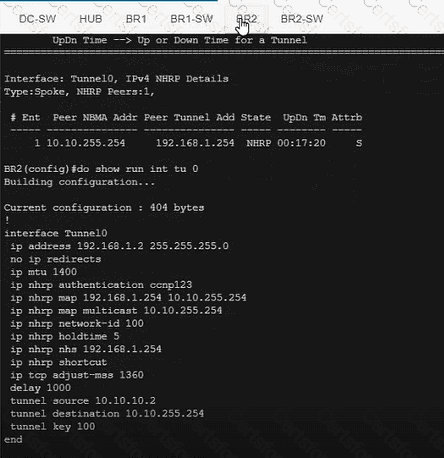
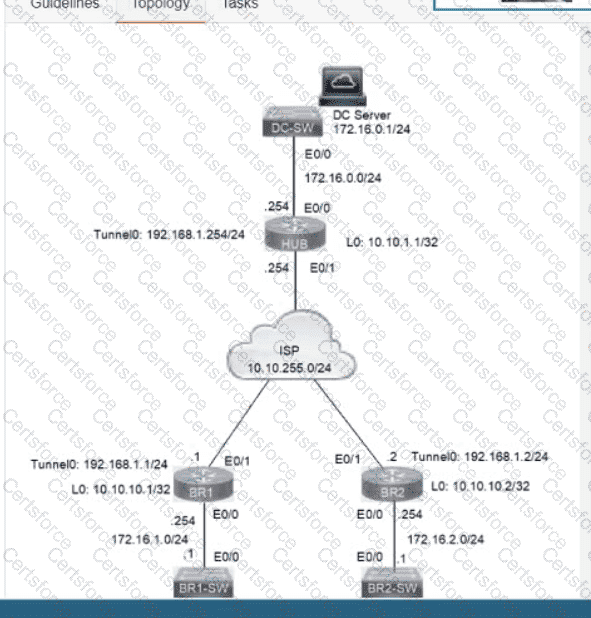
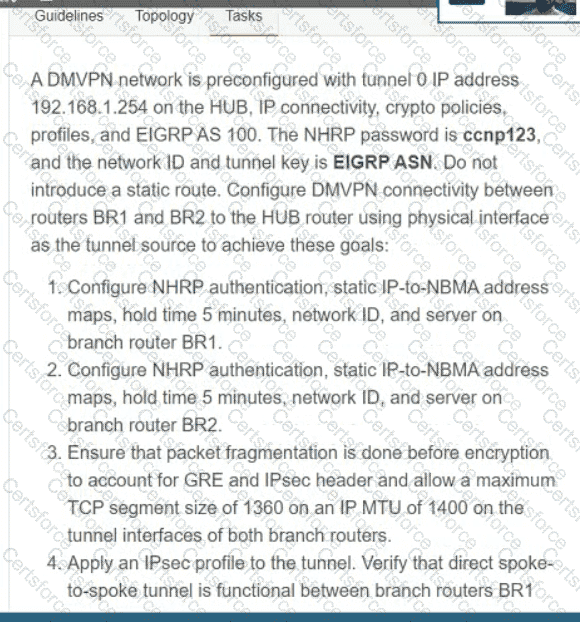
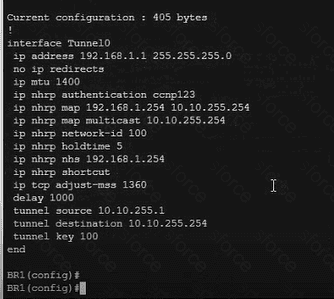
A DMVPN network is preconfigured with tunnel 0 IP address 192.168.1.254 on the HUB, IP connectivity, crypto policies, profiles, and EIGRP AS 100. The NHRP password is ccnp123, and the network ID and tunnel key is EIGRP ASN Do not introduce a static route. Configure DMVPN connectivity between routers BR1 and BR2 to the HUB router using physical interface as the tunnel source to achieve these goals:
Question # 7

Question # 7

Question # 7Question # 7


Expert Solution
Questions # 8:

Question # 8

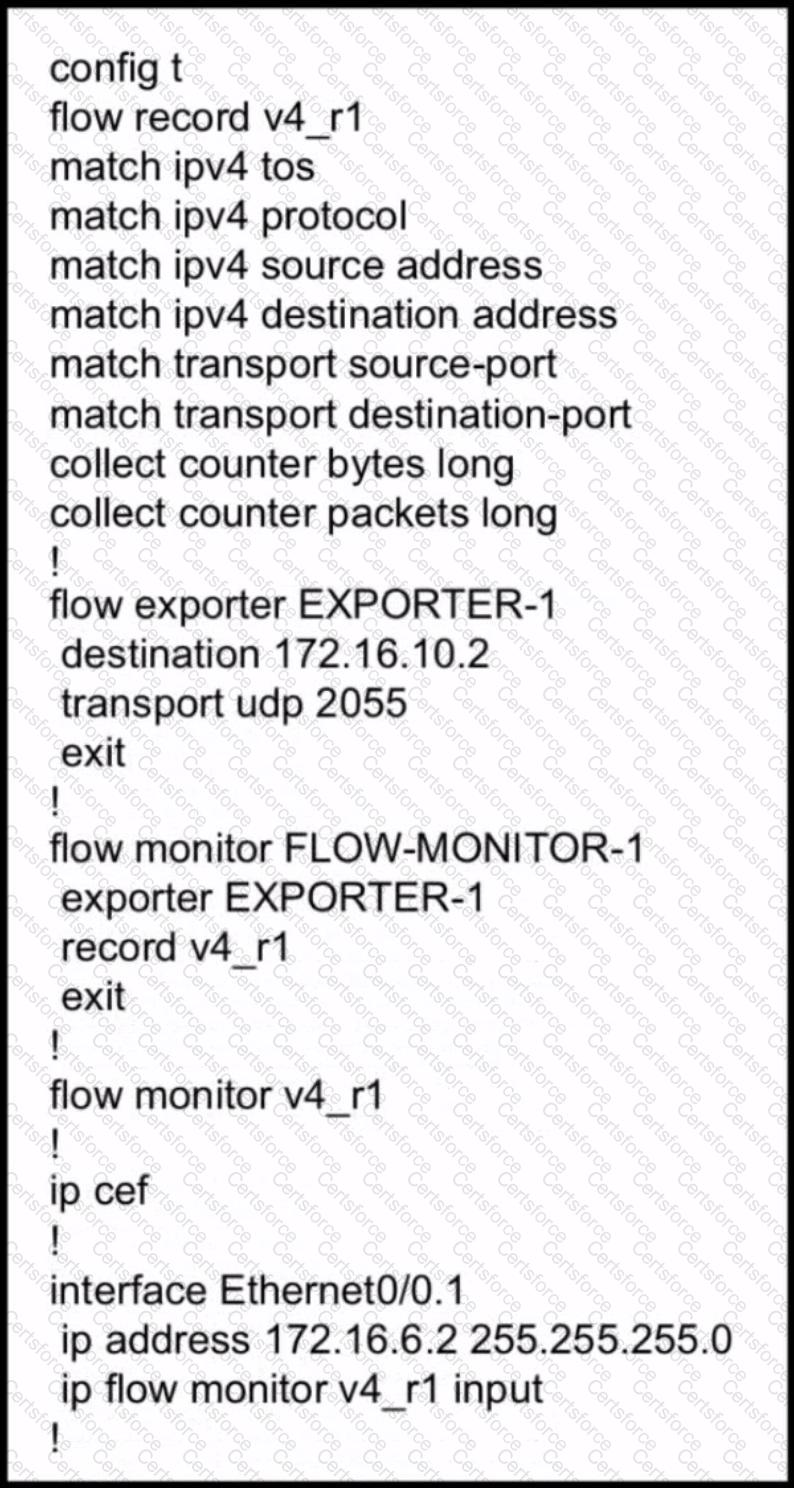
Refer to the exhibit. The remote server is failing to receive the NetFlow data Which action resolves the issue?

Options:

A.

Modify the flow transport command transport udp 2055 to move under flow monitor profile.


B.

Modify the interlace command to Ip flow monitor FLOW-MONITOR-1 Input.


C.

Modify the udp port under flow exporter profile to Ip transport udp 4739.


D.

Modify the flow record command record v4_r1 to move under flow exporter profile.


Expert Solution
Questions # 9:

What are two functions of LDP? (Choose two.)

Options:

A.

It is defined in RFC 3038 and 3039.


B.

It requires MPLS Traffic Engineering.


C.

It advertises labels per Forwarding Equivalence Class.


D.

It must use Resource Reservation Protocol.


E.

It uses Forwarding Equivalence Class


Expert Solution
Questions # 10:

Which attribute eliminates LFAs that belong to protected paths in situations where links in a network are connected through a common fiber?

Options:

A.

shared risk link group-disjoint


B.

linecard-disjoint


C.

lowest-repair-path-metric


D.

interface-disjoint


Expert Solution
Questions # 11:

Which feature is required for IPv6 Source Guard to block traffic arriving on the server interface from unknown sources?

Options:

A.

Dynamic ARP Inspection


B.

IPv6 RA Guard


C.

IPv6 ND Inspection


D.

DHCPv6 Guard


Expert Solution
Questions # 12:

Refer to the exhibit.

Question # 12

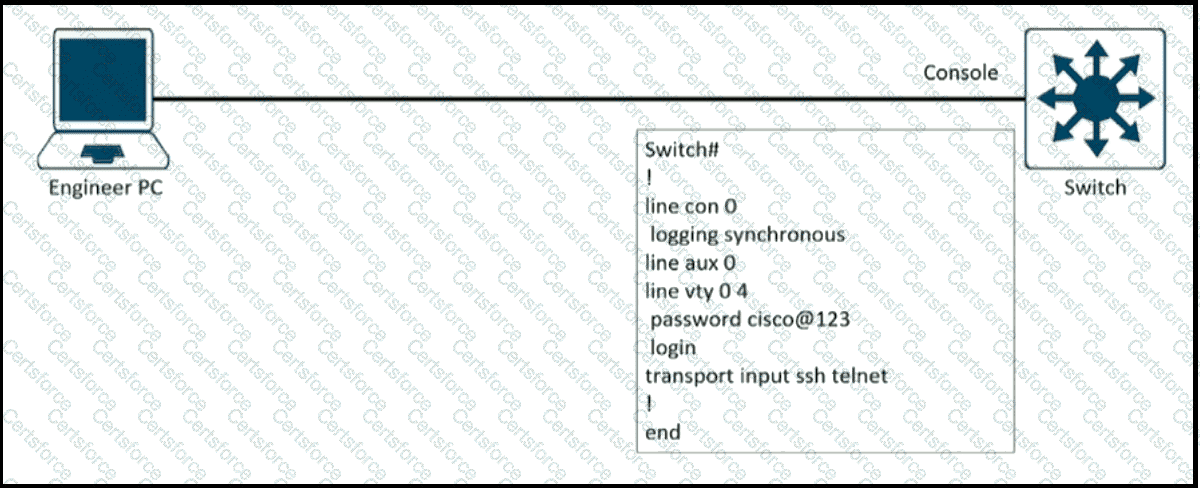
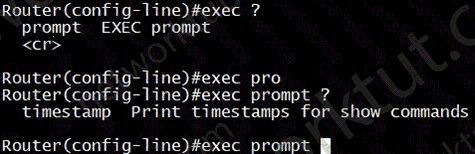
An engineer must block access to the console ports for all corporate remote Cisco devices based on the recent corporate security policy but the security team stilt can connect through the console port. Which configuration on the console port resolves the issue?

Options:

A.

transport input telnet


B.

login and password


C.

no exec


D.

exec 0.0


Expert Solution
Questions # 13:

Refer to the exhibit.

Question # 13

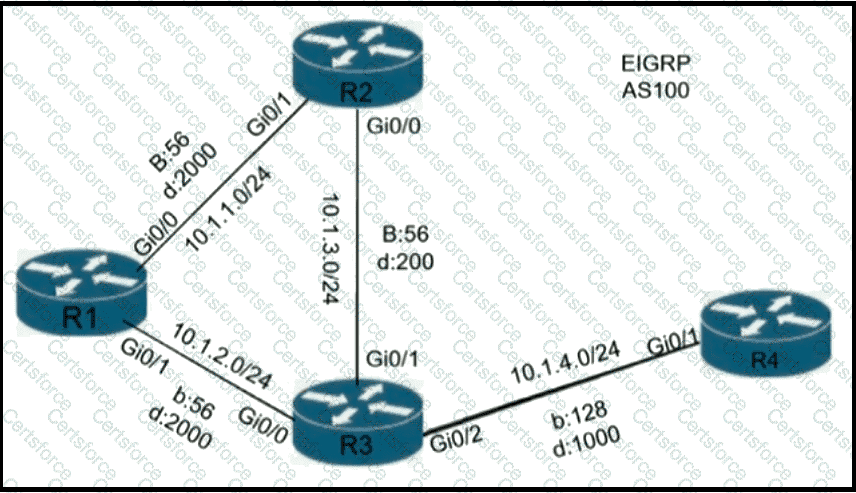
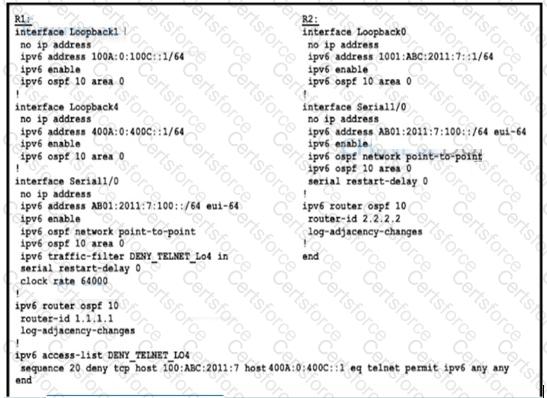
A loop occurs between R1, R2, and R3 while EIGRP is run with poison reverse enabled. Which action prevents the loop between R1, R2, and R3?
Options:

A.

Configure route tagging


B.

Enable split horizon


C.

Configure R2 as stub receive-only


D.

Configure route filtering


Expert Solution
Questions # 14:

Question # 14

Question # 14

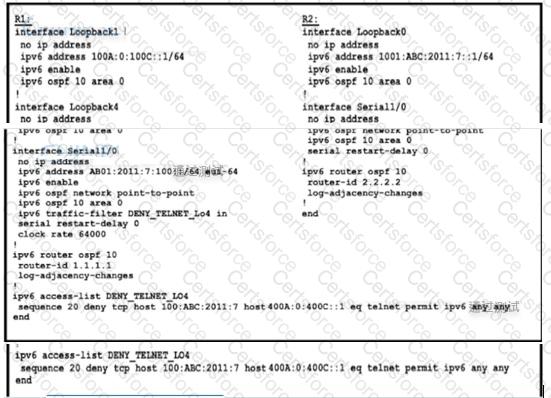
Refer to the exhibit. An engineer implemented an access list on R1 to allow anyone to Telnet except R2 Loopback0 to R1 Loopback4 How must sequence 20 be replaced on the R1 access list to resolve the issue?

Options:

A.

sequence 20 permit tcp host 1001 ABC:2011:7:: 1 host 400A:0:400C::1 eq telnet


B.

sequence 20 deny tcp host 400A:0:400C::1 host 1001 :ABC:2011:7::1 eq telnet


C.

sequence 20 deny tcp host 1001:ABC:2011:7::1 host 400A:0:400C::1 eq telnet


D.

sequence 20 permit tcp host 400A:0:400C::1 host 1001ABC:2011:7::1 eq telnet


Expert Solution
Questions # 15:

Refer to the exhibit.

Question # 15

An engineer is trying to connect to R1 via Telnet with no success. Which configuration resolves the issue?
Question # 15

Options:

A.

Option A


B.

Option B


C.

Option C


D.

Option D


Expert Solution
Viewing page 1 out of 13 pages
Viewing questions 1-15 out of questions