
A company implements a data mesh that has a central governance account. The company needs to catalog all data in the governance account. The governance account uses AWS Lake Formation to centrally share data and grant access permissions.
The company has created a new data product that includes a group of Amazon Redshift Serverless tables. A data engineer needs to share the data product with a marketing team. The marketing team must have access to only a subset of columns. The data engineer needs to share the same data product with a compliance team. The compliance team must have access to a different subset of columns than the marketing team needs access to.
Which combination of steps should the data engineer take to meet these requirements? (Select TWO.)
A data engineer must orchestrate a series of Amazon Athena queries that will run every day. Each query can run for more than 15 minutes.
Which combination of steps will meet these requirements MOST cost-effectively? (Choose two.)
An ecommerce company wants to use AWS to migrate data pipelines from an on-premises environment into the AWS Cloud. The company currently uses a third-party too in the on-premises environment to orchestrate data ingestion processes.
The company wants a migration solution that does not require the company to manage servers. The solution must be able to orchestrate Python and Bash scripts. The solution must not require the company to refactor any code.
Which solution will meet these requirements with the LEAST operational overhead?
A company receives .csv files that contain physical address data. The data is in columns that have the following names: Door_No, Street_Name, City, and Zip_Code. The company wants to create a single column to store these values in the following format:
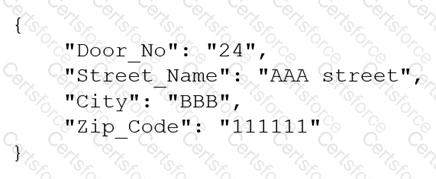
Which solution will meet this requirement with the LEAST coding effort?
A sales company uses AWS Glue ETL to collect, process, and ingest data into an Amazon S3 bucket. The AWS Glue pipeline creates a new file in the S3 bucket every hour. File sizes vary from 200 KB to 300 KB. The company wants to build a sales prediction model by using data from the previous 5 years. The historic data includes 44,000 files.
The company builds a second AWS Glue ETL pipeline by using the smallest worker type. The second pipeline retrieves the historic files from the S3 bucket and processes the files for downstream analysis. The company notices significant performance issues with the second ETL pipeline.
The company needs to improve the performance of the second pipeline.
Which solution will meet this requirement MOST cost-effectively?
A company stores logs in an Amazon S3 bucket. When a data engineer attempts to access several log files, the data engineer discovers that some files have been unintentionally deleted.
The data engineer needs a solution that will prevent unintentional file deletion in the future.
Which solution will meet this requirement with the LEAST operational overhead?
A company is uploading log files from on-premises servers to an Amazon S3 bucket. The company needs to validate that the logs from the on-premises servers are the same as the logs that are stored in the S3 bucket.
Which solution will meet this requirement?
A company stores time-series data that is collected from streaming services in an Amazon S3 bucket. The company must ensure that only workloads that are deployed within the company ' s VPC can access the data.
Which solution will meet this requirement?
A company is building an analytics solution. The solution uses Amazon S3 for data lake storage and Amazon Redshift for a data warehouse. The company wants to use Amazon Redshift Spectrum to query the data that is in Amazon S3.
Which actions will provide the FASTEST queries? (Choose two.)
A manufacturing company wants to collect data from sensors. A data engineer needs to implement a solution that ingests sensor data in near real time.
The solution must store the data to a persistent data store. The solution must store the data in nested JSON format. The company must have the ability to query from the data store with a latency of less than 10 milliseconds.
Which solution will meet these requirements with the LEAST operational overhead?
