Month End Sale Limited Time 70% Discount Offer - Ends in 0d 00h 00m 00s - Coupon code: simple70

Pass the VMware VCAP-VKS 3V0-24.25 Questions and answers with CertsForce

Viewing page 2 out of 2 pages
Viewing questions 11-20 out of questions
Questions # 11:

What three components run in a VMware vSphere Kubernetes Service (VKS) cluster? (Choose three.)

Options:

A.

Cloud Provider Implementation


B.

Container Network Implementation


C.

Cloud Provider Interface


D.

Container Storage Interface


E.

Cloud Storage Implementation


F.

Container Network Interface


Expert Solution
Questions # 12:

An administrator is deploying vSphere Kubernetes Service (VKS) on a VMware Cloud Foundation workload domain to support a new internal AI and data analytics platform. The environment must host both virtual machine (VM) applications and containerized workloads while maintaining a unified networking and security model through NSX. The design documentation outlines the requirements for the Supervisor infrastructure components.

What three components form the foundation of a VMware vSphere Kubernetes Service (VKS) Supervisor deployment? (Choose three.)

Options:

A.

Cluster API


B.

NSX Manager virtual machine


C.

Supervisor control plane virtual machine


D.

vCenter Virtual Distributed Switch


E.

Virtual Machine Service


F.

NSX Advanced Load Balancer Controller virtual machine


Expert Solution
Questions # 13:

An administrator is tasked with installingIstio Service Meshfor VMware vSphere Kubernetes Service (VKS). Which command installs Istio?

Options:

A.

Use curl to download and install Istio.


B.

Use vcf package install to install the Istio package.


C.

Use kubectl istioctl install.


D.

Use docker build istioctl.


Expert Solution
Questions # 14:

What three controllers maintain the lifecycle of VMware vSphere Kubernetes Service (VKS) clusters? (Choose three.)

Options:

A.

Container Network Interface


B.

Virtual Machine Service


C.

Cloud Provider Plug-in


D.

Container Storage Interface


E.

Cluster API


Expert Solution
Questions # 15:

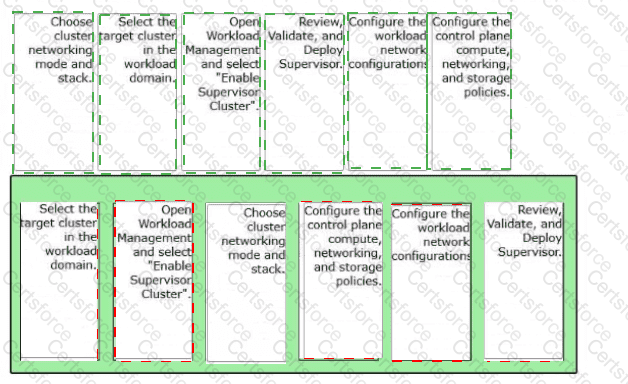
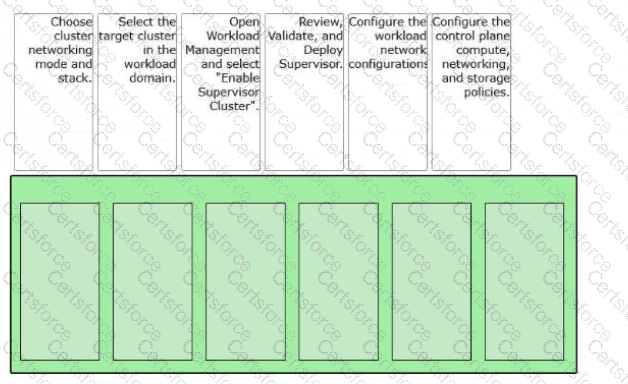
An administrator is tasked with enabling a Supervisor cluster in VMware Cloud Foundation (VCF).

Arrange the steps below In the correct order to complete the process of enabling a Supervisor In the environment.
Question # 15


Expert Solution
Questions # 16:

The DevOps engineer deployed a new application to a vSphere Kubernetes Service (VKS) cluster in a vSphere Namespace and then determined that a newer Kubernetes version was required. The vSphere administrator verified compatibility between the Supervisor and all running VKS clusters and successfully updated the vSphere Supervisor to the latest version. After the Supervisor update, the DevOps engineer still could not get the application to work.

What caused the application to fail?

Options:

A.

The vSphere administrator updated the Supervisor control plane.


B.

The vSphere administrator failed to complete all the pre-checks before the update.


C.

The vSphere administrator did everything correctly and the DevOps engineer deployed the application incorrectly.


D.

The vSphere administrator pulled the wrong version of the Supervisor.


Expert Solution
Questions # 17:

A remote site has a requirement for VMware vSphere Kubernetes Service (VKS). The environment has minimal storage available. Which action ensures the Content Library does not consume all available space on the datastore?

Options:

A.

Select theDownload contentoption and chooseWhen needed.


B.

Use a local datastore on one of the ESXi hosts.


C.

Create a scheduled task to download the images that are needed.


D.

Select theDownload contentoption and chooseImmediately.


Expert Solution
Questions # 18:

An administrator must create amulti-zone vSphere Supervisordeployment in a VMware Cloud Foundation (VCF) environment. What is the primary purpose of this configuration?

Options:

A.

To create isolated security domains using NSX micro-segmentation.


B.

To enable cross-site vSAN stretched clusters for data replication between data centers.


C.

To provide high availability for the Supervisor Cluster and vSphere Kubernetes clusters.


D.

To simplify the management of network pools and IP address ranges.


Expert Solution
Viewing page 2 out of 2 pages
Viewing questions 11-20 out of questions