A cache drive failed on one of the vSAN OSA nodes in the cluster.
When the drive failed, vSAN started a resync to ensure the health of the data, and all objects are showing a healthy and compliant state.
The vSAN administrator needs to replace the failed cache drive.
Which set of steps should the vSAN administrator take?
An administrator is tasked with deploying a vSAN ESA Stretched Cluster for a VMware Cloud Foundation (VCF) workload domain. The stretched cluster must meet the following requirements:
• Ensure the cluster supports a storage policy with a secondary level of resilience of FTT=2 using RAID-6 erasure coding.
• Allow vSAN to regain its prescribed level of resilience in the event of a sustained host outage.
What is the minimum number of hosts required in each availability zone?
An administrator needs to quickly test a possibly destructive change to a Virtual Machine (VM) in production. The VM is currently protected by vSAN Data Protection.
Which feature of vSAN Data Protection can be leveraged to achieve this objective?
An administrator just built a new workload domain including a vSAN ESA cluster. The architecture design included the use of memory tiering and a specific smaller NVMe device has been installed in each ESX host for this purpose.
When looking in the vSphere UI, the administrator notices that the device intended to be used for memory tiering has been claimed by vSAN.
What action should be taken on each host to achieve the desired configuration?
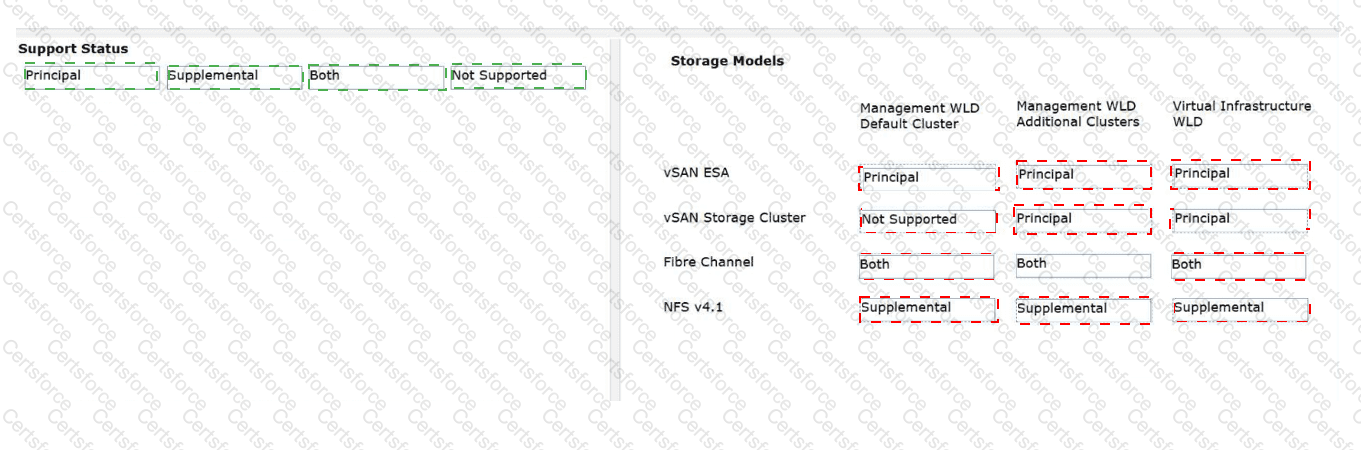
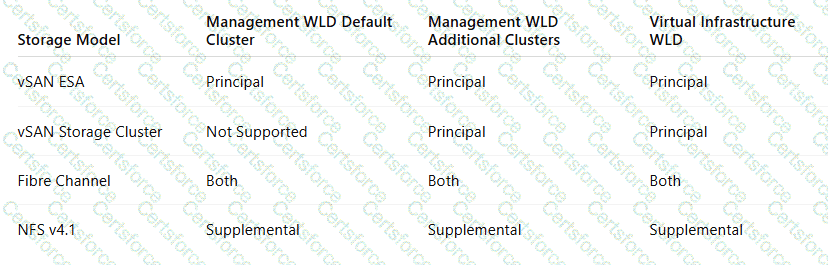
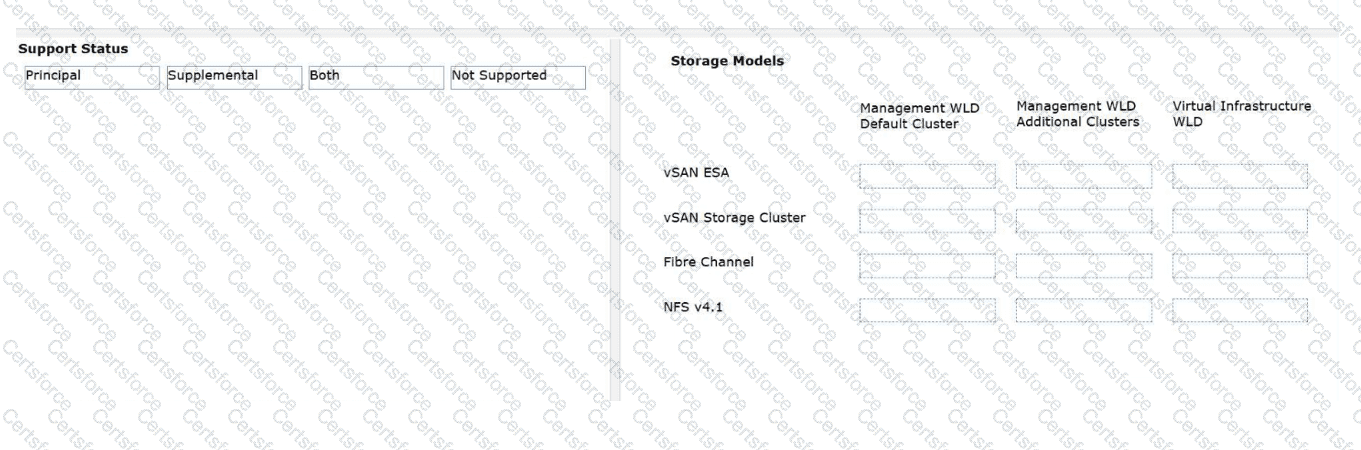
An architect is describing the for a client which storage platforms are supported in which types of Domains for automated installation in VMware Cloud Foundation (VCF) Private Clouds.
Drag and drop the Support Status of each storage model on the left to each type of Workload Domain on the right.
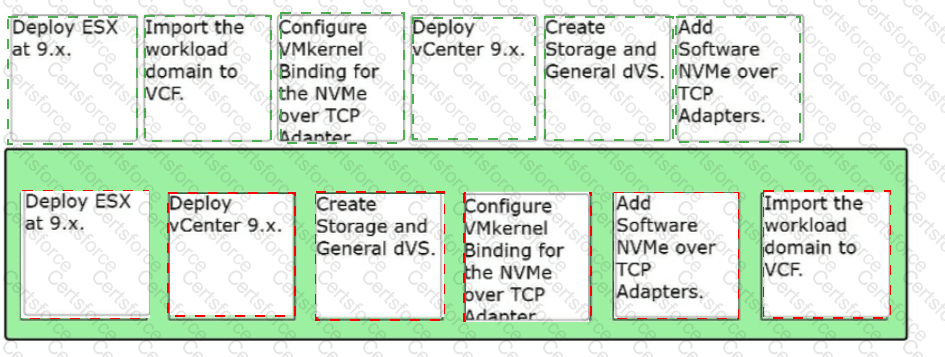
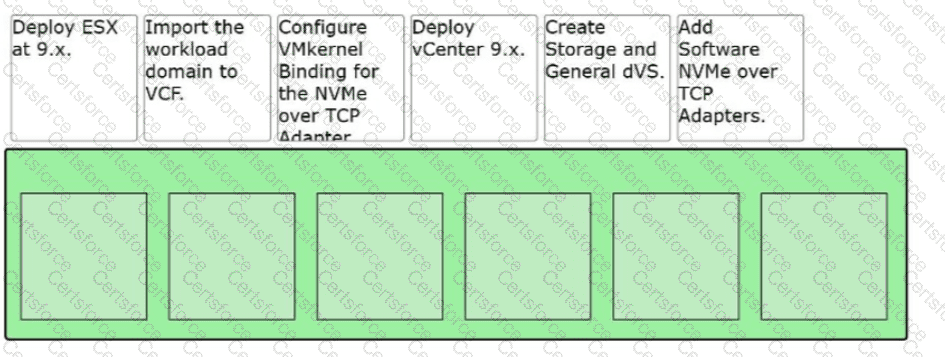
A VMware Cloud Foundation (VCF) Workload Domain is requested to be deployed with the following information:
. 6 blade style hosts with no local storage beyond the operating system.
. 4 25 Gb networking cards installed in each host.
. A 30 TB external array configured to support NVMe/TCP only.
. 2 dVS switches, one configured for storage isolation and one for all other traffic.
. NVMe/TCP multi-path configuration required.
. Existing Management Domain is deployed with VCF.
Place the steps for importing VCF on to this configuration.
An administrator has been tasked with suggesting storage models for a new VMware Cloud Foundation (VCF) Private Cloud with the following characteristics:
• Single VCF Instance with a single Workload Domain.
• The VCF Management Workload Domain will consist of a single cluster that uses a highly scalable, integrated storage solution that does not require additional management software or hardware.
• The VCF Workload Domain consists of a single Cluster that requires a multiple-tier storage solution consisting of:
A highly scalable, policy-based storage solution for critical application workloads.
A file-based storage solution that can scale independently of the cluster for workloads with large data requirements. Which three storage models should the administrator recommend? (Choose three.)
A firm is migrating to VMware Cloud Foundation (VCF) and will leverage its existing enterprise Fibre Channel SAN for workload domain storage.
Their priorities include seamless integration into VCF, automated lifecycle management via VCF Operations, consistent VM-level performance control, and alignment with best practices for large-scale VI environments. Management does not require vSAN, and operational simplicity is critical.
Which design meets all of the specified requirements?
An administrator is preparing to enable vSAN Data-at-Rest Encryption and must verify that the identity and key provider prerequisites are met before proceeding with the configuration.
Which two requirements must be met? (Choose two.)
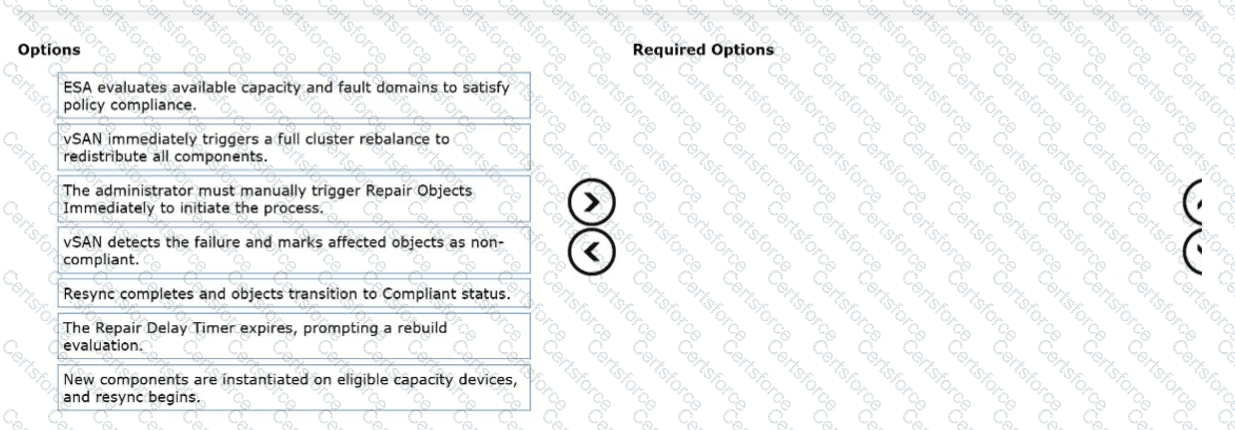
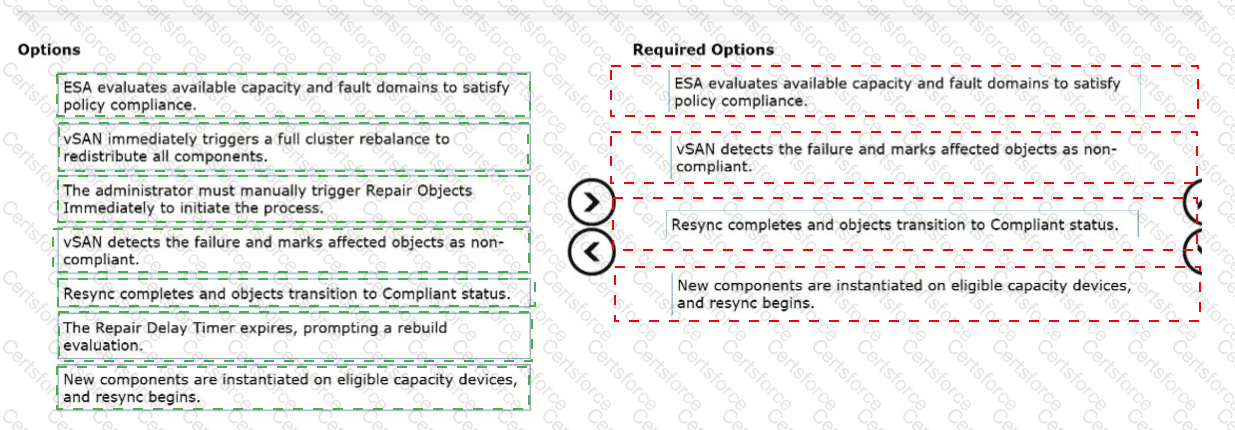
A vSAN ESA cluster experienced a host NVMe failure, causing several objects to become non-compliant.
Select the steps vSAN ESA follows to detect, evaluate and repair the non-compliant objects.
Drag and drop the four correct options from the Options list on the left and place them into the Required Options on the right in any order. (Choose four.)