An administrator is responsible for managing a VMware Cloud Foundation (VCF) Private Cloud.
The following information has been provided about the environment:
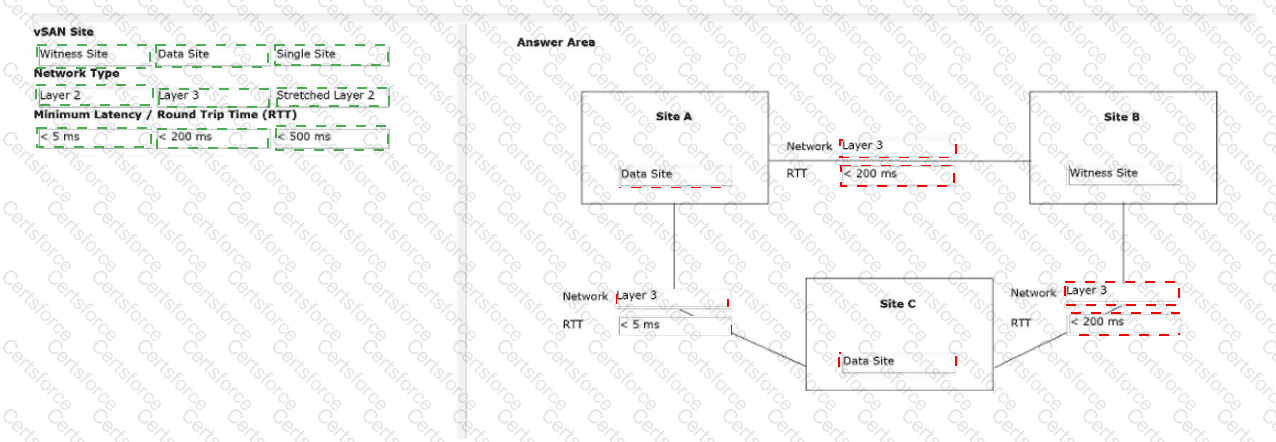
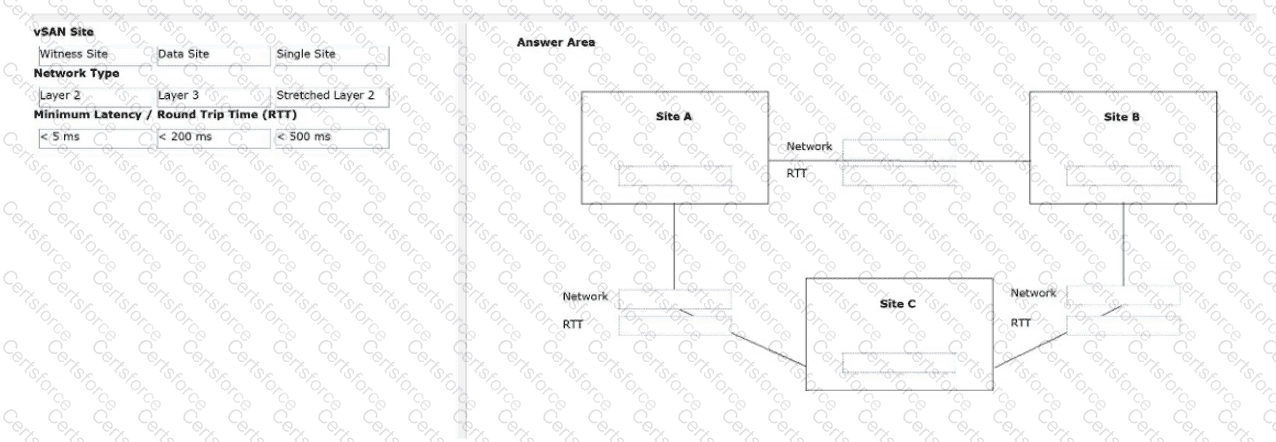
• There are 3 customer datacenters, Site A, Site B and Site C.
• The datacenter at Site A runs all Production Services.
• The datacenter at Site B has reached capacity and there is no space for additional physical hardware.
• The datacenter at Site C has been commissioned to replace Site B, because there is more rack space and power capacity to cater for future demand.
The administrator has been tasked with identifying the networking requirements for a new VMware vSAN Stretched Cluster with the following requirements:
• The solution will deploy a total of 10 new ESX host servers to create a VMware vSAN Stretched Cluster.
• The solution must deploy appropriate networking to ensure minimal disruption from issues with Spanning Tree Protocol (STP).
Drag and drop the correct vSAN Site Type, Networking Type and Round Trip Latency (RTT) within the boxes provided to complete the high-level diagram.
An administrator is using an external Key Management Server (KMS) with a vSAN Data-at-Rest Encryption cluster.
The KMS becomes temporarily unavailable.
What happens if a host without a Trusted Platform Module in the cluster is rebooted during this outage?
An architect is presented with the following requirements for the storage solution in a VMware Cloud Foundation (VCF) Workload Domain.
The solution must:
• Allow for rapid recovery in case of an availability zone failure.
• Provide an extremely high amount of IOPS to all applications.
• Allow for additional storage to be added as application needs grow.
• Provide the lowest latency possible for configured applications.
• Provide recovery in case of datastore failure.
• Encrypt data in transit and at rest.
What two vSAN advanced technologies must be deployed to meet these requirements? (Choose two.)
As part of standard operating procedures, when an administrator leaves the organization, a shallow rekey operation must be performed on a vSAN ESA cluster with vSAN Data-at-Rest Encryption enabled.
Which key is rotated during a shallow rekey operation?
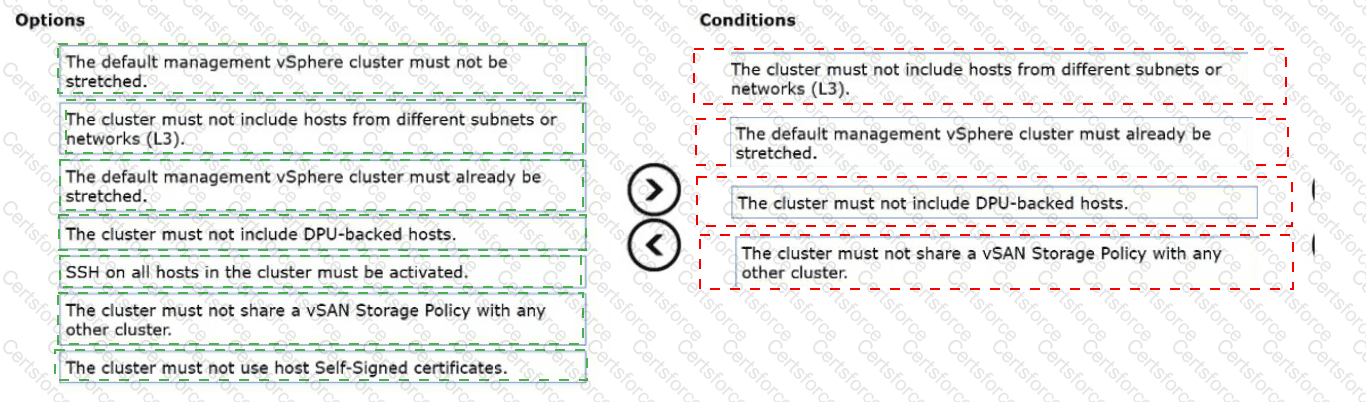
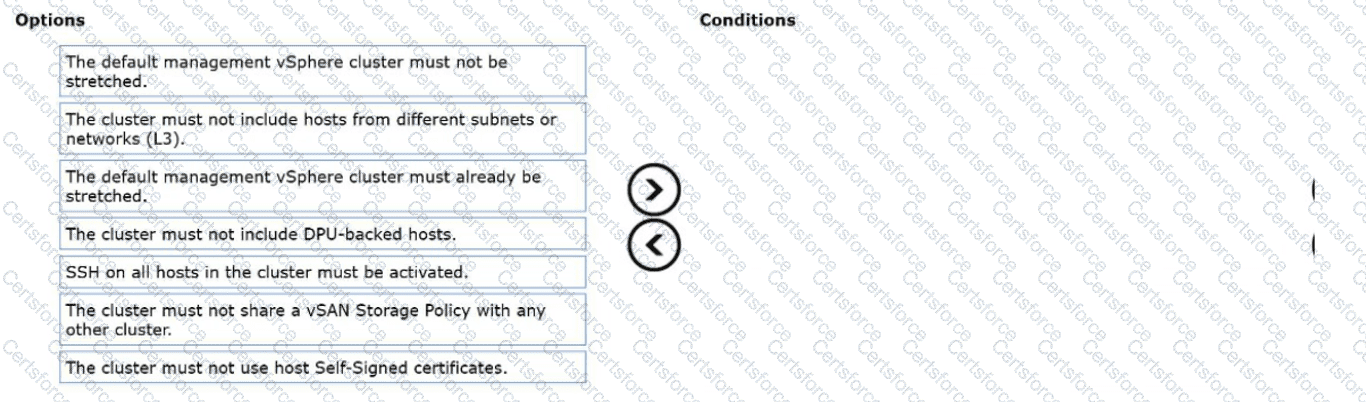
An administrator is tasked with stretching a vSAN cluster in a VMware Cloud Foundation (VCF) Workload Domain across two availability zones within a region. Both availability zones contain an equal number of hosts.
What four Conditions must also be met in order to stretch the cluster?
Drag and drop the four correct options from the Options list on the left and place them into the Conditions on the right in any order. (Choose four.)
An administrator has been tasked with making changes to a VMware Cloud Foundation (VCF) Workload Domain cluster that is configured with NFS for both Principal storage and Supplemental storage.
The cluster has the following configuration:
• There are 3 x ESX host servers.
• There are 3 x NFS Datastores allocated to host Virtual Machines workloads.
• There is a single NFS Datastore allocated for hosting ISO files.
The administrator has the following concerns with the existing configuration:
• Every time a new Virtual Machine is deployed to the Workload Domain, the administrator must choose which datastore should be used.
• When reviewing the Datastores in VCF Operations:
One of the datastores has no Virtual Machines running in it.
The other two datastores have an imbalance of Virtual Machines and this is causing resource contention. The administrator has the following requirements: • Virtual Machines must be placed automatically on the most appropriate datastore based on utilization. • Migration recommendations on Virtual Machine placement should be made when one datastore reaches 50% utilization. • Virtual Machines must only be migrated to another datastore after being approved by an administrator. What four actions must the administrator take to meet all of the requirements? (Choose four.)
An administrator is tasked with enabling vSAN Data Protection.
Which action is required to enable vSAN Data Protection?
An enterprise is planning to deploy a new vSAN ESA enabled cluster to their existing VMware Cloud Foundation (VCF) Private Cloud Workload Domain. The following requirements have been given:
• 2 x 4 TB NVMe disks per host
• FTT=1/RAID-5 for all deployed Virtual Machines
• Expected dedupe/compression ratio = 1.5 (50%)
• Reserve enough capacity to rebuild a host completely in case of a failure (Host Rebuild Reservation)
• Operational Reserve of 10%
• Expected overhead for filesystem, object, etc. of 25%
How many hosts are required to meet a minimum usable capacity of 12 TB?
vSAN encounters a noncompliant Virtual Machine and is able to locate a full replica of 55% of the votes for the noncompliant objects.
What action will vSAN do with the Virtual Machine?
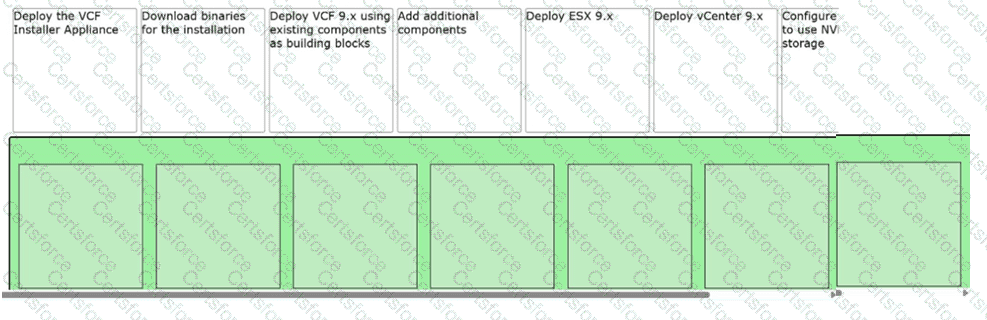
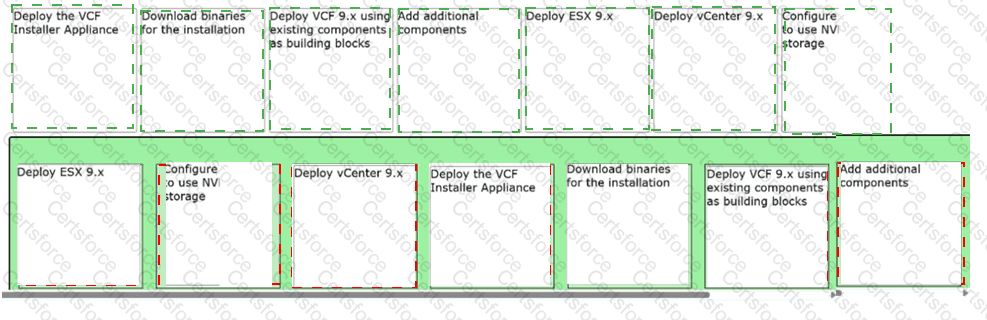
A VMware Cloud Foundation (VCF) Management Domain is requested to be deployed with the following information:
. 6 blade style hosts with no local storage beyond the operating system.
. 4 25 Gb networking cards installed in each host.
. A 30 TB external array configured to support NVMe/TCP only.
. 2 dVS switches, one configured for storage isolation and one for all other traffic.
. Aria Operations is not currently deployed in the environment.
Place the general steps in sequence for converging VCF on to this configuration.