A CMDB Administrator wants to remove all Linux Servers in the organization that have not been updated in six months.
Which recommended action should the Administrator take in Data Foundations?
A CMDB Administrator is retiring a server and sets its Life Cycle Stage to End of Life .
Which values can be selected as the Life Cycle Stage Status?
(Choose two options.)
A CMDB Administrator uses the CMDB Data Foundations Dashboard to gain insights into the CMDB. The results display low scores for several metrics.
Which actions can the CMDB Administrator take to improve the CMDB Health? (Choose two.)
A CMDB Configuration Manager intends to implement CMDB Data Manager delete and archive policies for all server records in the New York data center.
In which lifecycle state would servers be affected by these new policies?
(Choose 2 options)
Which ServiceNow solutions create automatic relationships?
An organization uses multiple data sources to update its CMDB, each assigned a different priority level. A high-priority data source is scheduled to update server records weekly. However, because of an integration issue, the high-priority data source stops updating the records.
Which configuration can allow a lower-priority data source to update records after a specified period of inactivity from the higher-priority source?
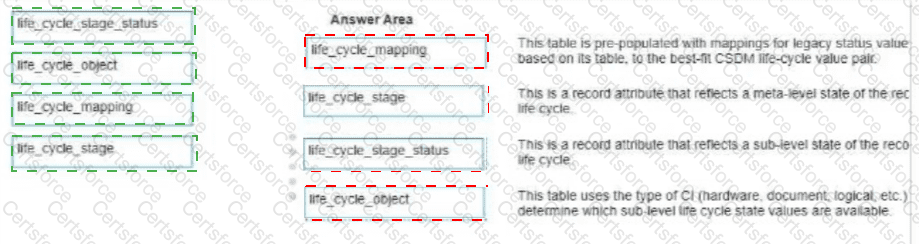
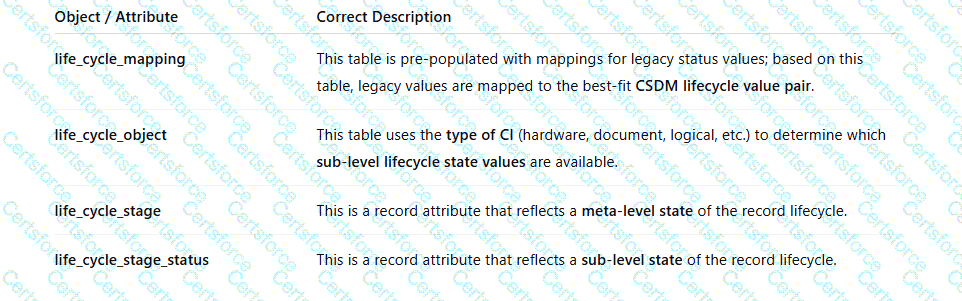
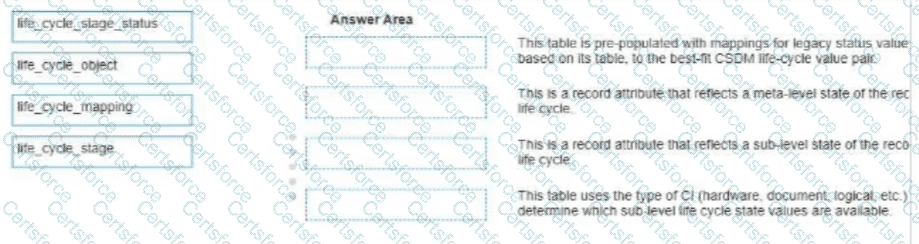
Some steps need to be taken to transition from using legacy CMDB status attributes to CSDM lifecycle objects.
Drag and drop the objects / attributes to the correct descriptions.
A CMDB Administrator wants to configure Identification and Reconciliation Engine rules for the CMDB. The Administrator opens CI Class Manager and sees the Identification Inclusion Rules tab available under a CI class.
How are these rules used by the IRE?
A Data Center Manager is working with the CMDB CI Class Manager to define the relationship between Application Servers and the Applications they host. The company has multiple Application Servers that host one or more Applications.
Which describes the relationship between the Application Server table [cmdb_ci_app_server] and the Application table [cmdb_ci_appl] ?
The following identification rule for a Hardware CI class has been defined
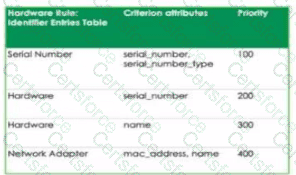
Two new CI records are imported into the Hardware class of the CMDB:
CI1: The name of this CI record matches the name of an existing CI record in the CMDB.
CI2: The IP address of this CI record matches the IP address of an existing CI record in the CMDB.
Which is correct based on the identification rule and the imported CI records?