
An existing Quoting API is defined in RAML and used by REST clients for interacting with the quoting engine. Currently there is a resource defined in the RAML that allows the creation of quotes; however, a new requirement was just received to allow for the updating of existing quotes.
Which two actions need to be taken to facilitate this change so it can be processed?
Choose 2 answers
An Order API must be designed that contains significant amounts of integration logic and involves the invocation of the Product API.
The power relationship between Order API and Product API is one of "Customer/Supplier", because the Product API is used heavily throughout the organization and is developed by a dedicated development team located in the office of the CTO.
What strategy should be used to deal with the API data model of the Product API within the Order API?
A circuit breaker strategy is planned in order to meet the goal of improved response time and demand on a downstream API.
* Circuit Open: More than 10 errors per minute for three minutes
* Circuit Half-Open: One error per minute
* Circuit Closed: Less than one error per minute for five minutes
Out of several proposals from the engineering team, which option will meet this goal?
A new upstream API Is being designed to offer an SLA of 500 ms median and 800 ms maximum (99th percentile) response time. The corresponding API implementation needs to sequentially invoke 3 downstream APIs of very similar complexity.
The first of these downstream APIs offers the following SLA for its response time: median: 100 ms, 80th percentile: 500 ms, 95th percentile: 1000 ms.
If possible, how can a timeout be set in the upstream API for the invocation of the first downstream API to meet the new upstream API's desired SLA?
A European company has customers all across Europe, and the IT department is migrating from an older platform to MuleSoft. The main requirements are that the
new platform should allow redeployments with zero downtime and deployment of applications to multiple runtime versions, provide security and speed, and utilize Anypoint MQ
as the message service.
Which runtime plane should the company select based on the requirements without additional network configuration?
Say, there is a legacy CRM system called CRM-Z which is offering below functions:
1. Customer creation
2. Amend details of an existing customer
3. Retrieve details of a customer
4. Suspend a customer
What is a typical result of using a fine-grained rather than a coarse-grained API deployment model to implement a given business process?
A TemperatureSensors API instance is defined in API Manager in the PROD environment of the CAR_FACTORY business group. An AcmelemperatureSensors Mule
application implements this API instance and is deployed from Runtime Manager to the PROD environment of the CAR_FACTORY business group. A policy that requires a valid
client ID and client secret is applied in API Manager to the API instance.
Where can an API consumer obtain a valid client ID and client secret to call the AcmeTemperatureSensors Mule application?
What API policy would be LEAST LIKELY used when designing an Experience API that is intended to work with a consumer mobile phone or tablet application?
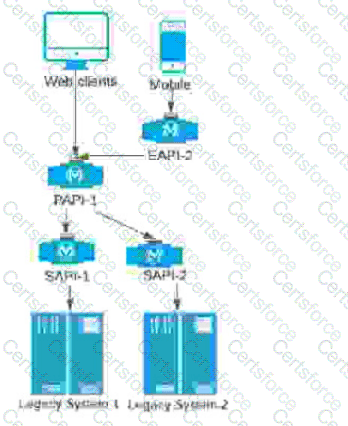
A company stores financial transaction data in two legacy systems. For each legacy system, a separate, dedicated System API (SAPI) exposes data for that legacy system. A Process API (PAPI) merges the data retrieved from ail of the System APIs into a common format. Several API clients call the PAPI through its public domain name.
The company now wants to expose a subset of financial data to a newly developed mobile application that uses a different Bounded Context Data Model. The company wants to follow MuleSoft's best practices for building out an effective application network.
Following MuleSoft's best practices, how can the company expose financial data needed by the mobile application in a way that minimizes the impact on the currently running API clients, API implementations, and support asset reuse?
Add two new Experience APIs (EAPI-i and EAPI-2}. Add Mobile PAPI-2 to expose the Intended subset of financial data as requested. Both PAPIs access the Legacy Systems via SAPI-1 and SAP]-2.
Add two new Experience APIs (EAPI-i and EAPI-2}. Add Mobile PAPI-2 to expose the Intended subset of financial data as requested. Both PAPIs access the Legacy Systems via SAPI-1 and SAP]-2.
Create a new mobile Experince API (EAPI) chat exposes that subset of PAPI endpoints.Add transformtion login to the mobile Experince API implementation to make mobile data compatible with the required PAPIs.
Develop and deploy is new PAPI implementation with data transformation and ... login to support this required endpoints of both mobile and web clients.Deploy an API Proxy with an endpoint from API Manager that redirect the existing PAPI endpoints to the new PAPI.
