Version 3.0.1 of a REST API implementation represents time values in PST time using ISO 8601 hh:mm:ss format. The API implementation needs to be changed to instead represent time values in CEST time using ISO 8601 hh:mm:ss format. When following the semver.org semantic versioning specification, what version should be assigned to the updated API implementation?
What condition requires using a CloudHub Dedicated Load Balancer?
Refer to the exhibit. An organization is running a Mule standalone runtime and has configured Active Directory as the Anypoint Platform external Identity Provider. The organization does not have budget for other system components.
What policy should be applied to all instances of APIs in the organization to most effecuvelyKestrict access to a specific group of internal users?
A Platform Architect inherits a legacy monolithic SOAP-based web service that performs a number of tasks, including showing all policies belonging to a client. The service connects to two back-end systems — a life-insurance administration system and a general-insurance administration system — and then queries for insurance policy information within each system, aggregates the results, and presents a SOAP-based response to a user interface (UI).
The architect wants to break up the monolithic web service to follow API-led conventions.
Which part of the service should be put into the process layer?
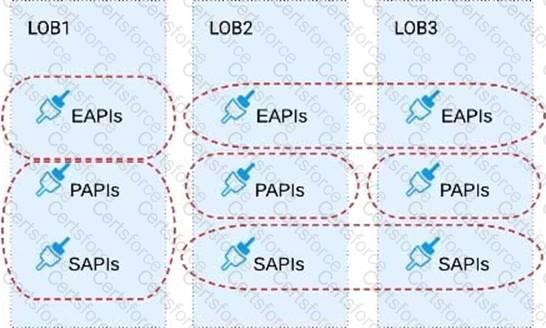
Refer to the exhibit.
Three business processes need to be implemented, and the implementations need to communicate with several different SaaS applications.
These processes are owned by separate (siloed) LOBs and are mainly independent of each other, but do share a few business entities. Each LOB has one development team and their own budget
In this organizational context, what is the most effective approach to choose the API data models for the APIs that will implement these business processes with minimal redundancy of the data models?
A) Build several Bounded Context Data Models that align with coherent parts of the business processes and the definitions of associated business entities

B) Build distinct data models for each API to follow established micro-services and Agile API-centric practices
C) Build all API data models using XML schema to drive consistency and reuse across the organization
D) Build one centralized Canonical Data Model (Enterprise Data Model) that unifies all the data types from all three business processes, ensuring the data model is consistent and non-redundant
A company uses a hybrid Anypoint Platform deployment model that combines the EU control plane with customer-hosted Mule runtimes. After successfully testing a Mule API implementation in the Staging environment, the Mule API implementation is set with environment-specific properties and must be promoted to the Production environment. What is a way that MuleSoft recommends to configure the Mule API implementation and automate its promotion to the Production environment?
A System API is designed to retrieve data from a backend system that has scalability challenges. What API policy can best safeguard the backend system?
What is a key performance indicator (KPI) that measures the success of a typical C4E that is immediately apparent in responses from the Anypoint Platform APIs?
What best describes the Fully Qualified Domain Names (FQDNs), also known as DNS entries, created when a Mule application is deployed to the CloudHub Shared Worker Cloud?
In an organization, the InfoSec team is investigating Anypoint Platform related data traffic.
From where does most of the data available to Anypoint Platform for monitoring and alerting originate?