You are an experienced audit team leader guiding an auditor in training.
Your team is currently conducting a third-party surveillance audit of an organisation that stores data on behalf of external clients. The auditor in training has been tasked with reviewing the PEOPLE controls listed in the
Statement of Applicability (SoA) and implemented at the site.
Select four controls from the following that would you expect the auditor in training to review.
Scenario 6: Sinvestment is an insurance company that offers home, commercial, and life insurance. The company was founded in North Carolina, but have recently expanded in other locations, including Europe and Africa.
Sinvestment is committed to complying with laws and regulations applicable to their industry and preventing any information security incident. They have implemented an ISMS based on ISO/IEC 27001 and have applied for ISO/IEC 27001 certification.
Two auditors were assigned by the certification body to conduct the audit. After signing a confidentiality agreement with Sinvestment. they started the audit activities. First, they reviewed the documentation required by the standard, including the declaration of the ISMS scope, information security policies, and internal audits reports. The review process was not easy because, although Sinvestment stated that they had a documentation procedure in place, not all documents had the same format.
Then, the audit team conducted several interviews with Sinvestment's top management to understand their role in the ISMS implementation. All activities of the stage 1 audit were performed remotely, except the review of documented information, which took place on-site, as requested by Sinvestment.
During this stage, the auditors found out that there was no documentation related to information security training and awareness program. When asked, Sinvestment's representatives stated that the company has provided information security training sessions to all employees. Stage 1 audit gave the audit team a general understanding of Sinvestment's operations and ISMS.
The stage 2 audit was conducted three weeks after stage 1 audit. The audit team observed that the marketing department (which was not included in the audit scope) had no procedures in place to control employees’ access rights. Since controlling employees' access rights is one of the ISO/IEC 27001 requirements and was included in the information security policy of the company, the issue was included in the audit report. In addition, during stage 2 audit, the audit team observed that Sinvestment did not record logs of user activities. The procedures of the company stated that "Logs recording user activities should be retained and regularly reviewed," yet the company did not present any evidence of the implementation of such procedure.
During all audit activities, the auditors used observation, interviews, documented information review, analysis, and technical verification to collect information and evidence. All the audit findings during stages 1 and 2 were analyzed and the audit team decided to issue a positive recommendation for certification.
Based on scenario 6, during stage 1 audit, the auditor found out that some documents regarding the ISMS had different format. What should the auditor do in this case?
Scenario 8: Tessa. Malik, and Michael are an audit team of independent and qualified experts in the field of security, compliance, and business planning and strategies. They are assigned to conduct a certification audit in Clastus, a large web design company. They have previously shown excellent work ethics, including impartiality and objectiveness, while conducting audits. This time, Clastus is positive that they will be one step ahead if they get certified against ISO/IEC 27001.
Tessa, the audit team leader, has expertise in auditing and a very successful background in IT-related issues, compliance, and governance. Malik has an organizational planning and risk management background. His expertise relies on the level of synthesis and analysis of an organization's security controls and its risk tolerance in accurately characterizing the risk level within an organization On the other hand, Michael is an expert in the practical security of controls assessment by following rigorous standardized programs.
After performing the required auditing activities, Tessa initiated an audit team meeting They analyzed one of Michael s findings to decide on the issue objectively and accurately. The issue Michael had encountered was a minor nonconformity in the organization's daily operations, which he believed was caused by one of the organization's IT technicians As such, Tessa met with the top management and told them who was responsible for the nonconformity after they inquired about the names of the persons responsible
To facilitate clarity and understanding, Tessa conducted the closing meeting on the last day of the audit. During this meeting, she presented the identified nonconformities to the Clastus management. However, Tessa received advice to avoid providing unnecessary evidence in the audit report for the Clastus certification audit, ensuring that the report remains concise and focused on the critical findings.
Based on the evidence examined, the audit team drafted the audit conclusions and decided that two areas of the organization must be audited before the certification can be granted. These decisions were later presented to the auditee, who did not accept the findings and proposed to provide additional information. Despite the auditee's comments, the auditors, having already decided on the certification recommendation, did not accept the additional information. The auditee's top management insisted that the audit conclusions did not represent reality, but the audit team remained firm in their decision.
Based on the scenario above, answer the following question:
Question:
After analyzing the audit conclusions, Company X accepted the risk related to a detected nonconformity and decided not to take corrective action. However, their decision was not documented. Is this acceptable?
You are carrying out your first third-party ISMS surveillance audit as an Audit Team Leader. You are presently in
the auditee's data centre with another member of your audit team.
You are currently in a large room that is subdivided into several smaller rooms, each of which has a numeric
combination lock and swipe card reader on the door. You notice two external contractors using a swipe card and
combination number provided by the centre's reception desk to gain access to a client's suite to carry out authorised electrical repairs.
You go to reception and ask to see the door access record for the client's suite. This indicates only one card was
swiped. You ask the receptionist and they reply, "yes it's a common problem. We ask everyone to swipe their
cards but with contractors especially, one tends to swipe and the rest simply 'tailgate' their way in" but we know who they are from the reception sign-in.
Based on the scenario above which one of the following actions would you now take?
ISMS (1)---------------helps determine (2)--------------,
Scenario 6
Sinvestment is an insurance provider that offers a wide range of coverage options, including home, commercial, and life insurance. Originally established in North California, the company has expanded its operations to other locations, including Europe and Africa. In addition to its growth, Sinvestment is committed to complying with laws and regulations applicable to its industry and preventing any information security incident. They have implemented an information security management system (ISMS) based on ISO/IEC 27001 and have applied for certification.
A team of auditors was assigned by the certification body to conduct the audit. After signing a confidentiality agreement with Sinvestment, they started the audit activities. For the activities of the stage 1 audit, it was decided that they would be performed on site, except the review of documented information, which took place remotely, as requested by Sinvestment.
The audit team started the stage 1 audit by reviewing the documentation required, including the declaration of the ISMS scope, information security policies, and internal audit reports. The evaluation of the documented information was based on the content and procedure for managing the documented information.
In addition, the auditors found out that the documentation related to information security training and awareness programs was incomplete and lacked essential details. When asked, Sinvestment’s top management stated that the company has provided information security training sessions to all employees.
The stage 2 audit was conducted three weeks after the stage 1 audit. The audit team observed that the marketing department (not included in the audit scope) had no procedures to control employees’ access rights. Since controlling employees' access rights is one of the ISO/IEC 27001 requirements and was included in the company's information security policy, the issue was included in the audit report.
Question
Was Sinvestment’s request for reviewing documented information remotely acceptable?
The following are definitions of Information, except:
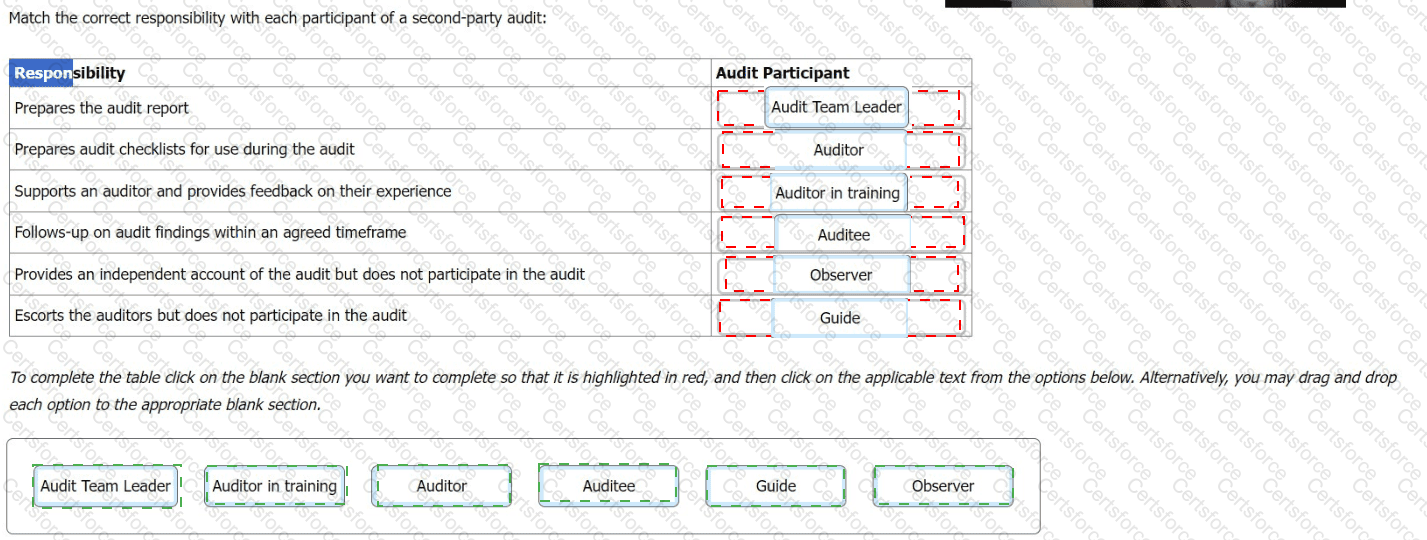
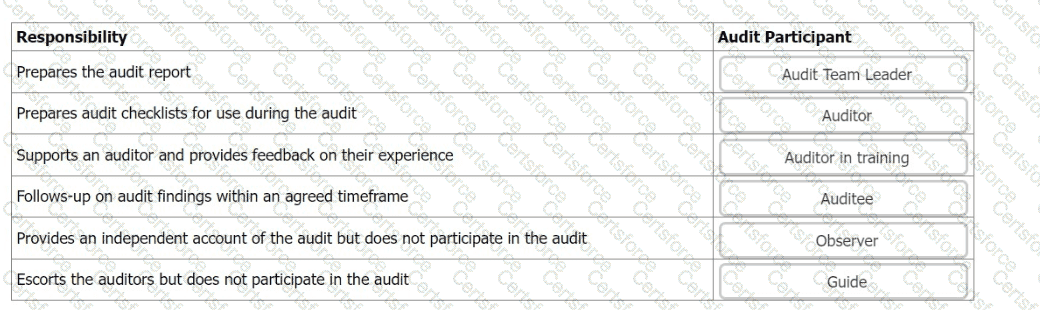
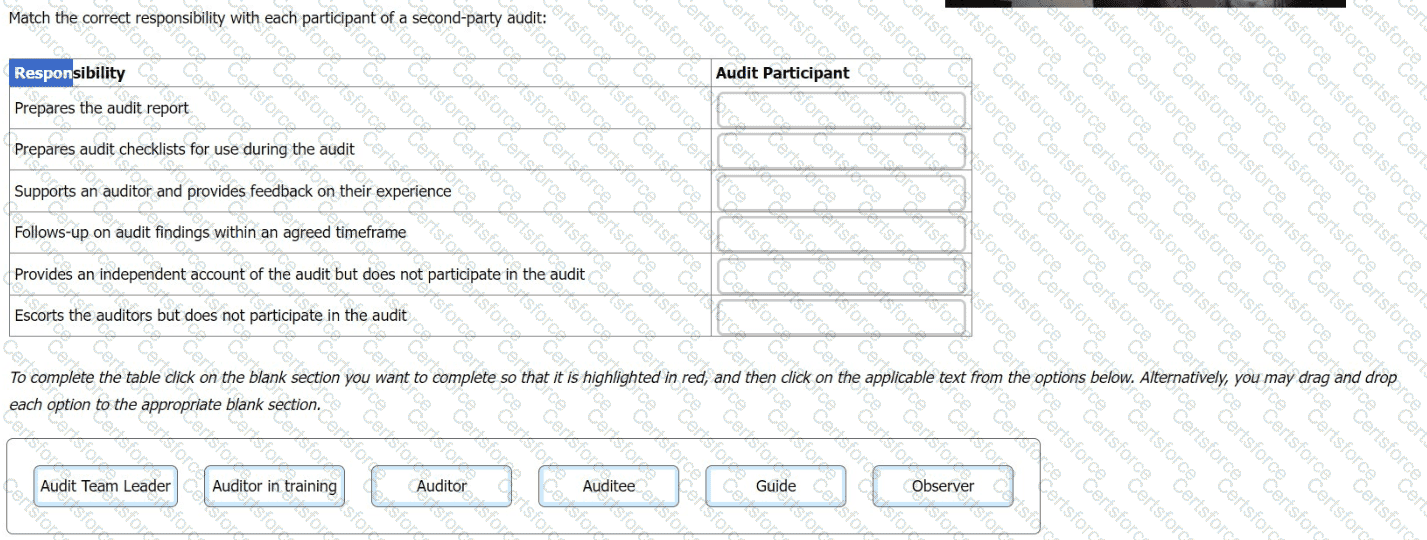
Match the correct responsibility with each participant of a second-party audit:
Question:
Finnco, a subsidiary of a certification body, provided ISMS consultancy services to an organization. Considering this scenario, when can the certification body certify the organization?
Select the words that best complete the sentence below to describe audit resources: