Pre-Summer Special Limited Time 70% Discount Offer - Ends in 0d 00h 00m 00s - Coupon code: force70

Pass the Nutanix NCP-NS NCP-NS-7.5 Questions and answers with CertsForce

Viewing page 3 out of 4 pages
Viewing questions 21-30 out of questions
Questions # 21:

An administrator needs to delegate the management of security policies to a dedicated SecOps team. To enforce the principle of least privilege, the administrator assigns the predefined Flow Policy Author role to a user on the team. The user confirms they can create, monitor, and enforce security policies. However, when attempting to build a new application security policy for a set of newly deployed VMs, the user reports they are unable to create a new category to group these VMs. The option is not available in the Prism Central UI. Which statement explains this behavior?

Options:

A.

The Flow Policy Author role must be cloned into a custom role before it can be used.


B.

The user's role must be assigned with a scope for the specific projects they manage.


C.

The user is missing the Flow Admin role, which is required for category management.


D.

The Flow Policy Author role can only apply policies to existing categories by design.


Expert Solution
Questions # 22:

Which statement best describes the function of an External Network in Flow Virtual Networking?

Options:

A.

It acts as the entry and exit point for traffic to and from a VPC.


B.

It enables communication between subnets within a VPC.


C.

It enables communication between VPCs.


D.

Each VPC requires a dedicated External Network that cannot be shared.


Expert Solution
Questions # 23:

Before creating a new Application Security Policy in Prism Central, what prerequisite must exist?

Options:

A.

A category key/value pair must be defined for use in the policy.


B.

Flow Network Security must be enabled on all registered clusters.


C.

Targeted VMs must have category assignments.


D.

The Network Controller must be deployed on each cluster in the policy's scope.


Expert Solution
Questions # 24:

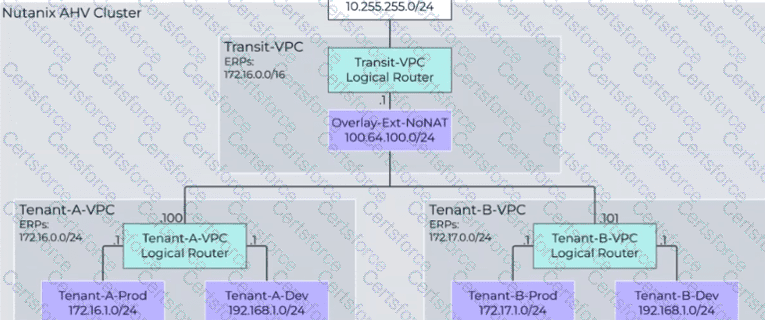
Exhibit:

Question # 24

An administrator has just added a new VPC for Tenant-B... However, users are reporting that they are unable to access external resources from VMs created in the Tenant-B-Prod subnet. What should be done to correct the problem?

Options:

A.

Update the ERPs for Tenant-B-VPC.


B.

Add a Network Policy in Tenant-B-VPC.


C.

Add a Network Policy in Transit-VPC.


D.

Update the ERPs for Transit-VPC.


Expert Solution
Questions # 25:

An administrator has a VPC with a single active gateway node that successfully peers with an external router using a single BGP GW and session. To eliminate a single point of failure, the administrator deploys a second BGP gateway to the VPC. After the second gateway is added and shows a healthy state, the external router still only sees a single BGP session. What is the most likely reason for the second session not being established on the external router?

Options:

A.

The BGP Hold-down timer on the external router is set too high.


B.

Network Security Groups are blocking BGP traffic from the second gateway's IP address.


C.

The external router needs BGP peering configuration pointing to the IP address of the first gateway node.


D.

The second BGP gateway requires a BGP session configured to peer with the external router.


Expert Solution
Questions # 26:

An administrator creates a VPC named AppVPC1 in Nutanix Cloud Infrastructure (NCI) with separate subnets for the web, app, and database tiers. The database subnet must remain isolated from external networks; however, all tiers need to communicate with each other internally. What should the administrator configure to limit external access to only the web and app subnets?

Options:

A.

Enable NAT Gateway on the database subnet for outbound communication.


B.

Configure a routing policy in the VPC to deny external traffic to and from the database subnet.


C.

Attach the web and app subnets to the external network through an AHV managed bridge.


D.

Create Static Routes on the physical network to interconnect the VPC subnets.


Expert Solution
Questions # 27:

A junior network operator is assigned two predefined roles in Prism Central... Role A: Prism Viewer Role B: VPC Admin The operator reports being able to successfully create, update, and delete Virtual Private Clouds (VPCs). However, the operator is unable to create a VM into the VPC. How does Prism Central determine the operator's effective permissions?

Options:

A.

The system applies the principle of "most privilege," granting the highest level of access from any assigned role.


B.

The permissions of the VPC Admin role override the more restrictive Prism Viewer role.


C.

The Prism Viewer role's permissions take precedence, preventing any write operations from the VPC Admin role.


D.

The permissions are the union of both roles, granting VPC management rights and global read-only access.


Expert Solution
Questions # 28:

An administrator plans to upgrade a Nutanix cluster running AHV and Prism Central. The current cluster is on AOS 6.10, and the administrator wants to move to AOS 7.3 while ensuring all components remain compatible. What is the correct upgrade order to minimize downtime and maintain cluster functionality?

Options:

A.

Upgrade CVMs - > Upgrade cluster AOS - > Upgrade Prism Central - > Upgrade AHV hosts


B.

Upgrade cluster AOS - > Upgrade AHV hosts - > Upgrade Prism Central - > Upgrade CVMs


C.

Upgrade Prism Central - > Upgrade AHV hosts - > Upgrade CVMs - > Upgrade cluster AOS


D.

Upgrade AHV hosts - > Upgrade cluster AOS - > Upgrade Prism Central - > Upgrade CVMs


Expert Solution
Questions # 29:

An administrator uses Nutanix Flow to secure a three-tier application (Web, App, and Database tiers). After observing the traffic, they find that: The Web tier communicates with the App tier over HTTP (port 80) The App tier communicates with the Database tier over TCP port 1433 The Database tier does not initiate connections The Web tier receives inbound HTTP traffic from the corporate DMZ on port 8080 No other traffic should be allowed What should the administrator do to document and then securely apply these flows in Nutanix Flow?

Options:

A.

Use Flow Network Visualization to capture observed flows and convert them into microsegmentation security policies.


B.

Add all VMs to a single security policy to simplify communication.


C.

Disable traffic-flow discovery and configure all policies manually.


D.

Manually create isolation policies between all VMs in the environment.


Expert Solution
Questions # 30:

Which action allows an administrator to reuse a single existing policy in a different scope?

Options:

A.

Place policy in Enforce mode


B.

Clone


C.

Place policy in Monitor mode


D.

Export


Expert Solution
Viewing page 3 out of 4 pages
Viewing questions 21-30 out of questions