Pre-Summer Special Limited Time 70% Discount Offer - Ends in 0d 00h 00m 00s - Coupon code: force70

Pass the Nutanix NCP-NS NCP-NS-7.5 Questions and answers with CertsForce

Viewing page 2 out of 4 pages
Viewing questions 11-20 out of questions
Questions # 11:

A VDI policy in Flow Network Security allows access to specific resources only when users from the Admins Active Directory group log into a VM. Some administrators report that when they log in to certain VMs, access is blocked (default deny applies), while the same user accounts work correctly when logged on to other VMs. When checking the VM details in Prism Central, operations observes that the expected dynamic category based on the logged-in AD user is not assigned on the affected VMs. What is the most likely reason for this behavior?

Options:

A.

The Admins group contains nested AD groups, and only the top-level group is synchronized by Prism Central.


B.

The Prism Central Active Directory service connection is misconfigured or has failed.


C.

The affected VMs allowed login using cached credentials without contacting the Domain Controller.


D.

The security policy is in Monitor mode, so the dynamic category assignment is not applied.


Expert Solution
Questions # 12:

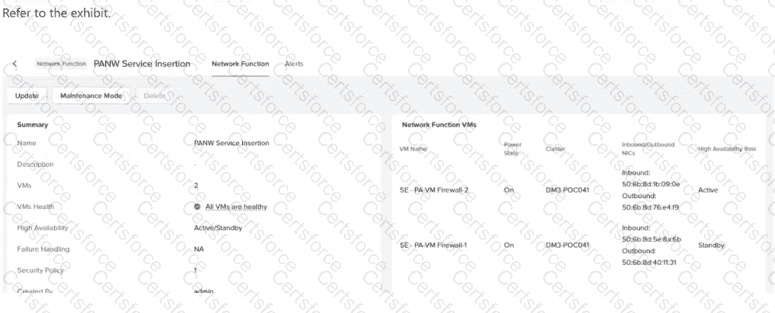
Refer to Exhibit:

Question # 12

An organization uses an FNS-NG Service Chain to steer application traffic through a pair of third-party firewall Network Function VMs operating in Active/Standby mode. Users suddenly report that all application access is blocked. The administrator reviews Prism Central - > Network & Security - > Network Functions, where the summary shown in the exhibit is displayed. Additional information: Alert: "Network Function 'PANW Service Insertion' virtual NIC pair(s) are unhealthy." Both firewall VMs are powered on and reachable. The security policy using the service chain has not been changed. Based on the exhibit and findings, what is the most likely cause of the traffic outage?

Options:

A.

The service-chain health check failed to reroute sessions to the healthy firewall.


B.

One of the Network Function vNIC pairs lost dataplane connectivity, interrupting traffic until health is stabilized.


C.

Firewall policy synchronization was not configured when the standby firewall became active.


D.

The inbound vNIC on SE-PA-VM Firewall-2 failed, preventing redirected packets from reaching the firewall.


Expert Solution
Questions # 13:

What must an administrator do before disabling the Network Controller?

Options:

A.

Convert external subnets into VLAN Basic networks.


B.

Delete VLAN Basic Subnets.


C.

Once enabled, the Network controller cannot be disabled.


D.

Delete all external subnets and VPCs which are in-use.


Expert Solution
Questions # 14:

When cloning a Flow Network Security policy, what should be verified before enabling Enforce mode?

Options:

A.

The cloned policy's secured entities reference the intended categories.


B.

The cloned policy is configured to a different scope than the source policy.


C.

The cloned policy must first be saved before it can be enforced.


D.

The cloned policy must be renamed before it can be enforced.


Expert Solution
Questions # 15:

An administrator needs to make a web server VM, which is inside a private VPC overlay subnet, accessible from the external network. The administrator assigns a Floating IP to the VM, but the service is still unreachable from the outside. What is a likely reason for this failure?

Options:

A.

A Floating IP was assigned from a different external subnet than the one used by the VPC.


B.

The VPC has no default route configured to use the external subnet.


C.

The VM was not rebooted after the Floating IP was assigned.


D.

The web server VM is not running the latest version of NGT.


Expert Solution
Questions # 16:

Which two statements are true with respect to Flow Network Security Policies? (Choose two.)

Options:

A.

Flow Network Security is a stateful firewall.


B.

Flow Network Security supports L3 and L4-based firewall rules.


C.

Flow Network Security supports L7-based firewall rules.


D.

Flow Network Security supports rules based on L2 MAC Addresses.


Expert Solution
Questions # 17:

An administrator plans to upgrade the Network Controller in a Flow Virtual Networking deployment. The environment includes multiple AHV clusters managed by Prism Central. Which prerequisite must be verified before upgrading the Network Controller?

Options:

A.

Flow Network Security must be upgraded to the target release before upgrading the Network Controller.


B.

Each cluster must be running the Flow Network Security version specified as compatible with the target Network Controller release.


C.

Each cluster must be running AHV versions compatible with the target Network Controller release.


D.

Network Controller Prism Element upgrades must be applied before before Network Controller Prism Central upgrades can be applied.


Expert Solution
Questions # 18:

An administrator is configuring a Nutanix environment for Flow Network Security Next-Gen. Where should the MTU be set to ensure that Geneve encapsulation overhead is properly accounted for?

Options:

A.

On the CVM's virtual network interfaces


B.

On the AHV host's physical network interfaces


C.

On the virtual switch within Prism Central


D.

On the upstream virtual router


Expert Solution
Questions # 19:

Which step is required to prepare an AHV cluster for Flow Network Security Next-Gen?

Options:

A.

Enable microsegmentation and network controller on the cluster.


B.

Assign static IP addresses to all VMs before enabling Flow.


C.

Enable microsegmentation policies on all VM groups before enabling Flow.


D.

Disable all existing VLANs in the cluster to allow Flow to control traffic.


Expert Solution
Questions # 20:

An administrator is responsible for managing user access to a Nutanix cluster... configure custom user roles... What is the first step in configuring and managing user roles for a Nutanix cluster?

Options:

A.

Create the requisite Authorization Polices from custom or built-in roles.


B.

Modify the administrator role to restrict access to critical system functions.


C.

Disable default roles and create new roles for each team.


D.

Create the requisite Custom Roles from custom or built-in Authorization Polices.


Expert Solution
Viewing page 2 out of 4 pages
Viewing questions 11-20 out of questions