Spring Sale Limited Time 70% Discount Offer - Ends in 0d 00h 00m 00s - Coupon code: simple70

Pass the Juniper JNCIS-ENT JN0-351 Questions and answers with CertsForce

Viewing page 3 out of 4 pages
Viewing questions 21-30 out of questions
Questions # 21:

What are two characteristics of RSTP alternate ports? (Choose two.)

Options:

A.

RSTP alternate ports block traffic while receiving superior BPDUs from a neighboring switch.


B.

RSTP alternate ports provide an alternate lower cost path to the root bridge.


C.

RSTP alternate ports provide an alternate higher cost path to the root bridge.


D.

RSTP alternate ports are active ports used to forward frames toward the root bridge.


Expert Solution
Questions # 22:

Which statement is correct about GRE tunnels?

Options:

A.

GRE tunnels only support encapsulating IP traffic.


B.

The time-to-live field in the tunnel payload is decremented during transit.


C.

There are 20 bytes of overhead with GRE encapsulation.


D.

GRE tunnels only support encapsulating non-IP traffic.


Expert Solution
Questions # 23:

Your GRE tunnel is not transitioning to the Up status.

What would be the first step in troubleshooting the problem?

Options:

A.

Verify tunnel endpoint reachability.


B.

Verify that the status of the management interface is up.


C.

Verify the status of the management routing instance.


D.

Verify that the routing instance for GRE tunnels is created.


Expert Solution
Questions # 24:

Which two statements are correct about link aggregation? (Choose two.)

Options:

A.

LAGs provide physical layer redundancy.


B.

Member links must use the same MTU.


C.

IP traffic is hashed using source and destination MAC addresses


D.

All RE-generated traffic traverses the lowest member link.


Expert Solution
Questions # 25:

In addition to the MAC addresses, what information is stored in the bridging table? (Choose two.)

Options:

A.

ether type details


B.

interface details


C.

preamble of Ethernet packet


D.

MAC learned time


Expert Solution
Questions # 26:

You are asked to create a default route that will be advertised to your internal OSPF neighbors. You have three upstream connections to the Internet and you must ensure that when available, all traffic uses ISP1 as your primary connection and only uses ISP2 and ISP3 when ISP1 is not available.

Which solution should you implement in this scenario?

Options:

A.

Create a default static route with ISP1 ' s address as the next hop while specifying the addresses for ISP2 and ISP3 as qualified next hops with a preference value of six or higher.


B.

Create a default generate route that includes an import policy to match BGP routes from ISP1 and assign a preference value of four or less.


C.

Create a default static route with each neighbor address as the next hop.


D.

Create a default aggregated route.


Expert Solution
Questions # 27:

You have two OSPF routers forming an adjacency. R1 has a priority of 32 and a router ID of 192.168.1.2. R2 has a priority of 64 and a router ID of 192.168.1.1. The routers were started at the same time and all other OSPF settings are the default settings.

Which statement is correct in this scenario?

Options:

A.

At least three routers are required for a DR/BDR election


B.

Router IDs must match for an adjacency to form.


C.

R2 will be the BDR.


D.

R1 will be the BDR.


Expert Solution
Questions # 28:

You are configuring an IS-IS IGP network and do not see the IS-IS adjacencies established. In this scenario, what are two reasons for this problem? (Choose two.)

Options:

A.

MTU is not at least 1492 bytes.


B.

IP subnets are not a /30 address.


C.

The Level 2 routers have mismatched areas.


D.

The lo0 interface is not included as an IS-IS interface.


Expert Solution
Questions # 29:

Which two statements about redundant trunk groups on EX Series switches are correct? (Choose two.)

Options:

A.

Redundant trunk groups load-balance traffic across two designated uplink interfaces.


B.

If the active link fails, then the secondary link automatically takes over.


C.

Layer 2 control traffic is permitted on the secondary link


D.

Redundant trunk groups must be connected to the same aggregation switch.


Expert Solution
Questions # 30:

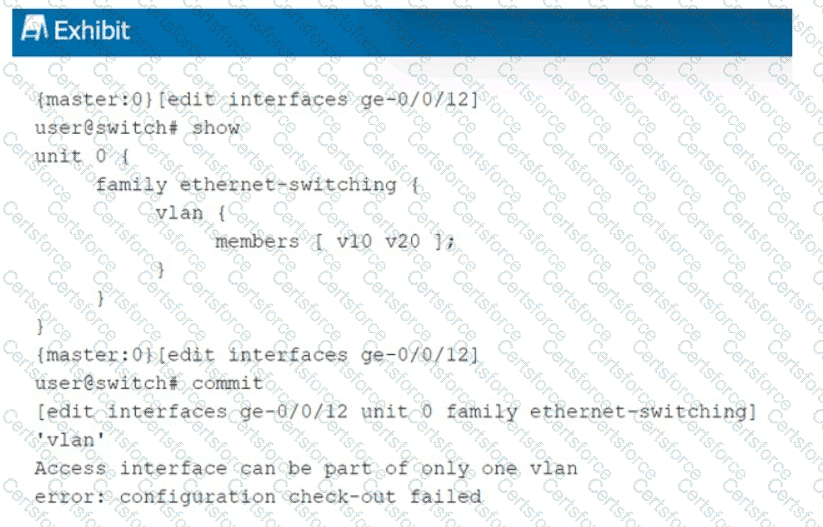
Exhibit:

Question # 30

When trying to commit the configuration shown in the exhibit, you receive an error.

What is the problem?

Options:

A.

You have omitted the interface-mode trunk command.


B.

You have not configured an IP address to the interface.


C.

You have not set the interface family correctly.


D.

You have omitted the interface-mode access command.


Expert Solution
Viewing page 3 out of 4 pages
Viewing questions 21-30 out of questions