Spring Sale Limited Time 70% Discount Offer - Ends in 0d 00h 00m 00s - Coupon code: simple70

Pass the Juniper JNCIS-ENT JN0-351 Questions and answers with CertsForce

Viewing page 2 out of 4 pages
Viewing questions 11-20 out of questions
Questions # 11:

An update to your organization ' s network security requirements document requires management traffic to be isolated in a non-default routing-instance. You want to implement this requirement on your Junos-based devices.

Which two commands enable this behavior? (Choose two.)

Options:

A.

set routing—instances mgmtjunoa interface ge-0/0/0.0


B.

set routing—instances mgmt_junos interface em1


C.

set system management—instance


D.

set routing—instances mgmt_junos


Expert Solution
Questions # 12:

Which two events cause a router to advertise a connected network to OSPF neighbors? (Choose two.)

Options:

A.

When an OSPF adjacency is established.


B.

When an interface has the OSPF passive option enabled.


C.

When a static route to the 224.0.0.6 address is created.


D.

When a static route to the 224.0.0.5 address is created.


Expert Solution
Questions # 13:

After receiving a BGP route, which two conditions are verified by the receiving router to ensure that the received route is valid? (Choose two)

Options:

A.

The AS-path length is greater than 0.


B.

The loops do not exist.


C.

The next hop is reachable.


D.

The local preference is greater than 0.


Expert Solution
Questions # 14:

Which three actions are required for filter-based forwarding? (Choose three.)

Options:

A.

Create a firewall filter to match desired traffic.


B.

Create routing policies for source addresses.


C.

Create a RIB group for next-hop entries.


D.

Create a forwarding option for load balancing.


E.

Create routing instances for individual destinations.


Expert Solution
Questions # 15:

You are asked to connect an IP phone and a user computer using the same interface on an EX Series switch. The traffic from the computer does not use a VLAN tag, whereas the traffic from the IP phone uses a VLAN tag.

Which feature enables the interface to receive both types of traffic?

Options:

A.

native VLAN


B.

DHCP snooping


C.

MAC limiting


D.

voice VLAN


Expert Solution
Questions # 16:

Which two types of tunnels are able to be created on all Junos devices? (Choose two.)

Options:

A.

STP


B.

GRE


C.

IP-IP


D.

IPsec


Expert Solution
Questions # 17:

A host is connected to your EX Series switch using an interface with persistent MAC learning enabled. When you connect the host to another interface on the same switch, all traffic generated by the host is dropped.

Which action should you perform to solve the problem?

Options:

A.

Disable dynamic ARP inspection.


B.

Enter the clear Ethernet switching table persistent learning command.


C.

Enter the clear dhcp snooping database command.


D.

Configure the Interface as a trunk port.


Expert Solution
Questions # 18:

Which two statements are correct about using firewall filters on EX Series switches? (Choose two.)

Options:

A.

You can deploy only stateless firewall filters on an EX Series switch.


B.

You can only apply firewall filters to Layer 2 traffic on an EX Series switch.


C.

You can apply firewall filters to both Layer 2 and Layer 3 traffic on an EX Series switch.


D.

You can deploy both stateless and stateful firewall filters on an EX Series switch.


Expert Solution
Questions # 19:

You need to configure a LAG between your switches. In this scenario, which two statements are correct? (Choose two.)

Options:

A.

Duplex and speed settings are not required to match on both participating devices.


B.

Duplex and speed settings are required to match on both participating devices.


C.

Member links are not required to be contiguous ports.


D.

Member links are required to be contiguous ports.


Expert Solution
Questions # 20:

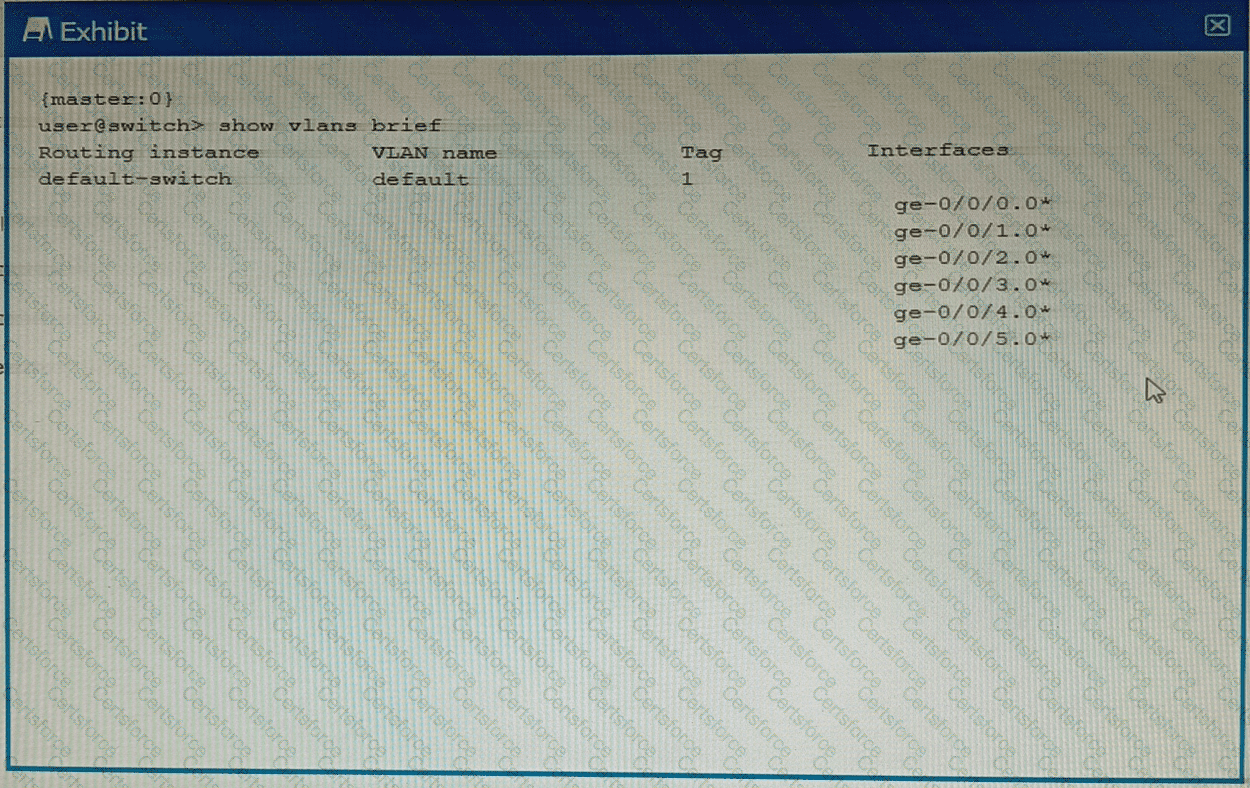
Exhibit

Question # 20

What does the * indicate in the output shown in the exhibit?

Options:

A.

The switch ports have a router attached.


B.

The interface is down.


C.

The interface is active.


D.

All interfaces have elected a root bridge.


Expert Solution
Viewing page 2 out of 4 pages
Viewing questions 11-20 out of questions