Which ONE of the following is NOT a benefit of using security testing standards?
Using only the information in this scenario, and assuming Emily must use every applicable technique, which one specific technique should she use for this type of Power analysis device?
You have been tasked with conducting the risk assessment for an internal project in your organization. You decide to involve customers, regulatory agencies, or standards that they recommend or mandate.
Which ONE of the following is a type of security threat you are likely to overlook because certain stakeholder types, such as the public/community, were insufficiently involved?
Which TWO of the following acceptance criteria are valid for this requirement?
Choose two.
As part of the planning, monitoring, and control support activities set out in the test plan, Kyle is reviewing every standard applicable to his project. In particular, he must confirm in each instance whether these standards apply for regulatory or contractual reasons.
Which ONE of the following options BEST describes how standards differ in applicability between regulated and contractual circumstances?
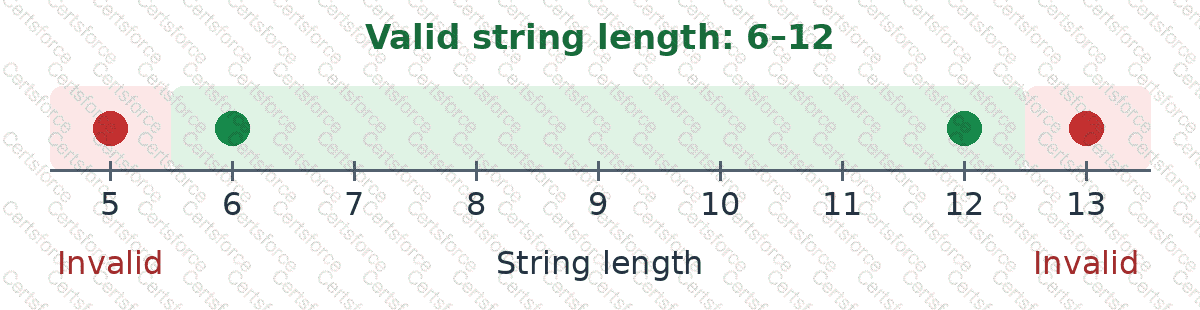
Which ONE of the following input-value sets provides 100% coverage of two boundary values for the string length?
Which TWO of the following system-hardening types is Jason planning to perform?
Choose two.
An auditor is tasked with assessing the effectiveness of security policies and procedures at an international organization that operates in a highly regulated domain.
Which ONE of the following could be an ADEQUATE source for extracting criteria to evaluate the adequacy of that organization’s security policies and procedures?
John is conducting a security review of a system architecture. In particular, he is responsible for assessing compliance with the IEEE Computer Society Center for Secure Design recommendations and has identified the following architectural approaches:
I. Establish trust automatically for all components operating within the organization's internal network.
II. Use an authentication mechanism that cannot be bypassed or tampered with.
III. Ensure that authorization decisions are performed only after successful authentication.
IV. Allow control instructions received from external systems to be processed without validation when those systems are considered trusted.
V. Validate input data only when it originates from external or unidentified sources.
VI. Understand how integrating external components affects the system's attack surface and introduces potential security risks.
Which ONE of the following options identifies all the architectural approaches that comply with the IEEE Computer Society Center for Secure Design recommendations?
Which ONE of the following options is LEAST IMPORTANT when planning for and obtaining approvals before carrying out security tests?