Boundary Value Analysis (BVA) is a specification-based test design technique used to identify defects occurring at the boundaries between equivalence partitions. It is particularly relevant to security testing because incorrect input-length restrictions can contribute to inadequate input validation, application instability and other security weaknesses.
The original question stem omits the permitted string-length range. The accompanying material establishes a minimum permitted length of six characters and a maximum permitted length of twelve characters.
Under two-value boundary value analysis, each boundary is tested using the boundary value and its closest neighboring value in the adjacent equivalence partition.
The required coverage values are:
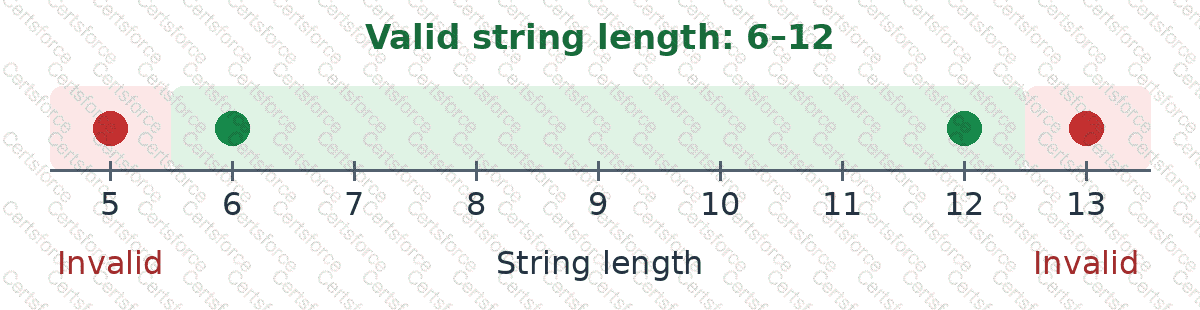
Illustration of two-value boundary coverage.
Test input
Length
Expected length validation
aB#@5
5
Rejected
aB#@56
6
Accepted
bbBb?!bB48bb
12
Accepted
abCd?!gH48klm
13
Rejected
Option B contains all four required boundary coverage values: 5, 6, 12 and 13.
Option A substitutes an eleven-character string for the required twelve-character value. Option C omits the five-character boundary value. Option D omits both six and thirteen.
Consequently, option B provides complete two-value boundary coverage for the specified length restriction. This establishes coverage of string-length boundaries, rather than complete security coverage of every possible string characteristic.
Official Reference: ISTQB CT-SEC Syllabus 2016, Sections 3.3.1 – Security Test Design and 4.4.2 – Security Test Design at the Component Level. Supporting technique: ISTQB Foundation Level – Boundary Value Analysis.


Submit