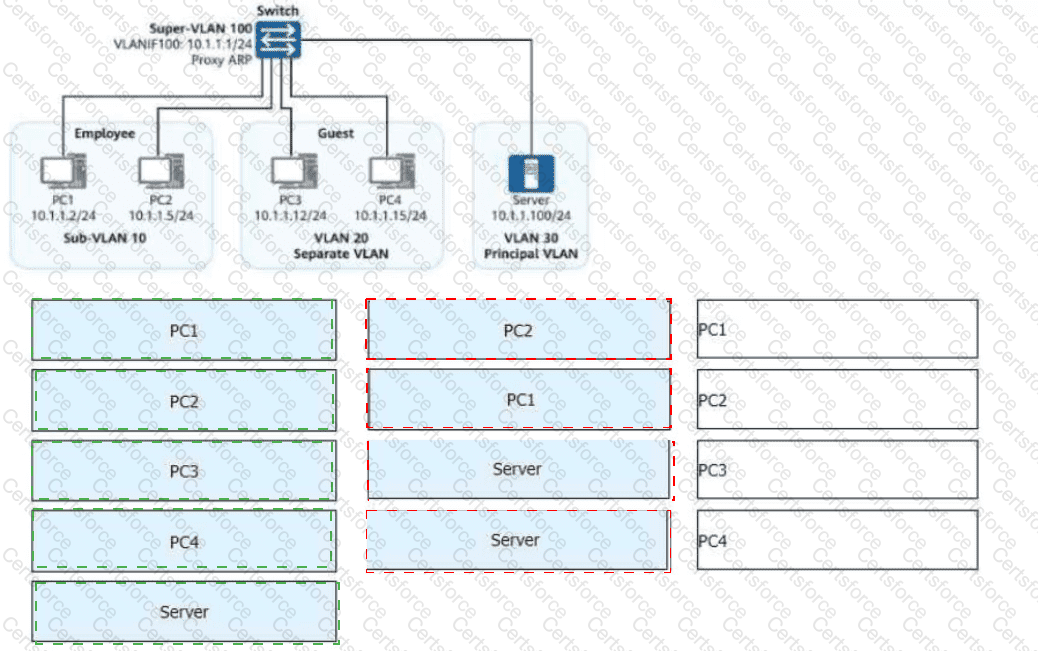
The figure shows information about an LSP generated by an IS-IS router. Which of the following conclusions is not drawn from the LSP information?
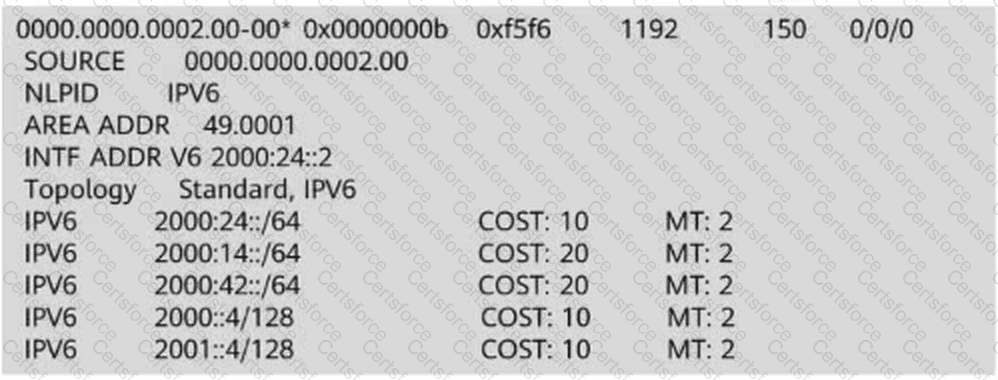
On the OSPF network shown in the figure, area 1 is a stub area, area 2 is a totally stub area, and area 3 is an NSSA. By default, which of the following routers does not have default routes in its routing table?
Type 7 LSAs, used to describe imported external routes, were introduced to support NSSAs. They are generated by autonomous system boundary routers (ASBRs) in NSSAs. The flooding scope of Type 7 LSAs is similar to that of Type 5 LSAs. That is, besides being flooded to common areas and stub areas, Type 7 LSAs are also flooded to all NSSAs on the OSPF network.
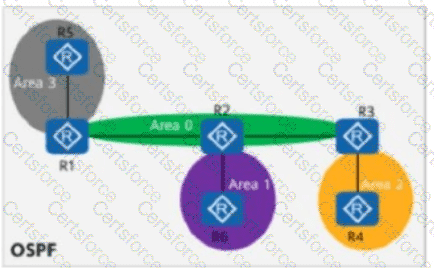
On the IS-IS network shown in the figure, R1 imports a default route using the default-route-advertise always level-1 command. Which of the following statements is false?
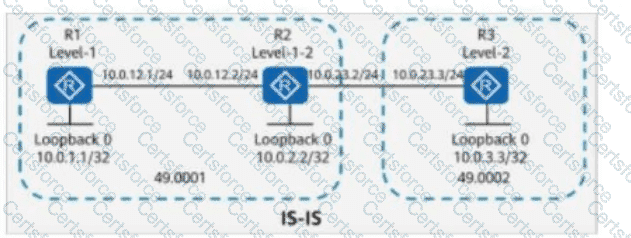
If end-to-end QoS is configured on an MPLS network, the penultimate hop device on the MPLS network can pop MPLS labels from packets based on penultimate hop popping (PHP), so that the egress node can process packets based on the QoS priority in inner packets.
The figure shows information about VPN1 on a PE (Provider Edge) router in a BGP/MPLS IP VPN network.
When the VPNv4 route corresponding to VPN1 is advertised to the remote PE, which VPNs of the remote PE will accept the route?
VPN1 Configuration:
ip vpn-instance VPN1
ipv4-family
route-distinguisher 100:1
vpn-target 100:1 200:1 300:1 export-extcommunity
VPN Import Policies on the Remote PE:
OSPFv3 packets are encapsulated in IPv6 packets and can be sent in unicast, multicast, or broadcast mode.
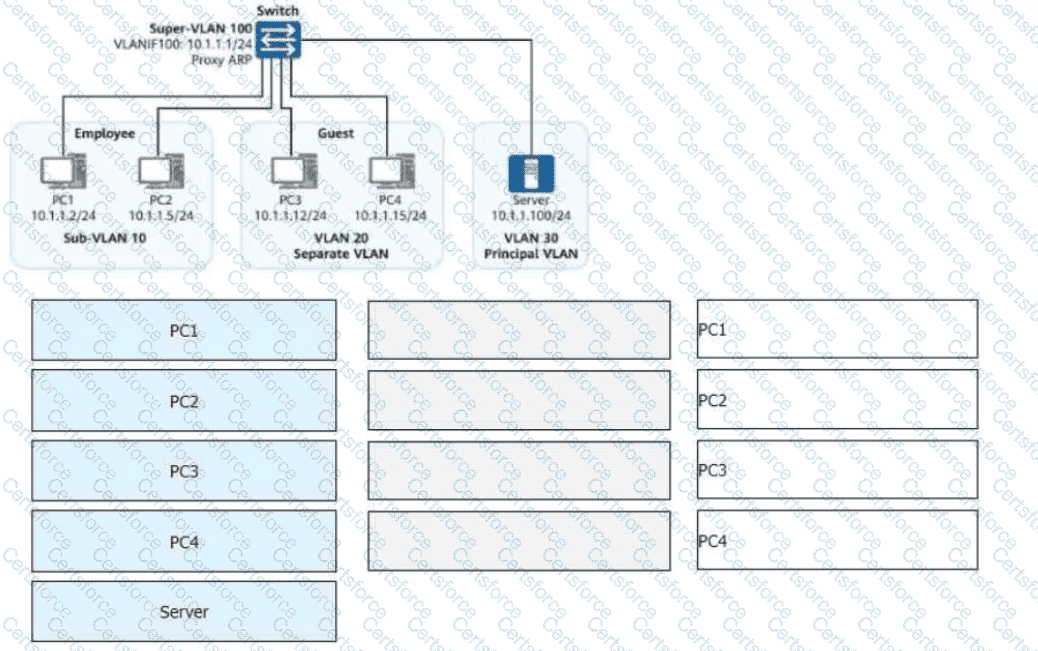
Both VLAN aggregation and MUX VLAN are deployed on the enterprise network shown in the figure.
All switch interfaces connected to terminals are access interfaces.
Given this, match PC1 to PC4 with the hosts or servers they can access on the network.
(Note: A host cannot be matched with itself. For example, PC1 cannot match PC1. Tokens can be reused.)
On the IS-IS IPv6 network shown in the figure, multi-topology is enabled on all routers.
The ipv6 default-route-advertise always level-1 command is configured in the IS-IS process of R4.
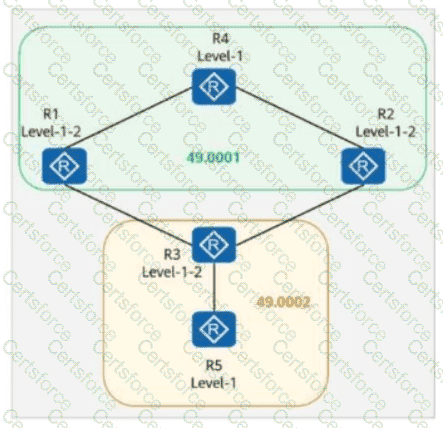
Which of the following routers does not have the default route in its routing table?
On an enterprise network shown in the figure, if CE2 is dual-homed to PE2 and PE3, a routing loop may occur during the exchange of Type 5 LSAs (External LSAs in OSPF).
To prevent the loop, the route-tag command can be run on PE2 and PE3.
In this way, if the route tag of the route received by PE3 is the same as that configured locally, the route is ignored.
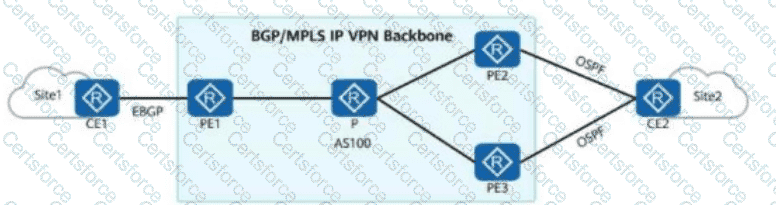
Is this statement True or False?