Black Friday Reward - Upto 75% off - Ends in 0d 00h 00m 00s - Coupon code: CFsave75

Pass the HP HPE Networking HPE7-A12 Questions and answers with CertsForce

Viewing page 2 out of 3 pages
Viewing questions 11-20 out of questions
Questions # 11:

What is the recommended practice for using VSX at the core of a two-tier design?

Options:

A.

You should implement VSX at the core when the access layer operates at layer 2 only.


B.

You should never implement VSX at the core of a two-tier design.


C.

You should implement VSX at the core when the access switches implement EVPN VXLAN.


D.

You should implement VSX at the core when the access is layer 3 only with OSPF routed traffic forwarding between core and access.


Expert Solution
Questions # 12:

You have designed an L3 spine-and-leaf topology for a customer’s highly virtualized VMware vSphere data center. The customer already uses HPE Aruba Networking mobility and switching solutions in the campus. You are recommending CX 8325 and CX 9300 switches and Fabric Composer. The customer asks you to justify the cost of the Fabric Composer licenses.

What should you explain?

Options:

A.

This solution enables the customer to monitor the data center and campus solutions from the same cloud console, eliminating travel costs.


B.

This solution ' s deep integration with vSphere saves IT time and eliminates costly errors with features like automatic VLAN provisioning.


C.

This solution ' s integration with ITSMs such as ServiceNow helps customers troubleshoot more quickly.


D.

This solution uses agentic AI to run the network automatically, reducing IT operational costs.


Expert Solution
Questions # 13:

Refer to the exhibit.

Question # 13

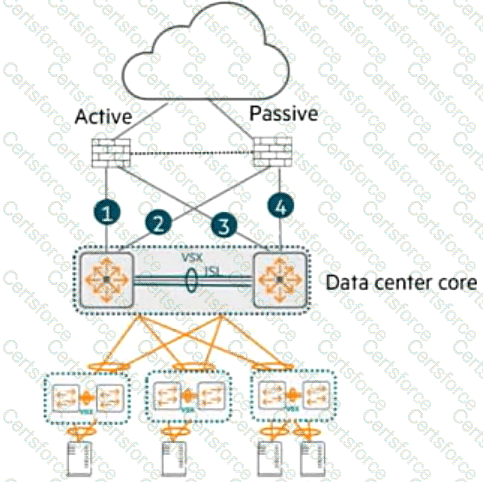
You are designing a data center network. The customer requests that you connect the data center core to their firewalls. The customer uses six VRFs for segmentation, and the firewalls are responsible for handling traffic in all of the VRFs.

What is the recommended design for the links between the data center core switches and the firewalls?

Options:

A.

Each link should be a routed-only port (ROP) in a /31 subnet.


B.

Link 1 and Link 3 should be one VSX LAG. Link 2 and Link 4 should be another VSX LAG.


C.

All links should be in the same VSX LAG.


D.

Link 1 and Link 2 should be one VSX LAG. Link 3 and Link 4 should be another VSX LAG.


Expert Solution
Questions # 14:

A customer is upgrading its data-center structured cabling to SMF. At the same time, the customer wants to upgrade the spine switches in its spine-and-leaf topology. A key objective of this upgrade is to eventually support 400GbE leaf-to-spine links. However, for some time, many leaf switches will continue to support 100GbE uplinks.

What is a valid recommendation for the spine switches?

Options:

A.

CX 9300-32D switches using 400G QSFP-DD MPO-16 transceivers


B.

CX 9300-32D switches using 4x100G DR QSFP-DD transceivers


C.

CX 10040 switches using 400G QSFP-DD MPO-16 transceivers


D.

CX 10040 switches using 4x100G DR QSFP-DD transceivers


Expert Solution
Questions # 15:

Which characteristics are important to mention when discussing potential VMware host connections to server-access switches?

Options:

A.

LACP is an old protocol and should no longer be used.


B.

Source MAC Load balancing is always the best option.


C.

VMware ESXi requires the appropriate license to support LACP.


D.

Only bare metal servers running Windows Server or Oracle Solaris can use LACP.


Expert Solution
Questions # 16:

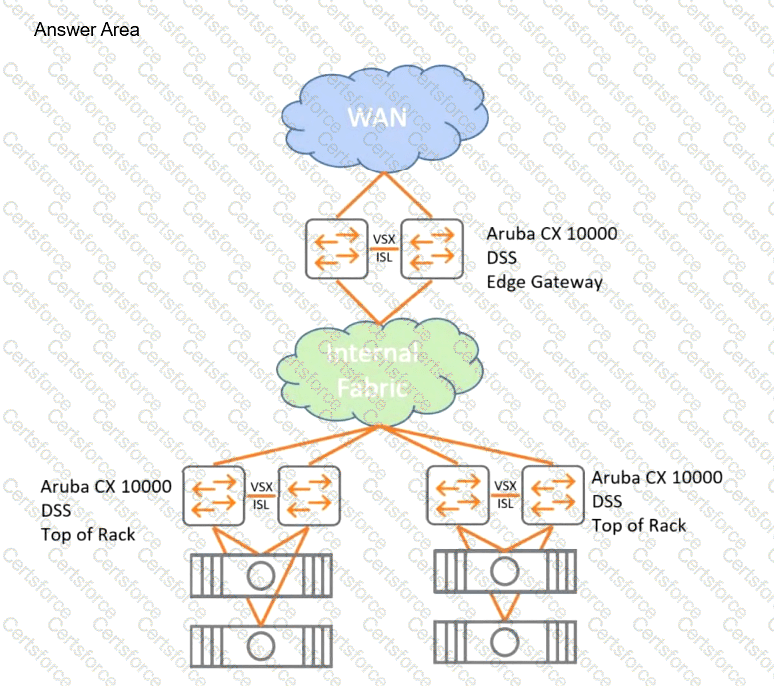
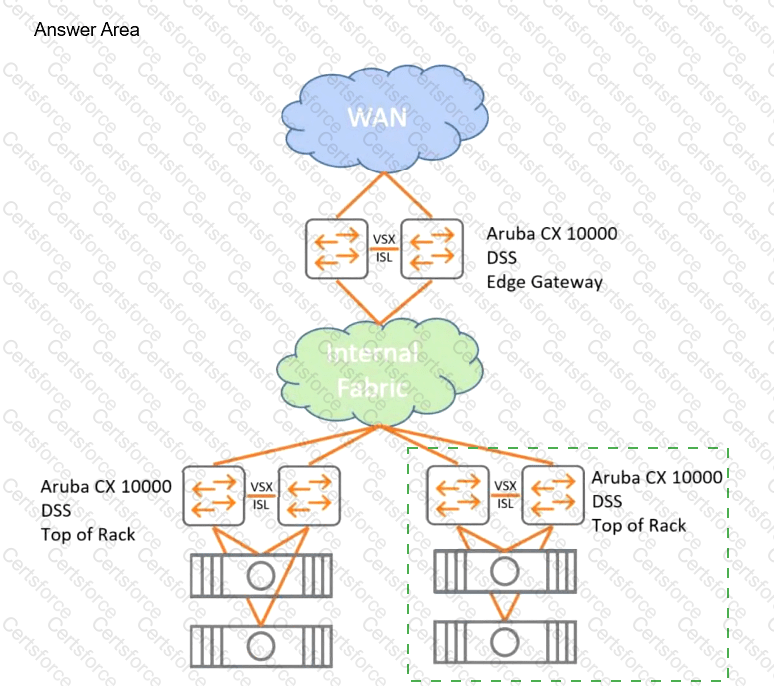
Click the location where you would implement the CX 10000 network-segmentation policy in this data-center deployment.
Question # 16


Expert Solution
Questions # 17:

Can EVPN/VXLAN fabrics be configured to provide protection against Layer 2 loops?

Options:

A.

No, a Layer 2 loop on VXLAN Infrastructure is not possible.


B.

Yes, using Spanning-Tree over VXLAN


C.

No, AOS-CX does not support such capability.


D.

Yes, using Loop Protection over VXLAN.


Expert Solution
Questions # 18:

The customer runs a 24/7 production facility and is concerned that the migration could interrupt the production line.

Which two approaches can minimize or eliminate this disruption? Choose two.

Options:

A.

Whenever possible, ramp up the new infrastructure in parallel and do transparent switching from old to new core switch.


B.

Replace one access switch at a time and patch the ports by using a patch plan.


C.

Create a Migration Plan which describes a phased approach, i.e. access layer first, distribution layer second, etc.


D.

Close the production site for at least 1 day to do a big-bang approach


Expert Solution
Questions # 19:

You are selecting switches for a new rack that must support several traffic types, including HTTPS multicast streaming and iSCSI traffic. You are deciding between the CX 8360v2-32Y6C and CX 8325-48Y8C models, both of which satisfy the rack’s port requirements.

Which technical requirement should lead you toward the 8325 model?

Options:

A.

A requirement to route the multicast traffic across multiple subnets


B.

A requirement to support a mix of 10GbE and 25GbE server connections


C.

A requirement to allocate two different specific amounts of buffer space to platinum-tier and to gold-tier iSCSI storage


D.

A requirement to support both IP ECN AND PFC


Expert Solution
Questions # 20:

In a multi-fabric design, what is the minimum recommended MTU?
Options:

A.

1450


B.

1512


C.

9000


D.

9198


Expert Solution
Viewing page 2 out of 3 pages
Viewing questions 11-20 out of questions