
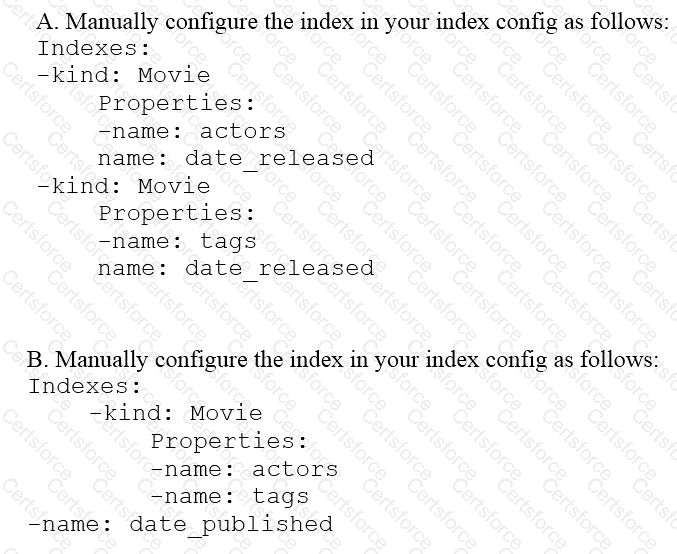
You are deploying a new storage system for your mobile application, which is a media streaming service. You decide the best fit is Google Cloud Datastore. You have entities with multiple properties, some of which can take on multiple values. For example, in the entity ‘Movie’ the property ‘actors’ and the property ‘tags’ have multiple values but the property ‘date released’ does not. A typical query would ask for all movies with actor=<actorname> ordered by date_released or all movies with tag=Comedy ordered by date_released. How should you avoid a combinatorial explosion in the number of indexes?
You work for an economic consulting firm that helps companies identify economic trends as they happen. As part of your analysis, you use Google BigQuery to correlate customer data with the average prices of the 100 most common goods sold, including bread, gasoline, milk, and others. The average prices of these goods are updated every 30 minutes. You want to make sure this data stays up to date so you can combine it with other data in BigQuery as cheaply as possible. What should you do?
Your company has recently grown rapidly and now ingesting data at a significantly higher rate than it was previously. You manage the daily batch MapReduce analytics jobs in Apache Hadoop. However, the recent increase in data has meant the batch jobs are falling behind. You were asked to recommend ways the development team could increase the responsiveness of the analytics without increasing costs. What should you recommend they do?
You work for a manufacturing plant that batches application log files together into a single log file once a day at 2:00 AM. You have written a Google Cloud Dataflow job to process that log file. You need to make sure the log file in processed once per day as inexpensively as possible. What should you do?
You are designing the database schema for a machine learning-based food ordering service that will predict what users want to eat. Here is some of the information you need to store:
The user profile: What the user likes and doesn’t like to eat
The user account information: Name, address, preferred meal times
The order information: When orders are made, from where, to whom
The database will be used to store all the transactional data of the product. You want to optimize the data schema. Which Google Cloud Platform product should you use?
Which of the following job types are supported by Cloud Dataproc (select 3 answers)?
What are two of the benefits of using denormalized data structures in BigQuery?
Suppose you have a dataset of images that are each labeled as to whether or not they contain a human face. To create a neural network that recognizes human faces in images using this labeled dataset, what approach would likely be the most effective?
Which of the following is NOT one of the three main types of triggers that Dataflow supports?
You work for a bank. You have a labelled dataset that contains information on already granted loan application and whether these applications have been defaulted. You have been asked to train a model to predict default rates for credit applicants.
What should you do?
