Which three statements accurately describe step utilities in a playbook step? (Choose three answers)
Refer to the exhibit.
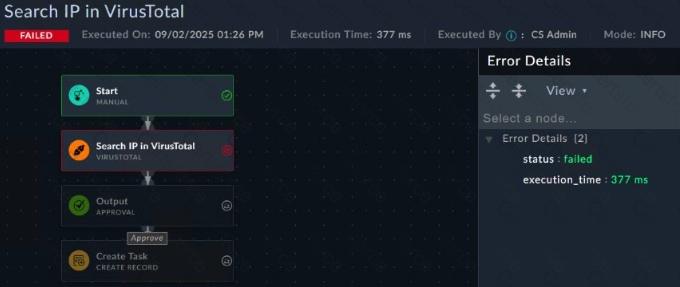
You created a new playbook and executed it as a test. However, it failed to run. You want to investigate, but you do not see details about the error. What is the reason for the lack of details?
Which two phases are part of the FortiSOAR incident handling process but are not phases in the NIST 800-61 Revision 2 model? Choose two answers.
Review the incident report. Shortly after being compromised, an infected host collected its own network configuration and connection details, then began sending low-volume connection attempts to multiple internal addresses to identify responding hosts. Which two MITRE ATT & CK techniques best describe this activity? Choose two answers.
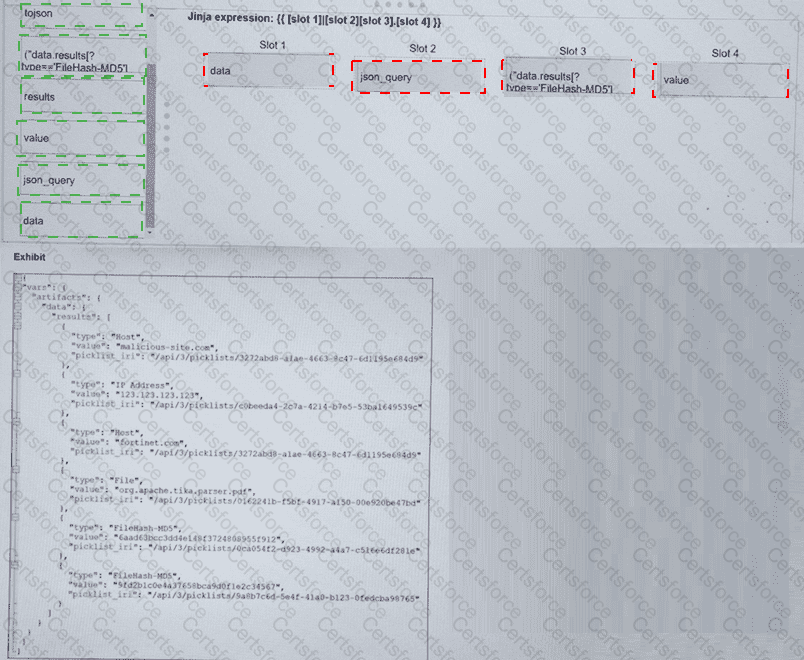
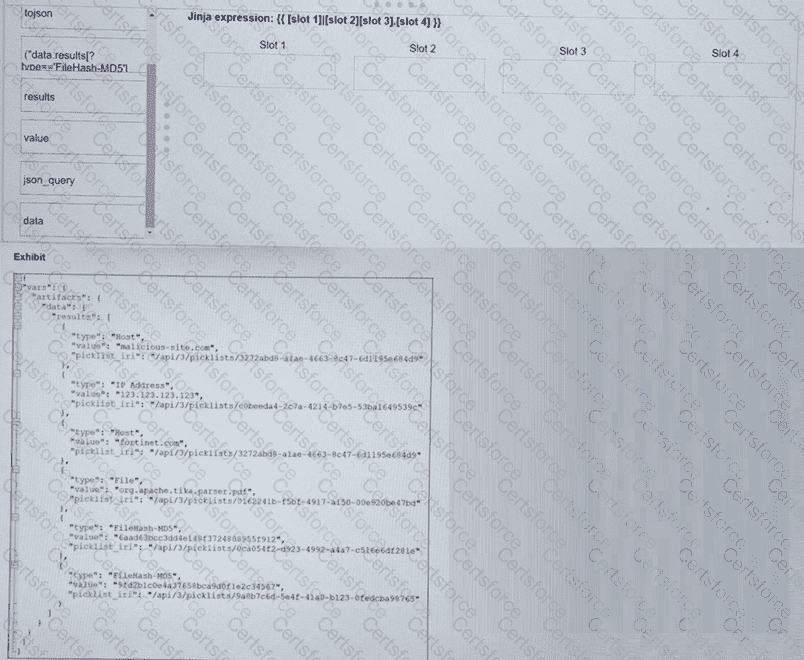
Refer to the exhibit. What is the correct Jinja expression to filter the results to show only the MD5 hash values?
{{ [slot 1] | [slot 2] [slot 3].[slot 4] }}
Select the Jinja expression in the left column, hold and drag it to a blank position on the right. Place the four correct steps in order, placing the first step in the first slot.
Refer to Exhibit:
A SOC analyst is designing a playbook to filter for a high severity event and attach the event information to an incident.
Which local connector action must the analyst use in this scenario?
Refer to the exhibits.
What can you conclude from analyzing the data using the threat hunting module?
Refer to the Exhibit:
An analyst wants to create an incident and generate a report whenever FortiAnalyzer generates a malicious attachment event based on FortiSandbox analysis. The endpoint hosts are protected by FortiClient EMS integrated with FortiSandbox. All devices are logging to FortiAnalyzer.
Which connector must the analyst use in this playbook?
According to the National Institute of Standards and Technology (NIST) cybersecurity framework, incident handling activities can be divided into phases.
In which incident handling phase do you quarantine a compromised host in order to prevent an adversary from using it as a stepping stone to the next phase of an attack?
An analyst prioritizes blocking IP addresses and domains from every phishing campaign. Based on the Pyramid of Pain model, which two statements accurately describe this approach? Choose two answers.