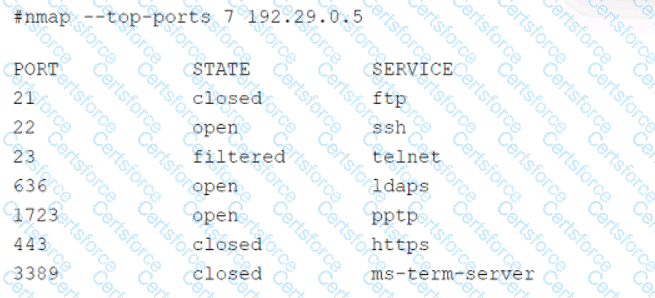
The output shows the results of a port scan, which is a technique used to identify open ports and services running on a network host. Port scanning can be used by attackers to discover potential vulnerabilities and exploit them, or by defenders to assess the security posture and configuration of their network devices1
The output lists six ports that are open on the target host, along with the service name and version associated with each port. The service name indicates the type of application or protocol that is using the port, while the version indicates the specific release or update of the service. The service name and version can provide useful information for both attackers and defenders, as they can reveal the capabilities, features, and weaknesses of the service.
Among the six ports listed, two are particularly risky and should be investigated further by the security team: port 23 and port 636.
Port 23 is used by Telnet, which is an old and insecure protocol for remote login and command execution. Telnet does not encrypt any data transmitted over the network, including usernames and passwords, which makes it vulnerable to eavesdropping, interception, and modification by attackers. Telnet also has many known vulnerabilities that can allow attackers to gain unauthorized access, execute arbitrary commands, or cause denial-of-service attacks on the target host23
Port 636 is used by LDAP over SSL/TLS (LDAPS), which is a protocol for accessing and modifying directory services over a secure connection. LDAPS encrypts the data exchanged between the client and the server using SSL/TLS certificates, which provide authentication, confidentiality, and integrity. However, LDAPS can also be vulnerable to attacks if the certificates are not properly configured, verified, or updated. For example, attackers can use self-signed or expired certificates to perform man-in-the-middle attacks, spoofing attacks, or certificate revocation attacks on LDAPS connections.
Therefore, the security team should investigate further why port 23 and port 636 are open on the target host, and what services are running on them. The security team should also consider disabling or replacing these services with more secure alternatives, such as SSH for port 23 and StartTLS for port 6362


Submit