Pre-Summer Special Limited Time 70% Discount Offer - Ends in 0d 00h 00m 00s - Coupon code: force70

Pass the Fortinet Fortinet Network Security Expert NSE6_SDW_AD-7.6 Questions and answers with CertsForce

Viewing page 2 out of 3 pages
Viewing questions 11-20 out of questions
Questions # 11:

(Refer to the exhibits.
Question # 11

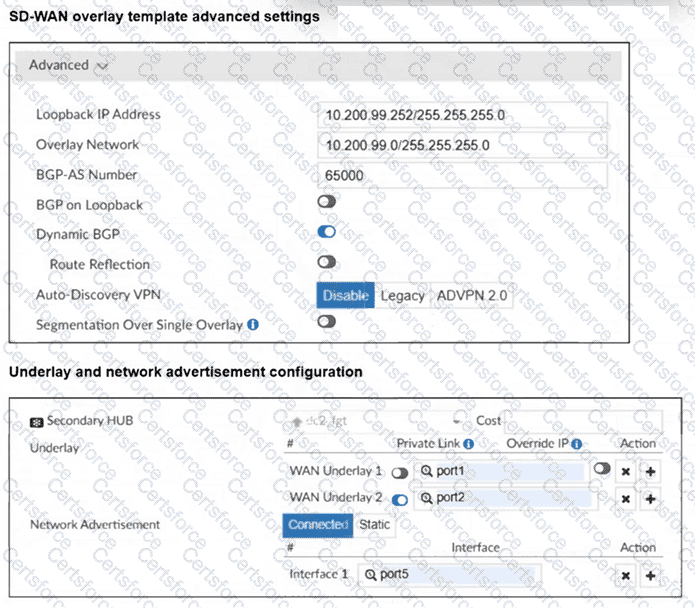
The SD-WAN overlay template advanced settings and the underlay and network advertisement settings are shown. These are the configurations for the secondary hub of a dual-hub SD-WAN topology created with the FortiManager SD-WAN overlay orchestrator.

Which two conclusions can you draw from the information shown in the exhibits? Choose two answers.)

Options:

A.

FortiManager will define port2 as a BGP neighbor.


B.

FortiManager will create an overlay tunnel on the port2 interface.


C.

FortiManager will create an overlay tunnel on the port1 interface.


D.

FortiManager will define port5 as a BGP neighbor.


Expert Solution
Questions # 12:

(You are configuring SD-WAN to load balance network traffic and you want to take into account the link quality.

Which two facts should you consider? Choose two answers.)

Options:

A.

When applicable, FortiGate load balances the traffic through all members that meet the SLA target.


B.

You can select the best quality strategy and allow SD-WAN load balancing.


C.

You can select the lowest cost service level agreement (SLA) strategy and allow SD-WAN load balancing.


D.

The best quality strategy supports only the round-robin hash mode.


Expert Solution
Questions # 13:

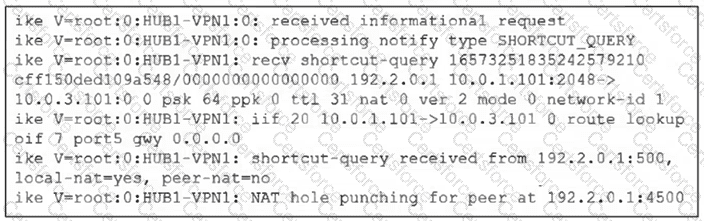
(Refer to the exhibit.

Question # 13

Which statement correctly describes the role of the ADVPN device in handling traffic? Choose one answer.)

Options:

A.

This device is a spoke that has received a direct shortcut query from a remote spoke.


B.

This device is a hub, and two spokes, 192.2.0.1 and 10.0.3.101, established a shortcut.


C.

This device is a hub that has received a shortcut query from a spoke and has forwarded it to another spoke.


D.

This device is a spoke that has received a shortcut query from a remote hub.


Expert Solution
Questions # 14:

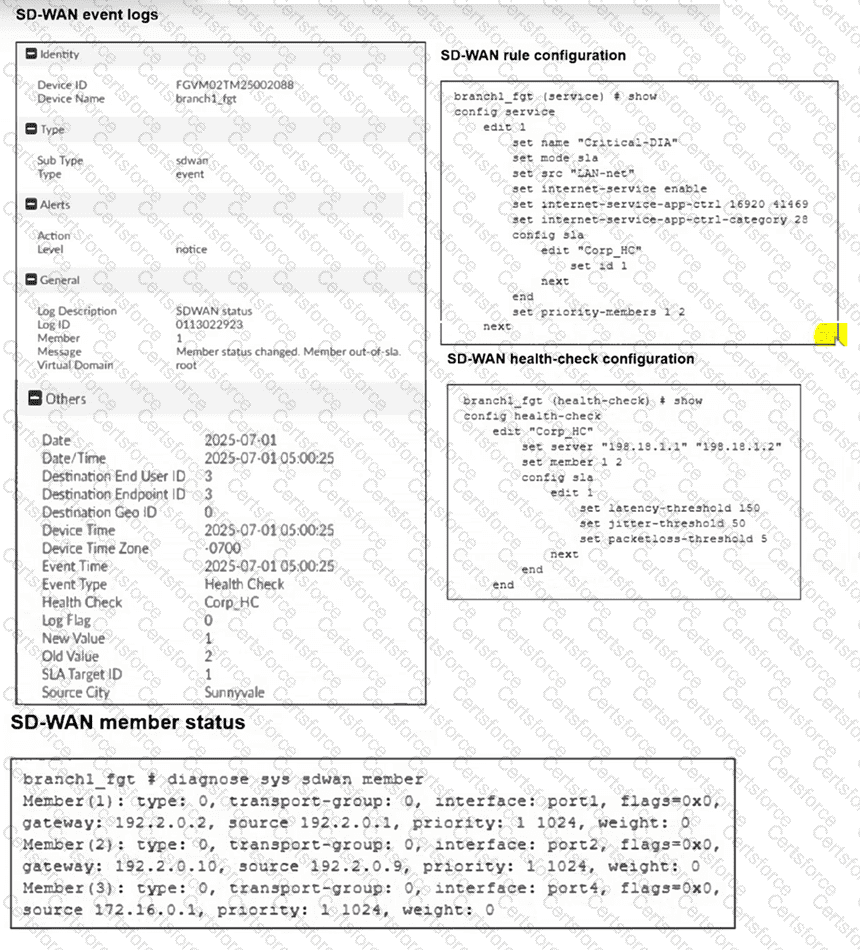
(Refer to the exhibits.

Question # 14

Two SD-WAN event logs, the member status, the SD-WAN rule configuration, and the health-check configuration for a FortiGate device are shown.

Immediately after the log messages are displayed, how will the FortiGate steer the traffic based on the information shown in the exhibits? Choose one answer.)

Options:

A.

FortiGate skips SD-WAN rule ID 1.


B.

FortiGate uses port2 to steer the traffic for SD-WAN rule ID 1.


C.

FortiGate uses port1 to steer the traffic for SD-WAN rule ID 1.


D.

FortiGate uses port1 or port2 to steer the traffic for SD-WAN rule ID 1.


Expert Solution
Questions # 15:

You have configured the performance SLA with the probe mode as Prefer Passive.

What are two observable impacts of this configuration? (Choose two.)

Options:

A.

FortiGate passively monitors the member if TCP traffic is passing through the member.


B.

After FortiGate switches to active mode, the SLA performance rule falls back to passive monitoring after 3 minutes.


C.

FortiGate passively monitors the member if ICMP traffic is passing through the member.


D.

During passive monitoring, the SLA performance rule cannot detect dead members.


E.

FortiGate can offload the traffic that is subject to passive monitoring to hardware.


Expert Solution
Questions # 16:

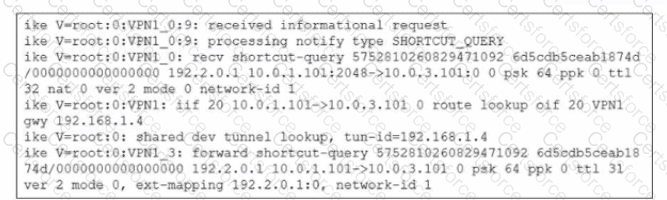
Refer to the exhibit.

Question # 16

Which statement best describe the role of the ADVPN device in handling traffic?

Options:

A.

This is a hub that has received a query from a spoke and has forwarded it to another spoke.


B.

This is a hub in a dual-region topology. The remote hub tunnel ID is 10.0.2.101.


C.

This is a spoke that has received a shortcut query from another spoke and has forwarded the response to its hub.


D.

This is a spoke. The kernel received a shortcut request and forwards the query to another spoke.


Expert Solution
Questions # 17:

Within the context of SD-WAN, what does SIA correspond to?

Options:

A.

Remote Breakout


B.

Local Breakout


C.

Software Internet Access


D.

Secure Internet Authorization


Expert Solution
Questions # 18:

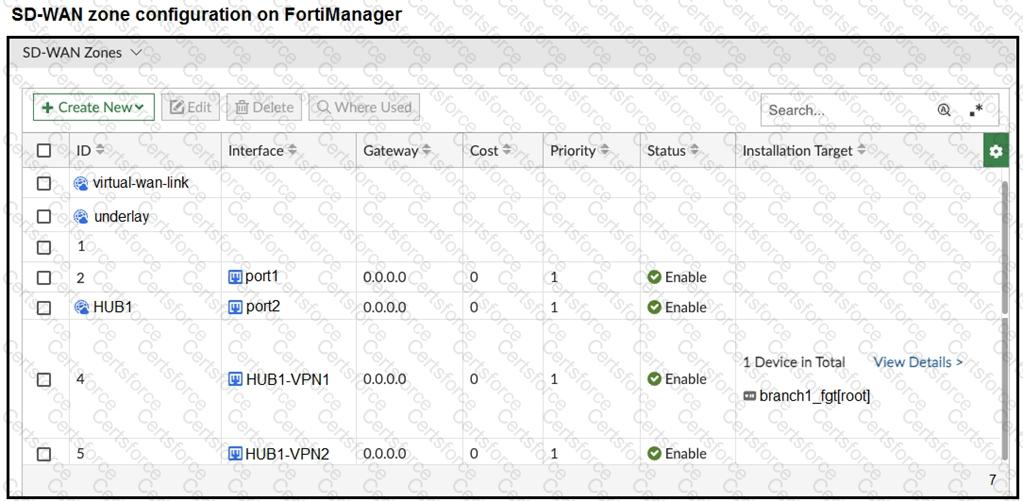
Refer to the exhibits.

Question # 18

Question # 18

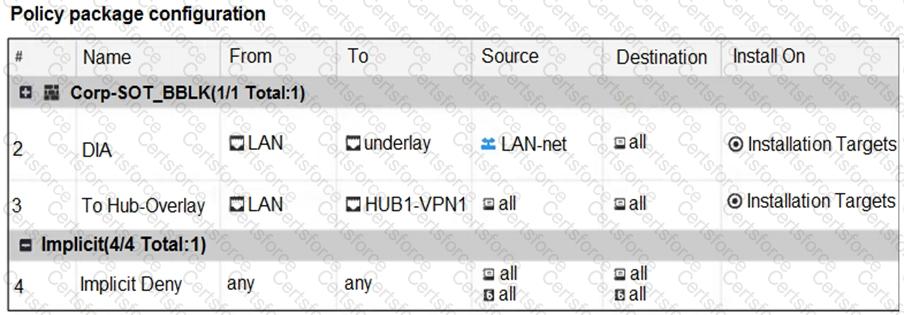
The exhibits show the SD-WAN zone configuration of an SD-WAN template prepared on FortiManager and the policy package configuration.

When the administrator tries to install the configuration changes, FortiManager fails to commit.

What should the administrator do to fix the issue?

Options:

A.

Configure branch1_fgt as the installation target for policy 3.


B.

Configure HUB1 as the destination of policy 3.


C.

Configure a normalized interface for the IPsec tunnel HUB1-VPN1.


D.

Configure both HUB1-VPN1 and HUB1-VPN2 as the destination of policy 3


Expert Solution
Questions # 19:

Refer to the exhibit.

Question # 19

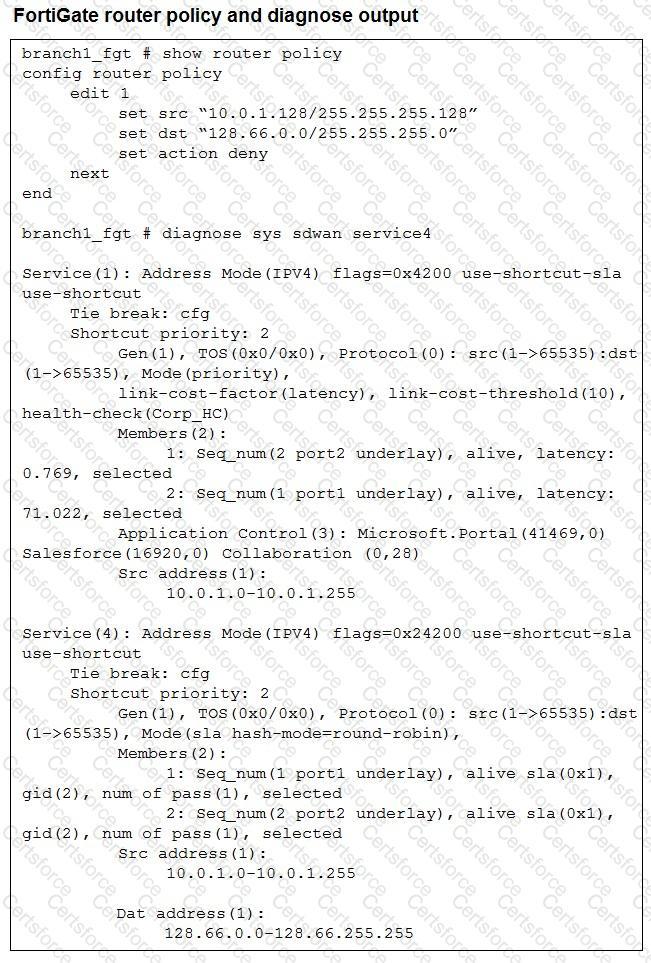
How does FortiGate handle the traffic with the source IP 10.0.1.130 and the destination IP 128.66.0 125?

Options:

A.

FortiGate routes the traffic flow according to the FIB.


B.

FortiGate load balances the traffic flow through port1 and port2.


C.

FortiGate drops the traffic flow.


D.

FortiGate steers the traffic flow through port2.


Expert Solution
Questions # 20:

(In which order does FortiGate consider the following elements during the route lookup process? Choose one answer.)

Options:

A.

SD-WAN rules, ISDB routes, policy routes, BGP routes


B.

Policy routes, SD-WAN rules, Internet Service Database (ISDB) routes, BGP routes


C.

SD-WAN rules, policy routes, static routes, ISDB routes


D.

Policy routes, ISDB routes, SD-WAN rules, static routes


Expert Solution
Viewing page 2 out of 3 pages
Viewing questions 11-20 out of questions