
Black Friday Reward - Upto 80% off - Ends in 0d 00h 00m 00s - Coupon code: VIP80

Pass the Fortinet Fortinet Network Security Expert NSE4_FGT_AD-8.0 Questions and answers with CertsForce

Viewing page 2 out of 4 pages
Viewing questions 11-20 out of questions
Questions # 11:

In a full-mesh VPN topology without network address translation (NAT), an administrator wants to sniff Encapsulating Security Payload (ESP) packets on FortiGate.

Which two sniffer commands can the administrator execute? (Choose two answers.)

Options:

A.

diagnose sniffer packet any ' proto 50 ' 2


B.

diagnose sniffer packet any ' port 500 ' 6


C.

diagnose sniffer packet any ' esp ' 5


D.

diagnose sniffer packet any ' port 4500 ' 4


Expert Solution
Questions # 12:

Original source entry: 91 • Security Rating

Which two statements about the Security Fabric rating are true? (Choose two answers)

Options:

A.

A license is required to obtain an executive summary in the Security Rating section.


B.

The root FortiGate provides executive summaries of all the FortiGate devices in the Security Fabric.


C.

The Security Posture category provides PCI compliance results.


D.

Security Rating Insights are available only in the Security Rating page.


Expert Solution
Questions # 13:

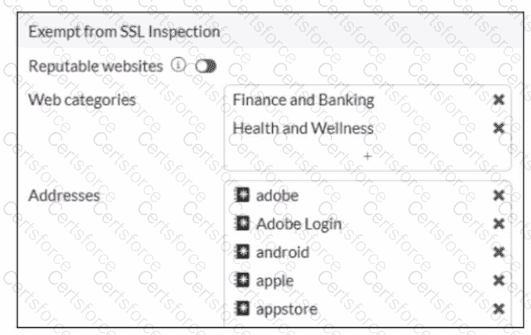
Refer to the exhibit.

The predefined deep-inspection and custom-deep-inspection profiles exclude some web categories from SSL inspection, as shown in the exhibit For which two reasons are these web categories exempted? (Choose two.)
Question # 13

Exhibit 1 — Source configuration / network evidence

Options:

A.

The resources utilization is optimized because these websites are in the trusted domain list on FortiGate.


B.

The legal regulation aims to prioritize user privacy and protect sensitive information for these websites.


C.

These websites are in an allowlist of reputable domain names maintained by FortiGuard.


D.

The FortiGate temporary certificate denies the browser ' s access to websites that use HTTP Strict Transport Security.


Expert Solution
Questions # 14:

Refer to the exhibits.

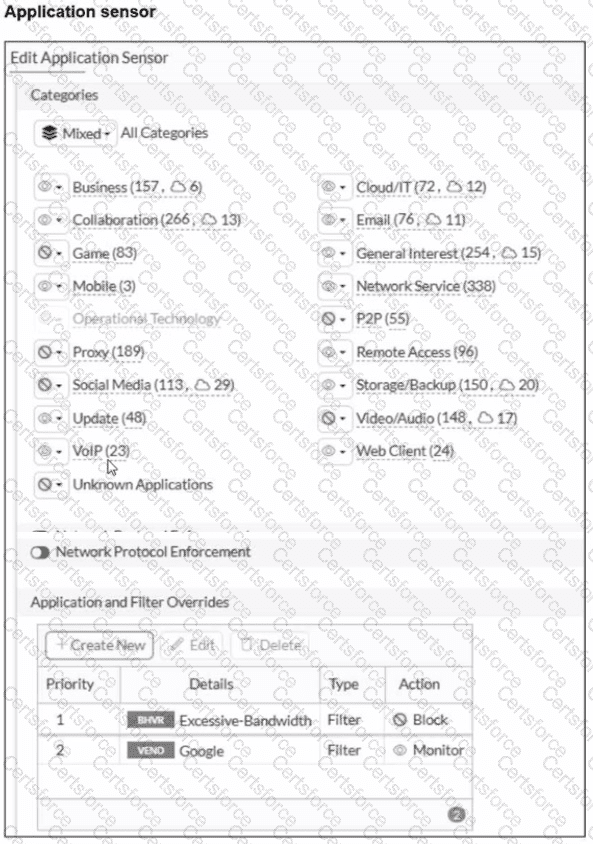
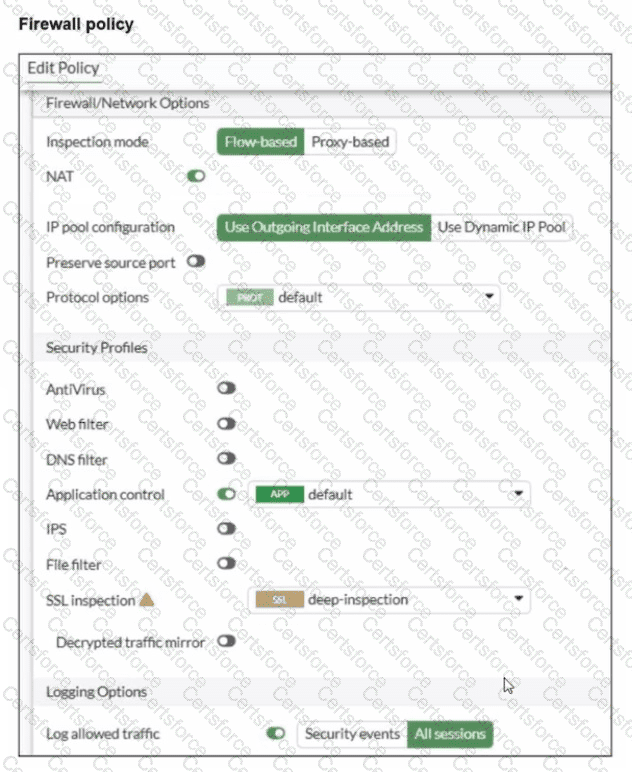
You have implemented the application sensor and the corresponding firewall policy as shown in the exhibits.

Which two factors can you observe from these configurations? (Choose two.)
Question # 14

Exhibit 1 — Source configuration / network evidence
Question # 14

Exhibit 2 — Source configuration / network evidence

Options:

A.

YouTube access is blocked based on Excessive-Bandwidth Application and Filter override settings.


B.

Facebook access is blocked based on the category filter settings.


C.

Facebook access is allowed but you cannot play Facebook videos based on Video/Audio category filter settings.


D.

YouTube search is allowed based on the Google Application and Filter override settings.


Expert Solution
Questions # 15:

Original source entry: 79 • FQDN static routing

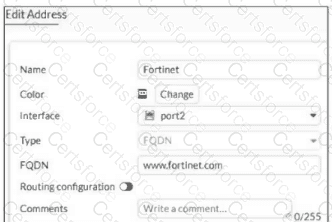
Refer to the exhibit.

An administrator has created a new firewall address to use as the destination for a static route. Why is the administrator not able to select the new address in the Destination field of the new static route? (Choose one answer)
Question # 15

Exhibit 1 — Source configuration / network evidence

Options:

A.

In the new static route, the administrator must select Named Address.


B.

In the new firewall address, the FQDN address must first be resolved.


C.

In the new static route, the administrator must first set the interface to port2.


D.

In the new firewall address, Routing configuration must be enabled.


Expert Solution
Questions # 16:

An administrator has configured a dialup IPsec VPN on FortiGate with add-route enabled. However, the static route is not showing in the routing table. Which two statements about this scenario are correct? (Choose two.)

Options:

A.

The administrator must use a policy route instead of a static route for add-route to work properly.


B.

The administrator must ensure phase 2 is successfully established


C.

The administrator must define the remote network correctly in the phase 2 selectors.


D.

The administrator must enable a dynamic routing protocol on the dialup interface.


Expert Solution
Questions # 17:

Original source entry: 93 • match-vip in deny policies

An administrator created a Deny policy with its default destination set to all to block Remote-User2 from a published Webserver. Remote-User1 must still access the Webserver. Which change makes the Deny policy more specific to the intended server? (Choose one answer.)
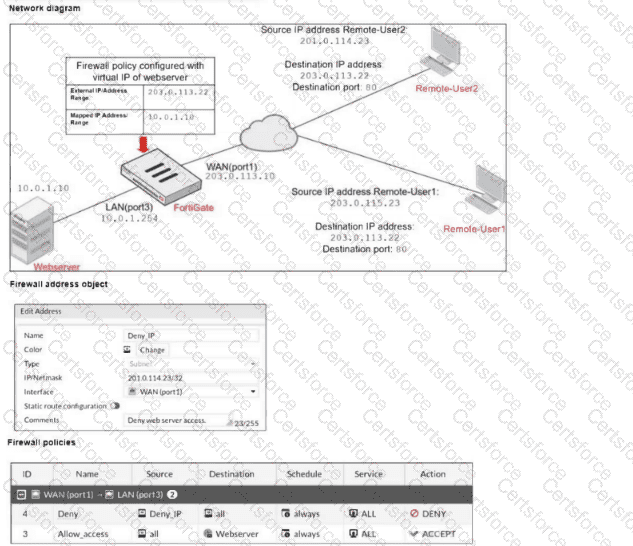
Question # 17

Exhibit 1 — Source configuration / network evidence

Options:

A.

Disable match-vip in the Allow_access policy.


B.

Configure a One-to-One IP Pool object in a new policy.


C.

Set the Destination address as Webserver in the Deny policy.


D.

Set the Destination address as Deny_IP in the Allow_access policy.


Expert Solution
Questions # 18:

Original source entry: 87 • Denied-session caching

An administrator has configured the following settings.

config system settings

set ses-denied-traffic enable

end

config system global

set block-session-timer 30

end

What are the two results of this configuration? (Choose two.)

Options:

A.

The number of logs generated by denied traffic is reduced.


B.

A session for denied traffic is created.


C.

Denied users are blocked for 30 minutes.


D.

Session helpers are disabled for denied traffic.


Expert Solution
Questions # 19:

Original source entry: 70 • Security Fabric object synchronization

An administrator creates a new address object on the root FortiGate (HQ-NGFW-1) in the Security Fabric. After synchronization, this object is not available on the downstream FortiGate (HQ-ISFW).

What must the administrator do to synchronize the address object?
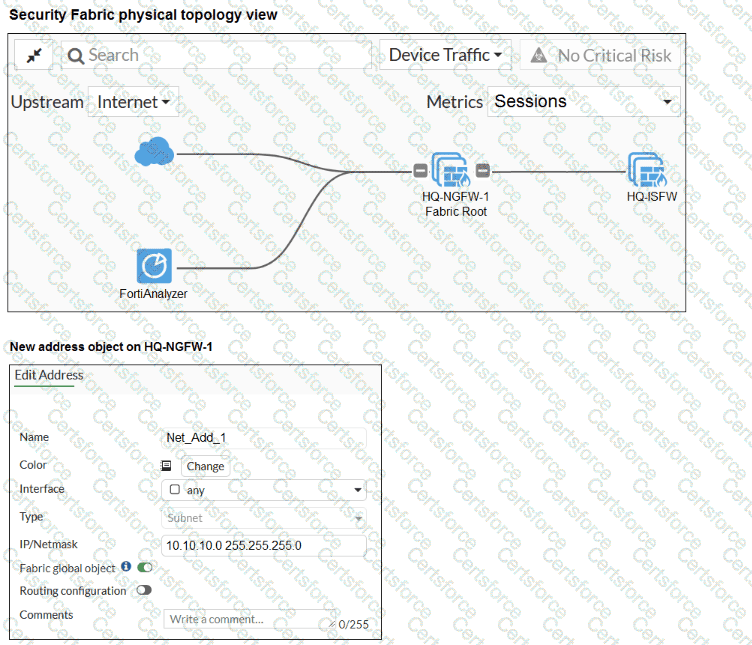
Question # 19

Exhibit 1 — Source configuration / network evidence
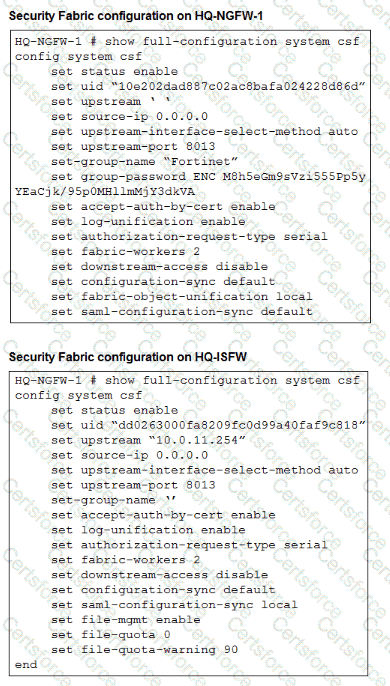
Question # 19

Exhibit 2 — Source configuration / network evidence

Options:

A.

Change the csf setting on HQ-ISFW (downstream) to set configuration-sync local.


B.

Change the csf setting on HQ-ISFW (downstream) to set saml-configuration-sync default.


C.

Change the csf setting on HQ-NGFW-1 (root) to set fabric-object-unification default.


D.

Change the csf setting on both devices to set downstream-access enable.


Expert Solution
Questions # 20:

Refer to the exhibits.

A diagram of a FortiGate device connected to the network VIP object and firewall policy configurations are shown.

The WAN (port2) interface has the IP address

100.65.0.101/24.

The LAN (port4) interface has the IP address

10.0.11.254/24.

If the host 100.65.1.111 sends a TCP SYN packet on port 443 to 100.65.0.200. what will the source address, destination address, and destination port of the packet be at the time FortiGate forwards the packet to the destination?
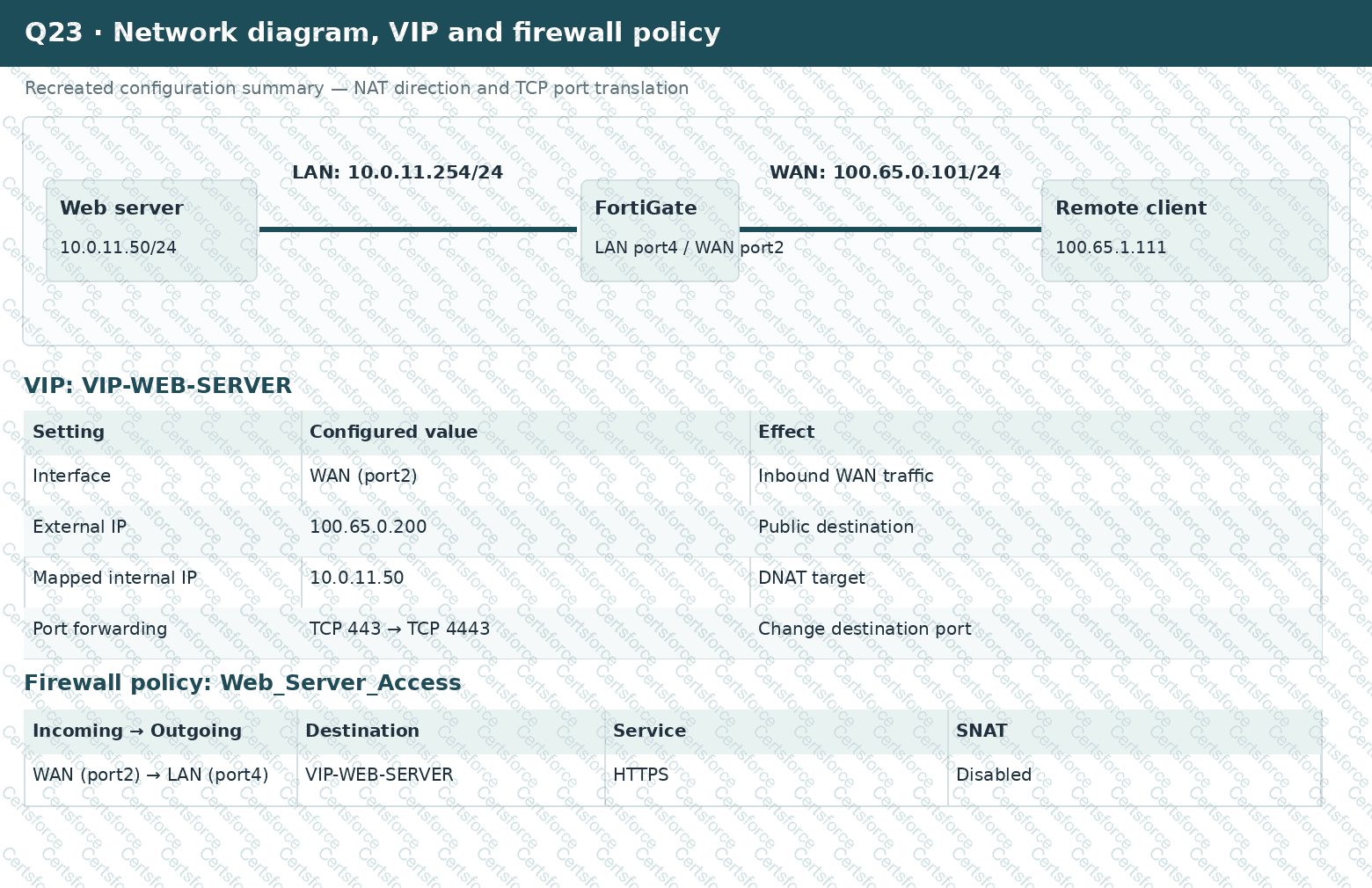
Question # 20

Exhibit 1 — Source configuration / network evidence

Options:

A.

10.0.11.254, 100.65.0.200. and 443, respectively


B.

10.0.11.254, 10.0.15.50, and 4443. respectively


C.

100.65.1. 111, 10.0.11.50, and 4443. respectively


D.

100.65.1.111, 10.0.11.50. and 443. respectively


Expert Solution
Viewing page 2 out of 4 pages
Viewing questions 11-20 out of questions