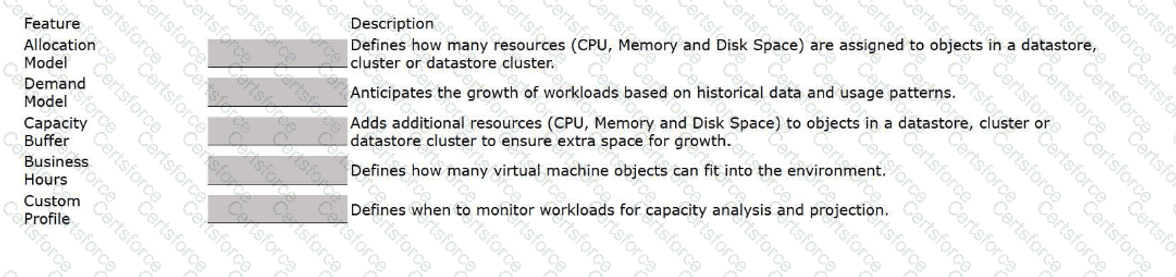
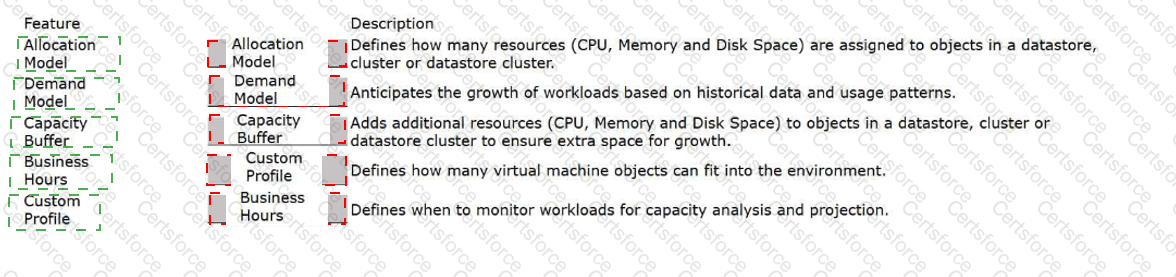
Match the VCF Operations capacity-based feature with its description by dragging and dropping the correct item from the Feature list on the left and placing it onto the Description list on the right.
The correct mapping reflects the capacity policy elements used by VCF Operations. The Allocation Model defines how much CPU, memory, or disk space is allocated to objects such as datastores, clusters, or datastore clusters; it is activated through policy and uses overcommit ratios for capacity calculations . The Demand Model predicts future resource requirements from historical data, usage patterns, trends, and workload behavior, allowing administrators to forecast when additional CPU, memory, storage, or network capacity will be needed . The Capacity Buffer element adds extra headroom for capacity and cost calculations, reducing usable capacity by the specified buffer so the environment retains space for growth . Business Hours define the time window used for capacity analysis and projections; after business hours are configured, capacity forecasting is based on those hours rather than a full 24-hour period . A Custom Profile defines a hypothetical VM configuration and calculates how many instances of that VM can fit in the environment based on remaining capacity and parent-object configuration . Reference topic: Objective 4.2 – Manage VCF Capacity / Capacity Models, Buffers, Business Hours, and Custom Profiles .
Contribute your Thoughts:
Chosen Answer:
This is a voting comment (?). You can switch to a simple comment. It is better to Upvote an existing comment if you don't have anything to add.


Submit