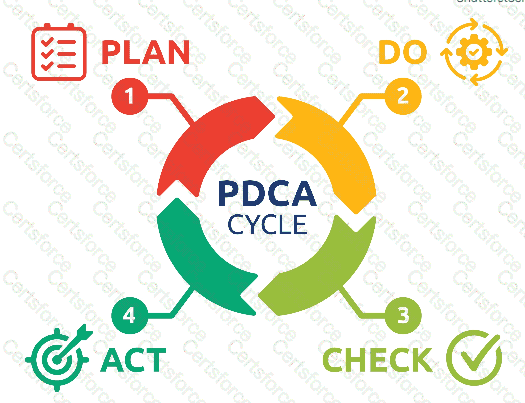
According to the PMBOK® Guide, specifically within the Project Quality Management Knowledge Area, the Plan-Do-Check-Act (PDCA) cycle is a foundational concept for iterative improvement.
The names most commonly associated with this cycle are Walter Shewhart and Edwards Deming.
Walter Shewhart: Originally developed the concept of the " Shewhart Cycle " at Bell Laboratories in the 1920s, focusing on the application of statistical methods to quality control.
Edwards Deming: Often called the " father of modern quality control, " Deming promoted and popularized the cycle in Japan in the 1950s. He referred to it as the " Shewhart Cycle " for learning and improvement, though it eventually became known globally as the Deming Cycle or PDCA.
The PDCA Stages:
Plan: Establish the objectives and processes necessary to deliver results.
Do: Implement the plan, execute the processes, and make the product.
Check: Study the actual results and compare against the expected results to identify differences.
Act: Request corrective actions on significant differences between actual and planned results.
Analysis of other choices:
Choice A (Pareto): Vilfredo Pareto is associated with the Pareto Principle (the 80/20 rule) and Pareto Charts, which are used to identify the " vital few " sources of problems in a process.
Choice B (Ishikawa): Kaoru Ishikawa developed the Cause-and-Effect Diagram (also known as the Fishbone or Ishikawa diagram) used for identifying the root causes of quality problems.
Choice D (Delphi): The Delphi Technique is a communication framework used for gathering expert judgment anonymously to reach a consensus, often used in risk identification or estimating.
Contribute your Thoughts:
Chosen Answer:
This is a voting comment (?). You can switch to a simple comment. It is better to Upvote an existing comment if you don't have anything to add.


Submit