Comprehensive and Detailed 150 to 250 words of Explanation From [SR Linux EVPN and Data Center Interconnect/Course Guide/topics]:
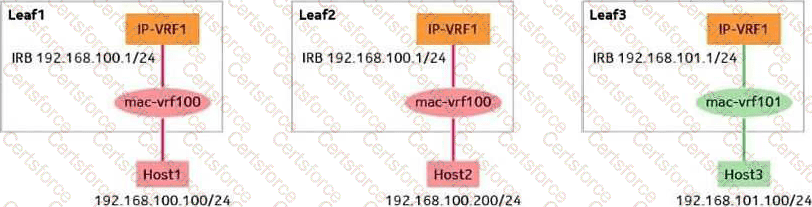
In interface-less symmetric L3 EVPN routing, hosts in a subnet may be attached to different leaf routers, while inter-subnet forwarding is performed through the IP-VRF using VXLAN routed interfaces. The ingress and egress PEs both participate in L3 forwarding, and the routed VXLAN interface provides the per-IP-VRF overlay data-plane construct needed for symmetric routing. The IRB interfaces on the local MAC-VRFs must advertise learned local host routes so that remote PEs have the necessary host reachability information. The MAC-VRFs also need the appropriate EVPN control-plane configuration so host MAC/IP information can be exchanged, while the IP-VRF participates in L3 VPN-style route exchange for routed reachability. Option A is false because anycast gateway is not optional in this design for Leaf1 and Leaf2. Anycast gateway allows the same default-gateway IP and virtual MAC behavior to exist consistently on multiple leaves serving the same subnet. Without it, host default-gateway behavior would be inconsistent and traffic mobility across the fabric would break expected distributed gateway operation. Reference: interface-less symmetric routing, IRB, anycast gateway, routed VXLAN interface.
================
Contribute your Thoughts:
Chosen Answer:
This is a voting comment (?). You can switch to a simple comment. It is better to Upvote an existing comment if you don't have anything to add.


Submit