Comprehensive and Detailed 150 to 250 words of Explanation From [SR Linux EVPN and Data Center Interconnect/Course Guide/topics]:
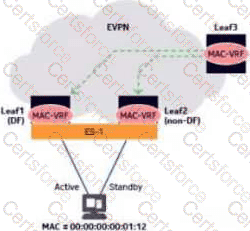
This setup represents single-active Layer 2 EVPN multi-homing. In single-active mode, the Ethernet Segment is configured so that only one PE acts as the active forwarding node for a given service, while the other remains standby. The ports connecting to the host are associated with ES-1 so the EVPN control plane can perform Ethernet Segment discovery, DF election, and standby behavior. If Leaf1 is the active/DF node for the service, all traffic to and from the host flows through Leaf1 until a failure or DF transition occurs. Option D is false because a host LAG is not required for this single-active topology. A LAG is typically required for all-active L2 multi-homing, where the host must treat multiple physical links toward different leaf routers as one logical bundle. In single-active operation, the host can be connected through separate physical links or active/standby access behavior without requiring LACP bundling. The EVPN PEs enforce the active path selection through DF and ES state rather than relying on host-side LAG hashing. Reference: single-active EVPN multi-homing, Ethernet Segment port association, DF-controlled active forwarding.
================
Contribute your Thoughts:
Chosen Answer:
This is a voting comment (?). You can switch to a simple comment. It is better to Upvote an existing comment if you don't have anything to add.


Submit