Verified Answer : =
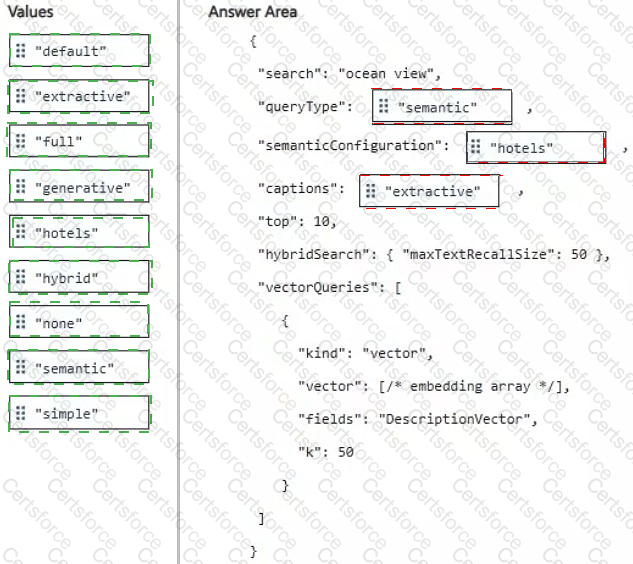
queryType → " semantic "
semanticConfiguration → " hotels "
captions → " extractive "
Comprehensive and Detailed Explanation with all Developing AI-Enabled Database Solutions documents : =
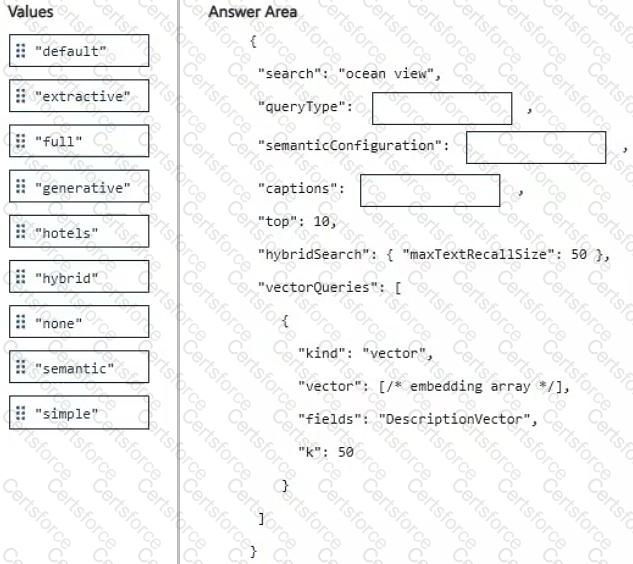
The correct configuration is queryType: " semantic " , semanticConfiguration: " hotels " , and captions: " extractive " .
The request is already a hybrid search because it contains both a textual search value ( " ocean view " ) and a vectorQueries block targeting DescriptionVector . Microsoft documents that hybrid search executes full-text and vector searches together and merges their result sets. When semantic ranking is required, queryType must be set to " semantic " .
The semanticConfiguration value must reference the semantic configuration defined for the target index. Since the index in this question is named hotels and the available answer choice is " hotels " , that is the appropriate configuration value in the supplied answer set. Microsoft’s REST examples show that semantic queries require both queryType: " semantic " and a valid semanticConfiguration .
To return semantic captions, use " captions " : " extractive " . Microsoft states that extractive captions identify the most relevant passages from the indexed content and return them with each result. They are generated from existing document text rather than generated by an LLM.
The completed request body is therefore:
{
" search " : " ocean view " ,
" queryType " : " semantic " ,
" semanticConfiguration " : " hotels " ,
" captions " : " extractive " ,
" top " : 10,
" hybridSearch " : {
" maxTextRecallSize " : 50
},
" vectorQueries " : [
{
" kind " : " vector " ,
" vector " : [ /* embedding array */ ],
" fields " : " DescriptionVector " ,
" k " : 50
}
]
}
Final drag-and-drop selections:
First target: " semantic "
Second target: " hotels "
Third target: " extractive "


Submit