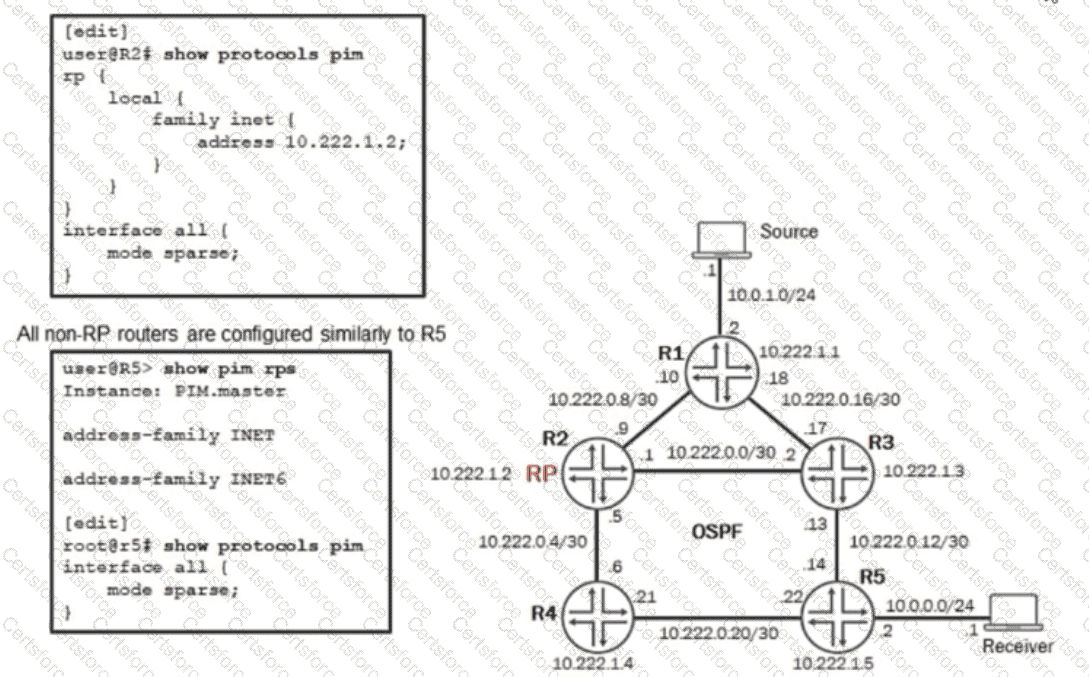
The exhibit shows a multicast network running PIM Sparse Mode where R2 is configured as a local Rendezvous Point (RP). However, the non-RP routers (like R5) show no learned RP in their show pim rps output. To resolve this using standard protocols for dynamic RP discovery, you must implement a mechanism that automates the distribution of RP information across the PIM domain.
Bootstrap Router (BSR) (Option B): BSR is the industry-standard (RFC 5059) mechanism for dynamically electing an RP and distributing that information throughout a PIM-SM domain.
It uses two roles: Candidate-RPs (C-RPs), which announce their desire to be an RP, and Candidate-BSRs (C-BSRs), which collect these announcements and flood them to all other routers in the network via PIM bootstrap messages.
BSR is a " standard protocol " as it is part of the PIMv2 specification. Once configured on R2 (as C-RP) and potentially R1 or R2 (as C-BSR), all other routers will dynamically learn that R2 is the RP for the specified group ranges.
Auto-RP (Option D): While this also provides dynamic RP discovery, it is a proprietary Cisco protocol. Although Junos supports it for interoperability, the question specifically asks for " standard protocols only, " making BSR the preferred choice.
MSDP (Option A): Multicast Source Discovery Protocol (MSDP) is used to share information about active sources between different PIM domains or for Anycast-RP. It does not handle the initial discovery of an RP within a single domain for standard PIM-SM operations.
Anycast RP (Option C): This is a technique used for RP redundancy and load balancing. While it can use BSR or MSDP for synchronization, it is a design architecture rather than a standalone " standard protocol " for the basic dynamic discovery of an RP in the manner requested here.
Configuration Example for BSR in Junos OS 24.4: To enable this, you would add the following to the RP (R2):
set protocols pim rp bootstrap-discovery
set protocols pim rp candidate-rp 10.222.1.2 group-ranges 224.0.0.0/4
set protocols pim rp candidate-bsr 10.222.1.2


Submit