
New Year Sale Limited Time 70% Discount Offer - Ends in 0d 00h 00m 00s - Coupon code: simple70

Pass the Cisco CCDE 352-011 Questions and answers with CertsForce

Viewing page 2 out of 8 pages
Viewing questions 11-20 out of questions
Questions # 11:

Refer to the exhibit,
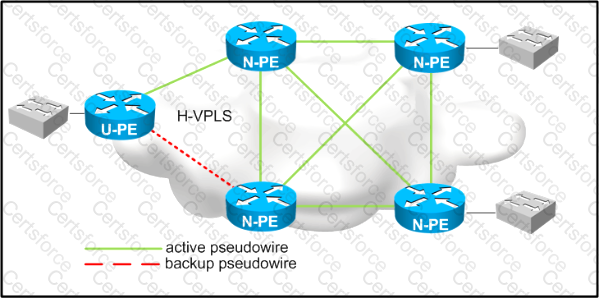
Question # 11

Which two design considerations should be implemented on the pseudowire between N-PE and U-PE routers for a loop-free hierarchical VPLS service? (Choose two)

Options:

A.

Disable split horizon towards the U-PE router.


B.

Disable MAC learning on the U-PE router.


C.

Enable split horizon towards the N-PE routers.


D.

Disable MAC learning on the U-PE routers.


E.

Disable MAC learning on the U-PE routers.


F.

Enable split horizon towards the U-PE routers.


G.

Disable split horizon toward the N-PE routers.


Expert Solution
Questions # 12:

Which two IoT use cases require the low latency and high reliability that 5G networks provide?

Options:

A.

Smart Home


B.

Automotive


C.

Health and Wellness


D.

Smart Cities


E.

Sports and Fitness


Expert Solution
Questions # 13:

Question # 13


Expert Solution
Questions # 14:

You must measure the amount of traffic that a mobile packet gateway produces when mobile phones access rather than the Internet. Which action do you take to allow this visibility?

Options:

A.

Poll OID that is configured for internal servers with SNMP.


B.

Collect information about traffic to the service prowler marked with IP precedence.


C.

Collect traffic information that is related to internal server IP addresses with NetFlow.


D.

Measure traffic characteristics of known internal servers with IP SLA.


Expert Solution
Questions # 15:

An network is designed to use OSPF to reach eBGP peers. Which condition should be avoided in the design to potentially prevent the eBGP peers do not flap continuously in case of link failure?

Options:

A.

Disable BGP synchronization.


B.

Advertise IP addresses used on eBGP peer statement via a non-backbone OSPF area.


C.

Advertise via eBGP IP addresses used on eBGP peer statements.


D.

Use an ACL to block BGP in one direction.


Expert Solution
Questions # 16:

Which reason prevents a designer from using a GDOI-based VPN to secure traffic that traverses the Internet?

Options:

A.

Enterprise host IP addresses are typically not routable.


B.

GDOI is less secure than traditional IPsec.


C.

Network address translation functions interfere with tunnel header preservation.


D.

The use of public addresses is not supported with GDOI.


Expert Solution
Questions # 17:

For a redesign requirement of the service provider network, summarization was implemented at multiple locations for each summary range. Now some customers of the service provider are complaining of higher latency and performance issues for a server hosted in the summarized area. Which design issues must be considered when creating the summarization?

Options:

A.

Summarization adds CPU overhead on the routers sourcing the summarized advertisement.


B.

Summarization prevents the visibility of the metric to the component subnets.


C.

Summarization causes packet loss when RPF is enabled.


D.

Summarization creates routing loops.


Expert Solution
Questions # 18:

A network engineering team is in the process of designing a lab network for a customer demonstration. The design engineer wants to show that the resiliency of the MPLS traffic Engineering Fast Reroute solution has the same failover/failback times as a traditional SONET/SDH network (around 50MSEC). In order to address both link failure and node failure within the lab typology network, which type of the MPLS TE tunnels must be considered for this demonstration?

Options:

A.

TE backup tunnel


B.

Next-hop (NHop) tunnel


C.

FRR Backup tunnel


D.

next-next-hop (NNHop) tunnel


Expert Solution
Questions # 19:

At which two networks points is route summarization supported? (Choose two)

Options:

A.

At EIGRP AS boundaries


B.

At EIGRP interface boundaries


C.

At OSPF virtual-link boundaries


D.

At EIGRP are boundaries


E.

At OSPF area boundaries


F.

At EIGRP stub interface boundaries


Expert Solution
Questions # 20:

The service provider that you work for wants to offer IPv6 internet service to its customers without upgrading all of its access equipment to support IPv6, which transition technology do you recommend?

Options:

A.

NAT64


B.

CGN


C.

Dual-stack CPE


D.

6RD


Expert Solution
Viewing page 2 out of 8 pages
Viewing questions 11-20 out of questions
