
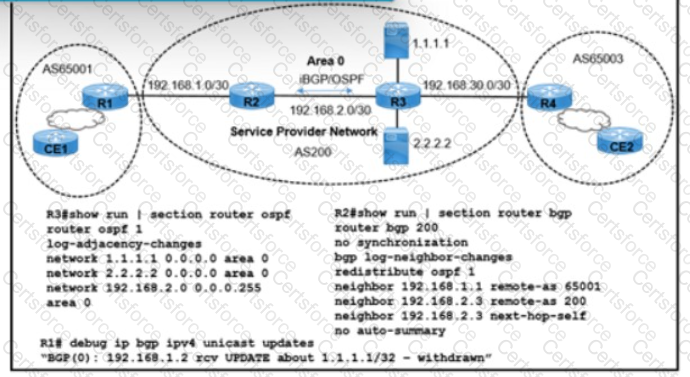
Refer to the exhibit. Users connected to an application on 1.1.1.1 via routers CE1 and CE2 are complaining of frequent disconnections. While troubleshooting the issue, a network engineer with an employee ID: 4333:96:916 determined that the application itself is working normally, but the link connected to the 1.1.1.1 application is flapping. The users on CE1 and CE2 are accessing applications on 2.2.2.2 without difficulty. Which action resolves the issue?
Refer to the exhibit.
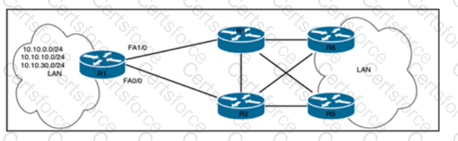
A network engineer must optimize link failures on the OSPF routing domain. The solution must follow RFC 5286. and downtime must be no more than 50 ms. All known subnets on R1 must be protected. Which solution must the engineer implement on R1?
Refer to the exhibit.
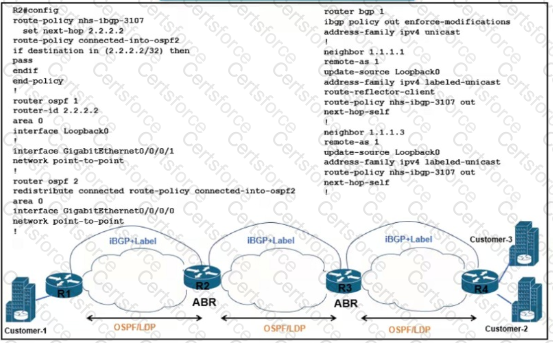
There is a connectivity issue between Customer-1 and Customer-2 File servers between the customers cannot send critical data R3 routes are missing from the routing table on the Customer-1 router All interlaces on Customer-1 are up Which configuration must be applied to router R2 to correct the problem?
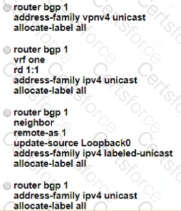
Refer to the exhibit. After creating dynamic neighbors for the range specified, the network administrator with an employee ID: 4690:88:374 cannot see all the BGP neighbors established. What is the issue?
Refer to the exhibit.
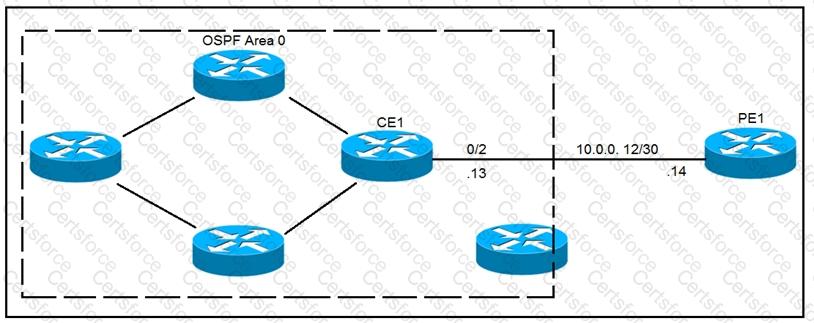
CE1 is the gateway router into the provider network via PE1. A network operator must
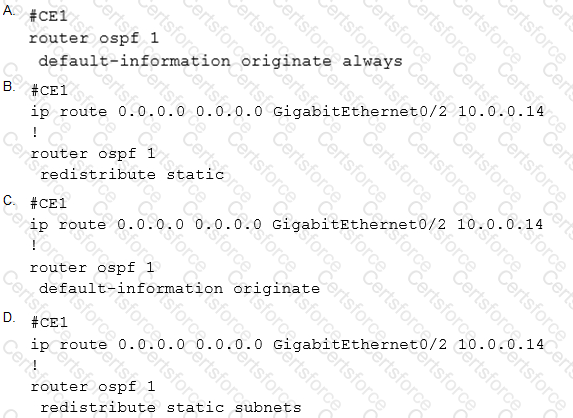
inject a default route into OSPF area 0. All devices inside area 0 must be able to reach PE1. Which configuration achieves this goal?
Refer to the exhibit.
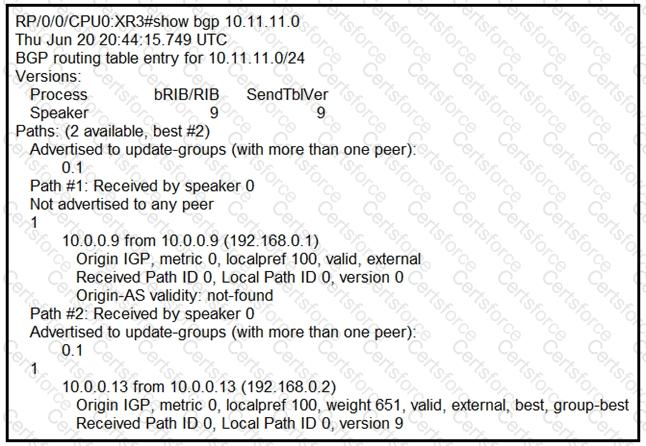
A network operator is getting the route for 10.11.11 0/24 from two upstream providers on
#XR3. The network operator must configure #XR3 to force the 10.11.11.0/24 prefix to route via next hop of 10.0.0.9 as primary when available. Which of these can the operator use the routing policy language for, to enforce this traffic forwarding path?
Refer to the exhibit.
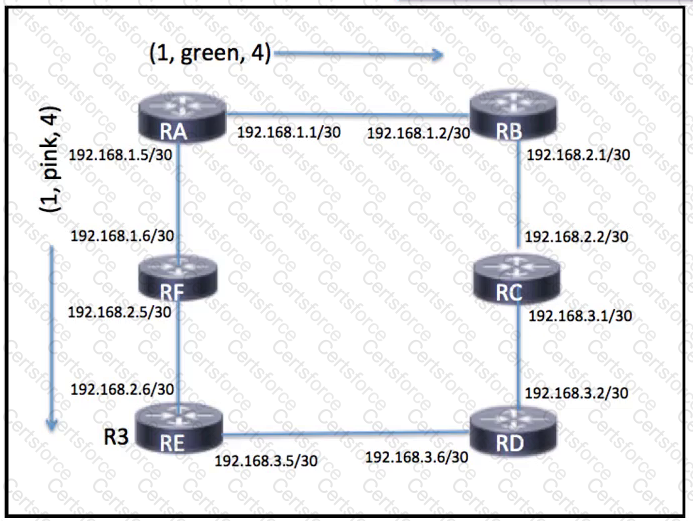
The green policy is designed with low delay, and the pink policy is designed with low cost. What is the next hop for node A on its way to node D, with the objective of achieving a low delay?
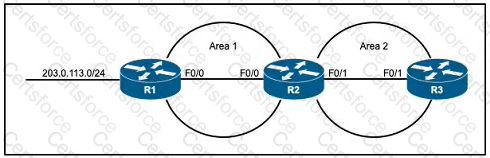
Refer to the exhibit After recent configuration changes to a customer's network, a network engineer notices that R2 cannot communicate with R3 Both FastEthemet interfaces on R2 and R3 are up and configured with the correct IP addresses MD5 password configured en R2 and R3 match with no issues What is the minimum change the engineer must make to enable R2 and R3 to communicate and fix the problem?
A network engineer recently deployed a wireless network for users at a new office to join video conferences wirelessly The existing network consists of routers that are configured for EIGRP and BGP. which are located at several data centers in different physical locations The engineer configured PIM-SSM within a single domain from a single source However, during the testing phase, the video conference failed to work for any of the users. The IPs are reachable and firewalls in the network are configured correctly to allow the traffic. Which action resolves the issue?
Which technique should be permitted on ASA Firewall to allow MSDP Peering?
