New Year Sale Limited Time 70% Discount Offer - Ends in 0d 00h 00m 00s - Coupon code: simple70

Pass the Cisco CCNP Service Provider 300-510 Questions and answers with CertsForce

Viewing page 4 out of 8 pages
Viewing questions 31-40 out of questions
Questions # 31:

Refer to the exhibit.
Question # 31

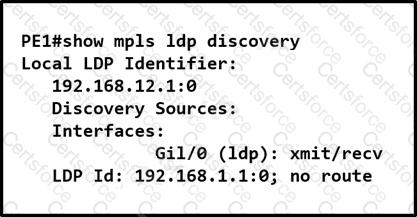
An administrator is troubleshooting network issues on a customer’s network PE1 cannot form an LDP relationship with PE2 using LDP ID 192 168.1.1. Due to this connectivity issue, the customer’s routes behind both PE routers cannot be exchanged. Which action must the administrator take to correct the problem?

Options:

A.

Configure PE2 to automatically select its own LDP router ID with 192.168.1.1.


B.

Create a targeted LDP session on PE2 to override the missing routing table entry on PEL


C.

Configure PE1 with a static route to 192 168.1.1.


D.

Enable LDP session protection on the link that P1 uses as the next hop to PE2.


Expert Solution
Questions # 32:

Refer to the exhibit.

Question # 32

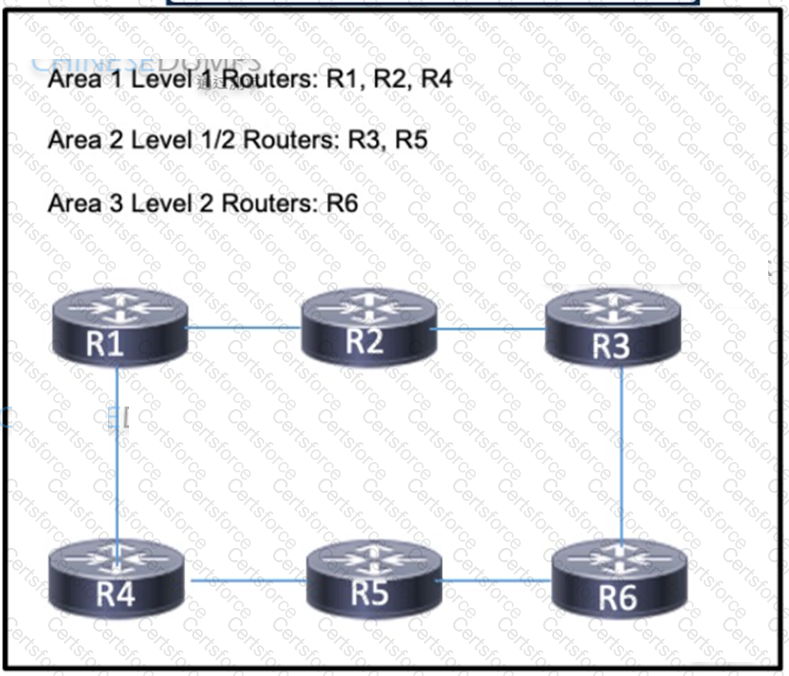
IS-IS is the routing protocol on the network. After the team noticed excessive CPU usage on all routers, particularly routers R2 and R6, they configured route summarization on all routers. However, a network engineer noticed that summary routes and more specific routes are present in the routing table on R1. Which action must the team take so that R1 receives only the summary routes?
Options:

A.

Configure R2 and R4 to perform summarization for Level 1 routers.


B.

Configure R3 to perform summarization for Level 1 routers, and configure R6 to perform summarization for Level 2 routers.


C.

Configure R3 and R5 to perform summarization for Level 1 and Level 2 routers.


D.

Configure R6 only to perform summarization for all routers.


Expert Solution
Questions # 33:

Question # 33

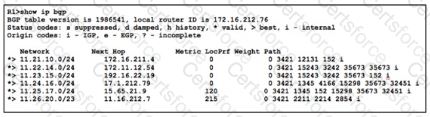
Refer to the exhibit. Company A established BGP sessions with several ISPs. A network engineer at the company must filter out all traffic except for routes that transit AS 152. The engineer configured the filtering policy “permit _152S_(_[0.9])” on R1, but after applying the configuration, the engineer notices that other routes are still visible. Which action resolves the issue?
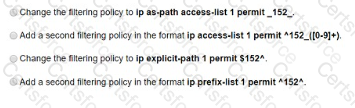

Question # 33

Options:

A.

Option A


B.

Option B


C.

Option C


D.

Option D


Expert Solution
Questions # 34:

Question # 34

Refer to the exhibit. A network consultant is updating the company s MPLS solution and configuring several new PE devices to enable full communication among PE devices connected to the network. The updates must ensure the redundancy and scalability of the network The egress LSR is configured with mpls Idp explicit-null While configuring the given PE router to be adjacent to the egress LSR. the consultant notices that MPLS forwarding is not working in the network Which action resolves the issue?

Options:

A.

Configure MVRF on all routers in the MPLS network


B.

Open TCP and UDP ports 464


C.

Open TCP and UDP ports 179


D.

Configure Cisco Express Forwarding on all routers in the MPLS network


Expert Solution
Questions # 35:

What is a restriction of 6PE?

Options:

A.

It is implemented only over eBGP peers.


B.

It is implemented only over iBGP peers.


C.

It adds a value of ::FFFf:: on the IPv4 next hop address.


D.

It cannot be implemented on VRFs.


Expert Solution
Questions # 36:

Which difference must an engineer consider when choosing whether to implement OSPF or IS-IS as the routing protocol on the network?

Options:

A.

The OSPF DR election process is deterministic, and the IS-IS DS election process is not deterministic.


B.

To support fast convergence. OSPF uses the LSA arrival timer and IS-IS uses the PRC-interval timer.


C.

IS-IS supports ordinary, stub, totally-stub. and NSSA areas, but OSPF supports only stub areas.


D.

IS-IS links are associated with either a Level 1 area or a Level 2 area at one time, but OSPF links are associated with multiple areas at one time.


Expert Solution
Questions # 37:

Refer to the exhibit.

Question # 37

Router 1 has established an SR-TE tunnel with router 2. Which statement describes this

configuration?

Options:

A.

Router 1 has a list of labels used to explicitly lay out a path to router 2.


B.

Router 1 and router 2 have a bidirectional tunnel set up with dynamic path selection.


C.

Router 1 is the head-end tunnel and has dynamically chosen a path to router 2.


D.

Router 2 is the head-end tunnel and has explicitly set a path to router 1.


Expert Solution
Questions # 38:

Refer to the exhibit.

Question # 38

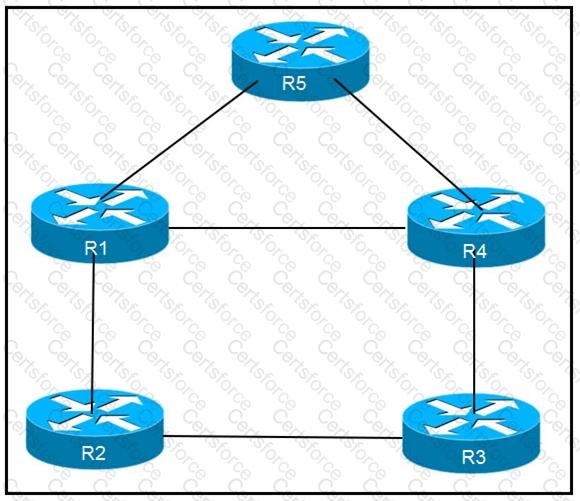
An engineer is addressing an IS-IS design issue which is running within the topology. All

links are running on FastEthernet, except the link between R5 and R4, which is Gigabit Ethernet. Which statement about the design is true?

Options:

A.

R4 prefer to reach R5 using R1 as the next hop


B.

All links have equal cost if the default metric is used


C.

R5 prefers to use R4 as the next hop for all routes


D.

R1 prefer to use R5 as the next hop to reach R4


Expert Solution
Questions # 39:

network engineer must implement a segment routing policy rule that specifies that SIDs are bounded manually. The policy will be used for traffic steering based on incoming label ..with the binding SIDs, adjacency SIDs, and BGP peering SIDs. All labels will be in the local segment with the range from 40000 to 50000. How must the engineer implement … label allocation?
Options:

A.

Implement the standard default SRGB range in the SR global segment.


B.

Implement a non-default SRGB range in the SR local segment.


C.

Implement a non-default SRLB range in the SR global segment.


D.

Implement the default SRLB range in the SR local segment


Expert Solution
Questions # 40:

Question # 40

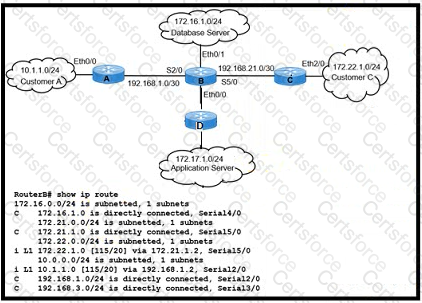
Refer to the exhibit. Customers A and C are experiencing packet drops when connecting to the application server While troubleshooting the problem the network engineer confirms that the IS-lS Level- 1/2 adjacency is up between routers A B C. and D and both customers can communicate with the database server without packet loss Which action must the engineer take to resolve the issue?

Options:

A.

Advertise the application server subnet in the router D IS-IS database


B.

Advertise a static default route to the router B IS-IS database.


C.

Leak the 172, 17.10/24 route in the IS-IS databases on routers A and C.


D.

Leak the customer A and customer C subnets in the router A IS-IS database.


Expert Solution
Viewing page 4 out of 8 pages
Viewing questions 31-40 out of questions