Month End Sale Limited Time 70% Discount Offer - Ends in 0d 00h 00m 00s - Coupon code: simple70

Pass the CBIC Infection Control CIC Questions and answers with CertsForce

Viewing page 7 out of 9 pages
Viewing questions 61-70 out of questions
Questions # 61:

An immunocompetent patient is diagnosed with active tuberculosis (TB). Which of the following sites of the disease is MOST likely to result in transmission to healthcare personnel?

Options:

A.

Renal TB


B.

Miliary TB


C.

Laryngeal TB


D.

Tuberculous meningitis


Expert Solution
Questions # 62:

A nurse claims to have acquired hepatitis A virus infection as the result of occupational exposure. The source patient had an admitting diagnosis of viral hepatitis. Further investigation of this incident reveals a 5-day interval between exposure and onset of symptoms in the nurse. The patient has immunoglobulin G antibodies to hepatitis A. From the evidence, the infection preventionist may correctly conclude which of the following?

Options:

A.

The nurse should be given hepatitis A virus immunoglobulin.


B.

The evidence at this time fails to support the nurse's claim.


C.

The patient has serologic evidence of recent hepatitis A viral infection.


D.

The 5-day incubation period is consistent with hepatitis A virus transmission.


Expert Solution
Questions # 63:

A 36-year-old female presents to the Emergency Department with a petechial rash, meningitis, and cardiac arrest. During the resuscitation, a phlebotomist sustained a needlestick injury. The next day, blood cultures reveal Neisseria meningitidis. The exposure management for the phlebotomist is:

Options:

A.

Prophylactic rifampin plus isoniazid.


B.

A tuberculin skin test now and in ten weeks.


C.

Work furlough from day ten to day 21 after exposure.


D.

A review of the phlebotomist’s hepatitis B vaccine status.


Expert Solution
Questions # 64:

The appropriate method to obtain cultures for the diagnosis of catheter-associated urinary tract infections (CAUTI) is:

Options:

A.

Aseptic technique via the collection port


B.

Removal with culture of the urinary catheter tip


C.

Disconnection of the catheter from the drainage tubing


D.

Aseptic technique via the drainage port of the collection bag


Expert Solution
Questions # 65:

A facility's goal is to increase hand-hygiene compliance from the current 52% to 75% within 12 months. A gap analysis identifies several different issues. Which of the following is BEST suited for summarizing these issues?

Options:

A.

Gantt chart


B.

Flow chart


C.

Ishikawa diagram


D.

Affinity diagram


Expert Solution
Questions # 66:

Which of the following is the BEST aid in the identification of patients affected by a recall due to failures in endoscope reprocessing?

Options:

A.

Maintaining a log of endoscope use by date of procedure


B.

Maintaining a log of patient identifiers linked with endoscope used


C.

Searching electronic records for endoscope serial number recorded in patient records


D.

Searching electronic records using diagnostic coding to identify all patients that had endoscopy procedures


Expert Solution
Questions # 67:

A healthcare worker experiences a percutaneous exposure to a patient with untreated HIV. The next step is to:

Options:

A.

Initiate HIV post-exposure prophylaxis (PEP) within 2 hours.


B.

Wait for HIV test results before starting treatment.


C.

Offer post-exposure prophylaxis only if symptoms develop.


D.

Retest for HIV after 6 months before deciding on PEP.


Expert Solution
Questions # 68:

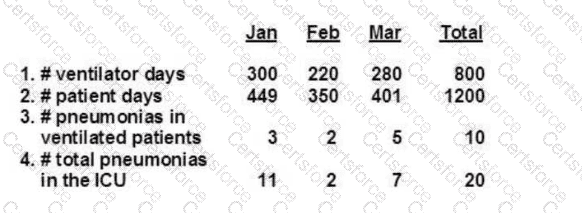
During an outbreak of ventilator-associated pneumonia (VAP), the infection preventionist should FIRST:

Options:

A.

Review adherence to ventilator bundle elements.


B.

Implement preemptive antibiotic therapy in all ventilated patients.


C.

Isolate all ventilated patients in negative pressure rooms.


D.

Perform bacterial cultures from ventilator circuits.


Expert Solution
Questions # 69:

One of the elements of antibiotic stewardship is controlling antibiotic use. Which of the following BEST describes a closed formulary?

Options:

A.

Requires the prescribing physician to obtain some form of approval before the antibiotic will be dispensed.


B.

Automatic switching from broad-spectrum empiric therapy to narrower-spectrum agents.


C.

Practice of rotating two or more classes of formulary drugs on a regular basis.


D.

Limits the number of antibiotics available for physicians to prescribe.


Expert Solution
Questions # 70:

Which of the following factors influences the growth of microorganisms in a multi-dose medication vial?

Options:

A.

Syringe size


B.

Aseptic technique


C.

Patient comorbidities


D.

Administration techniques


Expert Solution
Viewing page 7 out of 9 pages
Viewing questions 61-70 out of questions