
Black Friday Reward - Upto 80% off - Ends in 0d 00h 00m 00s - Coupon code: VIP80

Pass the Amazon Web Services AWS Certified Associate DVA-C03 Questions and answers with CertsForce

Viewing page 1 out of 11 pages
Viewing questions 1-15 out of questions
Questions # 1:

A company is using Amazon RDS as the Backend database for its application. After a recent marketing campaign, a surge of read requests to the database increased the latency of data retrieval from the database.

The company has decided to implement a caching layer in front of the database. The cached content must be encrypted and must be highly available.

Which solution will meet these requirements?

Options:

A.

Amazon Cloudfront


B.

Amazon ElastiCache to Memcached


C.

Amazon ElastiCache for Redis in cluster mode


D.

Amazon DynamoDB Accelerate (DAX)


Expert Solution
Questions # 2:

A company needs to package and deploy an application that uses AWS Lambda to compress and decompress video clips. The application uses a video codec library that is larger than 250 MB. The application uses the library to compress the videos before storage and to decompress the videos upon retrieval.

Options:

A.

Create one Lambda function. Upload one zip file that contains code to handle video compression and decompression to the function. Include the codec library in the zip file.


B.

Create two Lambda functions. Upload one zip file that contains code to handle video compression to one function. Upload a second zip file that contains code for video decompression to the second function. Include the codec library in both zip files.


C.

Create two Lambda functions. Upload one zip file that contains code to handle video compression to one function. Upload a second zip file that contains code for video decompression to the second function. Create one Lambda layer for the codec library. Add the layer to both functions.


D.

Create two Lambda functions. Build one container image that contains code to handle video compression and a second image that contains video decompression code. Add the codec library to both images. Upload the images to Amazon ECR. Use the containers to create the Lambda functions.


Expert Solution
Questions # 3:

A developer is building an application that processes a stream of user-supplied data. The data stream must be consumed by multiple Amazon EC2-based processing applications in parallel and in real time. Each processor must be able to resume without losing data if there is a service interruption. The application architect plans to add other processors in the near future and wants to minimize the amount of data duplication involved.

Which solution will satisfy these requirements?

Options:

A.

Publish the data to Amazon SQS.


B.

Publish the data to Amazon Data Firehose.


C.

Publish the data to Amazon EventBridge.


D.

Publish the data to Amazon Kinesis Data Streams.


Expert Solution
Questions # 4:

A stock trading company is developing a mobile app that provides near real-time market data and historical trading analytics to thousands of professional traders who make trades concurrently. The app needs to provide market data to traders in under 100 milliseconds. Historical analytics charts can take 2–3 seconds to generate. The app needs to be highly available and handle market events that cause sudden spikes in trading activity. Some trades involve messages that are over 1 MB in size.

The company must provide equal market access to all traders. The company must ensure that all traders experience the same performance when they use the app.

Which solution will meet these requirements?

Options:

A.

Use Amazon ElastiCache Redis OSS in cluster mode and include read replicas. Implement write-through caching for market data updates and lazy loading with a TTL for analytics results.


B.

Implement client-side caching by using browser local storage. Use Amazon CloudFront to cache static content.


C.

Store all data in Amazon DynamoDB by using DynamoDB Accelerator (DAX). Enable DynamoDB global tables for cross-Region replication.


D.

Deploy Amazon ElastiCache Redis OSS in single-node mode. Implement a cache-aside pattern with periodic bulk updates.


Expert Solution
Questions # 5:

An application is using Amazon Cognito user pools and identity pools for secure access. A developer wants to integrate the user-specific file upload and download features in the application with Amazon S3. The developer must ensure that the files are saved and retrieved in a secure manner and that users can access only their own files. The file sizes range from 3 KB to 300 MB.

Which option will meet these requirements with the HIGHEST level of security?

Options:

A.

Use S3 Event Notifications to validate the file upload and download requests and update the user interface (UI).


B.

Save the details of the uploaded files in a separate Amazon DynamoDB table. Filter the list of files in the user interface (UI) by comparing the current user ID with the user ID associated with the file in the table.


C.

Use Amazon API Gateway and an AWS Lambda function to upload and download files. Validate each request in the Lambda function before performing the requested operation.


D.

Use an IAM policy within the Amazon Cognito identity prefix to restrict users to use their own folders in Amazon S3.


Expert Solution
Questions # 6:

A developer previously deployed an AWS Lambda function as a .zip package. The developer needs to deploy the Lambda function as a container.

Options:

A.

Create an Amazon ECR repository in the same AWS Region as the Lambda function. Package the Lambda function into a container image. Build the image and upload it to the Amazon ECR repository. Update the existing Lambda function configuration to specify the repository URI and container image tag.


B.

Create an AWS SAM template that defines the Lambda function and its resources as code. Include a container image in the template, and store the container image in an Amazon S3 bucket. Deploy the AWS SAM template. Specify the S3 bucket URI.


C.

Create an AWS CloudFormation template that defines the Lambda function and its resources as code. Include a container image in the template, and store the image in an Amazon S3 bucket. Deploy the CloudFormation template. Specify the S3 bucket URI.


D.

Create an Amazon ECR repository in the same AWS Region as the Lambda function. Build the image and upload it to the Amazon ECR repository. Update the existing Lambda function to use the new image by specifying the repository URI.


Expert Solution
Questions # 7:

A developer is troubleshooting an application mat uses Amazon DynamoDB in the uswest-2 Region. The application is deployed to an Amazon EC2 instance. The application requires read-only permissions to a table that is named Cars The EC2 instance has an attached IAM role that contains the following IAM policy.
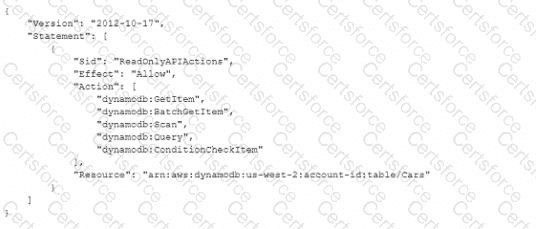
Question # 7

When the application tries to read from the Cars table, an Access Denied error occurs.

How can the developer resolve this error?

Options:

A.

Modify the IAM policy resource to be " arn aws dynamo* us-west-2 account-id table/* "


B.

Modify the IAM policy to include the dynamodb * action


C.

Create a trust policy that specifies the EC2 service principal. Associate the role with the policy.


D.

Create a trust relationship between the role and dynamodb Amazonas com.


Expert Solution
Questions # 8:

A company is using AWS SAM to develop a social media application. A developer needs a quick way to test AWS Lambda functions locally by using test event payloads. The developer needs the structure of these test event payloads to match the actual events that AWS services create.

Which solution will meet these requirements with the LEAST development effort?

Options:

A.

Create shareable test Lambda events. Use these test Lambda events for local testing.


B.

Store manually created test event payloads locally. Use the sam local invoke command with the file path to the payloads.


C.

Store manually created test event payloads in an Amazon S3 bucket. Use the sam local invoke command with the S3 path to the payloads.


D.

Use the sam local generate-event command to create test payloads for local testing.


Expert Solution
Questions # 9:

A company with multiple branch locations has an analytics and reporting application. Each branch office pushes a sales report to a shared Amazon S3 bucket at a predefined time each day. The company has developed an AWS Lambda function that analyzes the reports from all branch offices in a single pass. The Lambda function stores the results in a database.

The company needs to start the analysis once each day at a specific time.

Which solution will meet these requirements MOST cost-effectively?

Options:

A.

Configure an S3 event notification to invoke the Lambda function when a branch office uploads a sales report.


B.

Create an AWS Step Functions state machine that invokes the Lambda function once each day at the predefined time.


C.

Configure the Lambda function to run continuously and to begin analysis only at the predefined time each day.


D.

Create an Amazon EventBridge scheduled rule that invokes the Lambda function once each day at the predefined time.


Expert Solution
Questions # 10:

A company has a two-tier application that runs on Amazon EC2 instances behind an Application Load Balancer (ALB). The EC2 instances are in an Auto Scaling group. The Auto Scaling group is configured with a lifecycle hook that uses the default health checks for the EC2 instances.

During a recent change deployment, the ALB reported HTTP 502 errors. When a developer checked the target group, some of the EC2 instances were marked as unhealthy. However, the Auto Scaling group was not replacing the unhealthy EC2 instances.

Which configuration change should the developer make to replace the unhealthy EC2 instances?

Options:

A.

Increase the cooldown period of the Auto Scaling group from its default value.


B.

Update the lifecycle hook to wait for the application to install.


C.

Update the Auto Scaling group’s health check from Amazon EC2 to Elastic Load Balancing (ELB).


D.

Set the health check grace period for the Auto Scaling group.


Expert Solution
Questions # 11:

A company runs a new application on AWS Elastic Beanstalk. The company needs to deploy updates to the application. The updates must not cause any downtime for application users. The deployment must forward a specified percentage of incoming client traffic to a new application version during an evaluation period.

Which deployment type will meet these requirements?

Options:

A.

Rolling


B.

Traffic-splitting


C.

In-place


D.

Immutable


Expert Solution
Questions # 12:

An 1AM role is attached to an Amazon EC2 instance that explicitly denies access to all Amazon S3 API actions. The EC2 instance credentials file specifies the 1AM access key and secret access key, which allow full administrative access.

Given that multiple modes of 1AM access are present for this EC2 instance, which of the following is correct?

Options:

A.

The EC2 instance will only be able to list the S3 buckets.


B.

The EC2 instance will only be able to list the contents of one S3 bucket at a time.


C.

The EC2 instance will be able to perform all actions on any S3 bucket.


D.

The EC2 instance will not be able to perform any S3 action on any S3 bucket.


Expert Solution
Questions # 13:

A developer is building an event-driven application that uses AWS Lambda functions and an Amazon SQS queue to handle Amazon S3 events and to perform additional processing. A parsing Lambda function implements business logic to parse each S3 event. The parsing function sends events on to an SQS queue. A processing Lambda function retrieves messages from the SQS queue and processes them.

During an isolated test, the developer observes that both Lambda functions work as expected for mock test events. However, when the test presents production S3 events to the functions, the developer observes that the number of messages in the SQS queue increases. The developer does not find any Amazon CloudWatch logs for the processing Lambda function when the processing function is presented with production S3 events. The developer does find logs for test events.

The developer must resolve these issues and ensure that the Lambda functions process production S3 events correctly.

Which solution will meet these requirements?

Options:

A.

Configure the SQS queue as a trigger for the processing Lambda function.


B.

Configure the SQS queue as a trigger for the parsing Lambda function.


C.

Grant the processing Lambda function permissions to access the SQS queue.


D.

Grant the processing Lambda function permissions to send logs to CloudWatch.


Expert Solution
Questions # 14:

A developer has a legacy application that is hosted on-premises. Other applications hosted on AWS depend on the on-premises application for proper functioning. In case of any application errors, the developer wants to be able to use Amazon CloudWatch to monitor and troubleshoot all applications from one place.

How can the developer accomplish this?

Options:

A.

Install an AWS SDK on the on-premises server to automatically send logs to CloudWatch.


B.

Download the CloudWatch agent to the on-premises server. Configure the agent to use IAM user credentials with permissions for CloudWatch.


C.

Upload log files from the on-premises server to Amazon S3 and have CloudWatch read the files.


D.

Upload log files from the on-premises server to an Amazon EC2 instance and have the instance forward the logs to CloudWatch.


Expert Solution
Questions # 15:

A company is developing an application that will be accessed through the Amazon API Gateway REST API. Registered users should be the only ones who can access certain resources of this API. The token being used should expire automatically and needs to be refreshed periodically.

How can a developer meet these requirements?

Options:

A.

Create an Amazon Cognito identity pool, configure the Amazon Cognito Authorizer in API Gateway, and use the temporary credentials generated by the identity pool.


B.

Create and maintain a database record for each user with a corresponding token and use an AWS Lambda authorizer in API Gateway.


C.

Create an Amazon Cognito user pool, configure the Cognito Authorizer in API Gateway, and use the identity or access token.


D.

Create an 1AM user for each API user, attach an invoke permissions policy to the API. and use an I AM authorizer in API Gateway.


Expert Solution
Viewing page 1 out of 11 pages
Viewing questions 1-15 out of questions